
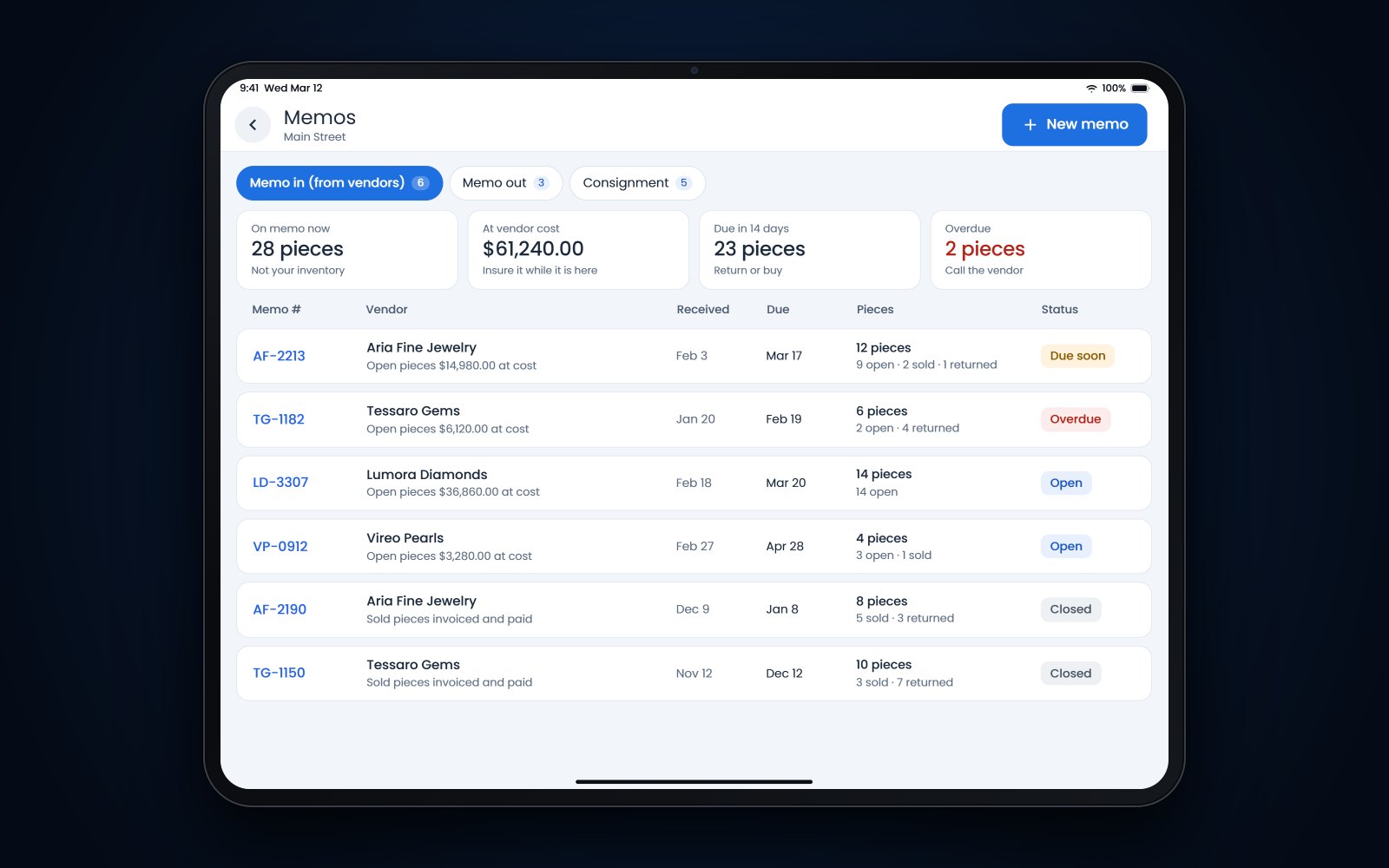
Short answer: Jewelry memo vs consignment is mostly a question of where the goods come from and how long you keep them, because in both cases the piece belongs to someone else until it sells. A memo is usually a short trade loan from a vendor, with a due date, and you pay when you sell or keep the piece. Consignment is usually a longer placement, often from a private owner or a designer, and you pay the owner an agreed share after the sale. Either way, track these pieces apart from your own stock and keep them out of your inventory value.
In this article
- What memo means in the jewelry trade
- What consignment means for a jewelry store
- Jewelry memo vs consignment, side by side
- The risks of holding goods you don't own
- How to track memo and consignment goods apart from your own stock
- Are memo goods part of your inventory?
- A checklist before you sign a memo or consignment agreement
- How Flawless POS handles memos
- Frequently asked questions
What memo means in the jewelry trade
Say a vendor ships you 3 oval engagement rings on a 10-day memo because a customer wants to choose one on Saturday. The rings sit in your safe until Saturday, and the customer buys one. You never owned any of them. You pay for the one that sold and send the other 2 back.
Memo is short for memorandum. The vendor keeps ownership, you hold the goods for a set time, and you either pay for a piece or return it. Stores use memo to show a customer a specific stone or to fill a bridal case without buying every size. Some carry a designer's line on memo for a whole season.
The memo is the paperwork that travels with the goods. A good one lists:
- A memo number and date
- Each item by number, with a description, weight and stone details
- Your price for each piece if you keep it
- The due date
- Who carries the risk of loss while you hold the goods
- Payment terms once a piece sells
- Signatures from both sides
What consignment means for a jewelry store
In trade law the terms overlap, and trade articles often use memo and consignment to mean the same thing. In day-to-day store use, consignment usually means a longer arrangement. An owner places pieces with you to sell, and you pay them their share after the customer pays.
Typical examples are an estate piece from a private client and work from a local designer. A vendor's line that stays in your cases for months can be set up as consignment too. The agreement usually sets:
- The split, for example 70% to the owner and 30% to you
- A minimum price, and whether you can discount
- The term, for example 6 months
- When you pay after a sale, for example within 15 days
- What happens if a piece doesn't sell
- Who insures the pieces, and at what value
When the owner is a private person rather than a business, different legal rules can apply than in a trade consignment. Put every arrangement in writing, and have your attorney look over your standard agreement once.
Jewelry memo vs consignment, side by side
Here are the typical differences. Your signed paperwork is what counts, and terms vary a lot from vendor to vendor.
| Question | Memo | Consignment |
|---|---|---|
| Who owns the piece? | The vendor, until you buy it | The owner, until it sells |
| Where does it usually come from? | A vendor or manufacturer in the trade | A private client, a designer or a vendor |
| How long do you hold it? | A set number of days on the memo | Usually months, set in the agreement |
| Who insures it while you hold it? | Usually you, under the memo terms | Whoever the agreement names, often you |
| When does money change hands? | When you sell or keep it, the vendor invoices you | After the customer pays, you pay the owner's share |
| How do returns work? | By the due date, or when the vendor asks | At the end of the term, or with notice |
| Is it your inventory? | No | No |
The risks of holding goods you don't own
Memo and consignment let you show far more than you could ever buy. The catch is that you're responsible for things that aren't yours. These are the problems that cost stores money.
Loss and theft
If a memo ring is stolen from your case, the vendor still expects to be paid. Read who carries the risk. Memo terms often make the store responsible from the day the goods arrive until they're back with the vendor.
Insurance gaps
Ask your insurer, in writing, whether your policy covers goods you hold for others, at what value, and whether there's a limit per item or per vendor. Ask about goods in transit and at trunk shows, and about pieces a customer takes home on approval. A vendor may ask to be named as loss payee. If gold and diamond prices climb while goods are on memo, the amount you'd owe climbs too, so review your coverage when prices move.
Overdue memos
A memo past its due date is still the vendor's property. Read the terms for what happens next, because some vendors bill goods that aren't returned on time. Overdue memos also strain a relationship you need.
Mix-ups
A pair of 1-carat round solitaires in 14k white gold from 2 vendors can look the same in a tray. Send the wrong one back and you've lost a ring on paper. Put the vendor and the vendor's item number on every memo tag.
Creditors and paperwork
Under the Uniform Commercial Code, while consigned goods sit in your store, your creditors can treat them as yours unless the vendor has protected its interest. That's why a memo vendor may ask you to sign a memo agreement, and may file a UCC-1 financing statement and send notice to any lender that already has a lien on your inventory. The Jewelers Board of Trade recommends all of these steps to its members. It's normal practice, so don't take it personally.
Customer repairs are the other goods in your safe that you don't own. Our repair intake checklist covers how to take those in.
How to track memo and consignment goods apart from your own stock
- Receive it as memo, never as a purchaseEnter each piece with the vendor or owner, the memo or agreement number, the agreed price and the due date. Keep it out of your owned inventory from the first minute.
- Tag it so anyone can tellUse a different tag color or a clear code, for example an M at the start of the item number, so staff and anyone counting know the piece isn't yours.
- Keep the paperwork with the recordScan the signed memo or consignment agreement and attach it to the vendor or item record, with photos of each piece as it arrived.
- Check due dates every weekRun a list of everything due in the next 14 days. Decide early whether to return it, buy it or ask for a written extension.
- Return it with proofShip returns insured, with a packing list or manifest that names every item by number. Keep the tracking number and the vendor's signed receipt.
- Close out a sale the same dayWhen a memo piece sells, tell the vendor, ask for the invoice and record the cost against the sale. For consignment, record what you owe the owner and the date it's due.
- Count them on their own listAt inventory time, count memo and consignment goods separately and confirm the list with each vendor. Our guide to the year-end inventory count walks through the whole count.
Are memo goods part of your inventory?
No. For tax purposes, IRS Publication 538 says to leave goods consigned to you out of your inventory, and to include goods you have out on consignment. In plain terms, the owner counts the piece, and the store holding it does not.
When a memo piece sells, the sale is yours and the vendor's invoice becomes your cost for that sale. For consignment, how you record the sale (the full price with an amount owed to the owner, or only your commission) depends on your agreement, so ask your accountant.
Tip: Keep a running report of memo and consignment goods. Your accountant needs it to keep those goods off your balance sheet, and your insurer may ask for it when setting coverage.
This is general information, not accounting or legal advice.
A checklist before you sign a memo or consignment agreement
- Ownership stays with the vendor or owner, in writing, until you pay
- The due date or term, and how to extend it
- Who carries the risk of loss from delivery until return
- Whether your insurance covers these goods, and at what value
- When and how you pay after a sale
- Your share or margin, and any minimum price
- How returns ship, and who pays for shipping and insurance
- What happens to goods kept past the due date
- Whether pieces may leave the store, for a trunk show or a customer's approval
- Signatures from both sides, with copies on file
How Flawless POS handles memos
Flawless POS is point of sale and store management software built by jewelers, for jewelers. Memos are part of it: wholesalers create memos, invoices and shipping manifests in the same system as their inventory.
Each item keeps its jewelry details, such as shape, clarity, certification and carat weight, and the audit history records every move. When a vendor or a retail account asks where a piece is, you can answer from the record instead of from memory.
See the full feature list, or book a demo, bring one of your own memos and ask us to walk through it.
Frequently asked questions
Is memo the same as consignment?
Legally, a vendor's memo is usually a form of consignment, and many people in the trade use the words interchangeably. In everyday store use, memo tends to mean a short trade loan with a due date, and consignment tends to mean a longer placement where you pay the owner a share after the sale. What your signed agreement says is what matters.
Who pays if a memo piece is stolen from my store?
Usually the store. Memo terms often make you responsible from delivery until the goods are returned, so the vendor can bill you for the piece. Read your memo terms and confirm with your insurer that goods you hold for others are covered.
How long can I keep goods on memo?
Until the due date on the memo, unless the vendor agrees in writing to extend it. Some memos run a few days so you can show one customer, and others cover a season. Return or buy before the due date, and get every extension in writing.
Why does a memo vendor want a UCC-1 filing?
Under the Uniform Commercial Code, a store's creditors can reach consigned goods in its possession unless the vendor has perfected its interest, usually by filing a UCC-1 financing statement. The filing protects the vendor if a store fails. It's routine in the jewelry trade and isn't a sign the vendor doubts you.
Sources
- IRS - Publication 538, Accounting Periods and Methods (inventories) (opens in a new tab)
- Cornell Law School LII - UCC 9-319, rights and title of consignee (opens in a new tab)
- Cornell Law School LII - UCC 9-102, definition of consignment (opens in a new tab)
- Jewelers Board of Trade - Guide to memo transactions (December 22, 2023) (opens in a new tab)
- Rapaport - Memos on your mind? Expert advice on diamond consignment (June 20, 2018) (opens in a new tab)