
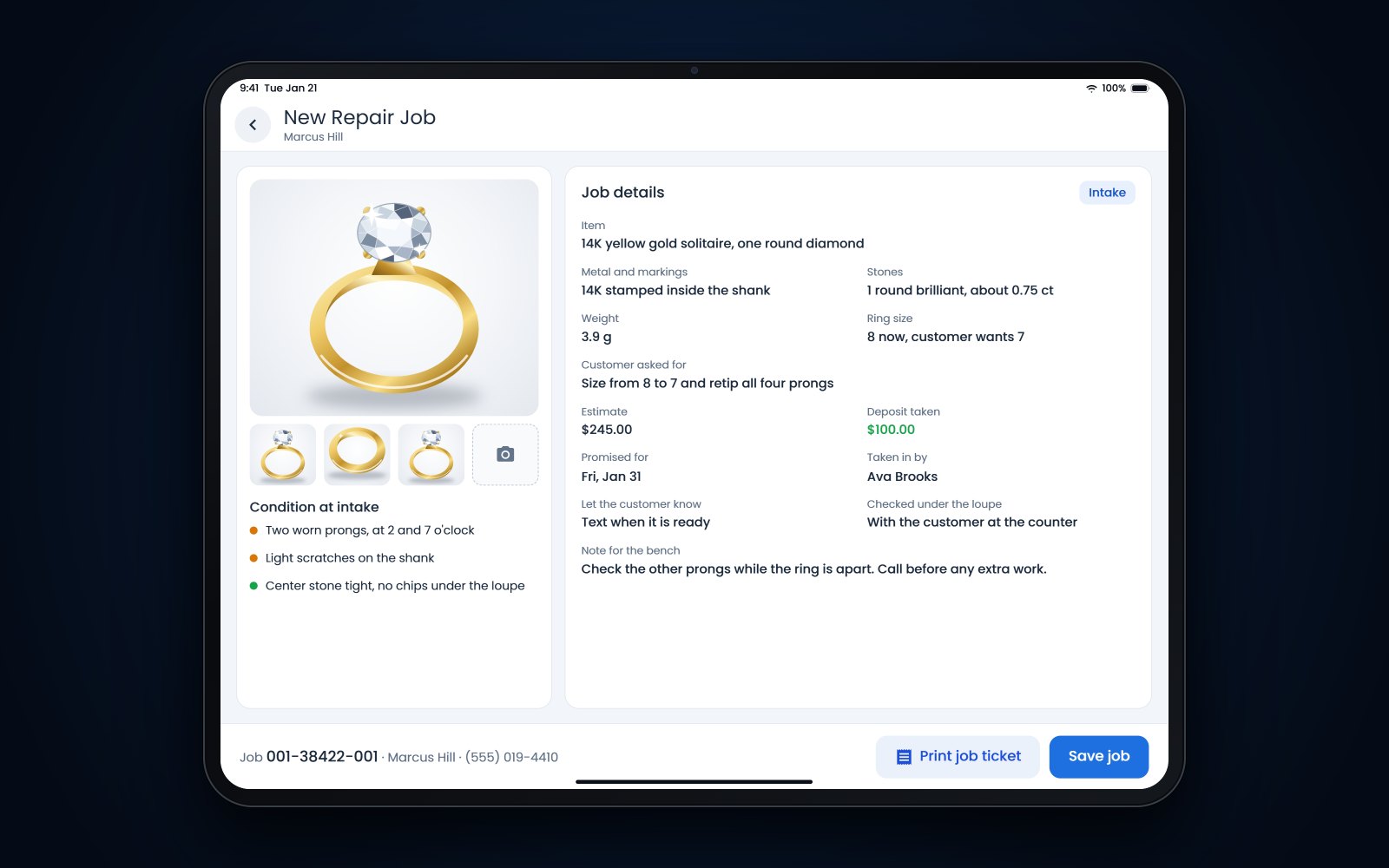
Short answer: Good jewelry repair intake records the piece's condition with the customer before it leaves their hands: metal and markings, stone count, existing damage, weight and photos, plus exactly what they asked for, the estimate, the deposit and the promised date. Look at the piece under a loupe together and have the customer sign the ticket. If a question comes up at pickup, you both go back to the same record.
In this article
Where repair disputes start
For example, a customer drops off a ring on a Tuesday for a sizing. At pickup she says one of the small side diamonds is missing, and that it was there when she brought the ring in. If the ticket says "14K ring, size 6 to 7" and nothing more, you have no way to show the stone was already gone. You end up replacing it, and she leaves unsure about your shop.
Most repair disputes come back to a handful of questions:
- Was that stone chipped, loose or missing before?
- Is this the same stone I brought in?
- Were those scratches, dents or thin spots already there?
- Is this what I asked for?
- Why does it cost more than you said, and why is it late?
A careful intake gives you an answer to each of these. Below are the routine, a checklist you can print and sample terms you can adapt for your own ticket.
What to record at jewelry repair intake
Write down what you see, in words that would let someone else at your store pick the piece out of a tray. Keep the order the same every time so nothing gets skipped.
| Field | What to write | Example |
|---|---|---|
| Customer | Name, phone, email and how they want to be contacted | Text preferred, number confirmed |
| Item | Type, style and size | Solitaire engagement ring, size 6 |
| Metal and markings | Metal color and any stamps, recorded as stamps | Yellow metal, stamped 14K inside the shank, maker's mark worn |
| Stones | Count, shape, color and approximate size of each type | 1 round white stone about 6.5 mm in 4 prongs; 12 round white stones in a channel |
| Stone condition | Chips, abrasions, loose or missing stones | Small chip at the girdle of the center stone, seen with the customer at 10x |
| Metal condition | Thin spots, cracks, worn prongs, earlier repairs | Shank thin at the bottom; 2 prongs worn flat |
| Weight | Total weight on your scale | 4.82 g |
| Photos | Top, side, back and any damage, with the job number in the shot | 4 photos taken |
| The request | What the customer asked for, in their words | "Make it a size 7 and fix whatever is loose" |
| Estimate and deposit | A price or range, the deposit and when you will call | $85 to $120, $40 deposit, call before anything over $120 |
| Promised date | A date you can keep | Friday, January 31, after 2 p.m. |
Describe stones and metal by what you can see
Unless you have tested a stone, describe it by its appearance: "round white stone" or "oval blue stone". Writing "diamond" or "sapphire" on the ticket turns a guess into a statement your store made. If the customer says it is a diamond, write "customer states diamond". Treat metal the same way. A stamp is a claim by whoever made the piece, so record "stamped 14K" rather than "14K gold" unless you have tested it.
Weigh it and photograph it
Weigh every piece on a scale you trust and write the weight on the ticket. Weight answers a later claim that metal went missing during a sizing, and it shows that what you hand back is what you took in. Then take a few photos with your phone in good light, with the job number in the frame. A set of 4 photos takes very little time and answers most "it didn't look like this" questions.
Check the piece under the loupe with the customer
Do the inspection across the counter while the customer watches. Hand them a loupe or let them look through yours. It takes a couple of minutes, and it changes the conversation at pickup, because the customer has already seen the chip or the worn prong for themselves.
- Count the stones out loud by type, and confirm the count on the ticket.
- Check each prong. Point out any that are thin, flat or lifting.
- Look at the center stone at 10x for chips, cracks and abrasions, and note where they are.
- Gently check whether any stone moves in its setting, and mark loose stones on the ticket.
- Look at the shank, the gallery and any old solder joints for thin spots, cracks or porosity.
- If a diamond has an inscription on its girdle, such as a lab report number, read it and write it down.
If the work carries a risk, say so before you take the job. Old prongs can crack when they are retipped, and some gems, such as emeralds, opals and pearls, do not tolerate heat. Write "customer advised of risk" next to the note and have the customer initial it.
Tip: If a customer is in a hurry and will not wait for the check, do it right after they leave, take the photos, and call them the same day with anything you found. Note "customer declined inspection at the counter" on the ticket.
Estimates, deposits and promised dates
Price surprises start plenty of disputes too. Give a firm price when you can and a range when you cannot, and write down the point at which you will call before going further. "We will call you before doing anything over $120" is much clearer than "price may vary".
Take a deposit on jobs that need parts, stones or vendor work, and on anything you would be stuck with if the customer never came back. Write the deposit on the ticket and on the receipt, and make sure it follows the job through to pickup.
Promise a date you can keep, with room for the bench queue. In a busy season, work out your weekly bench capacity first, the way we described in our guide to keeping repair dates in the holiday rush.
The repair envelope and the customer's receipt
The ticket becomes 2 documents. The repair envelope travels with the piece and carries the job number, customer name, promised date and description. The customer's repair receipt carries the same job number, the description, the price or range, the deposit, the promised date and your terms. If they ever disagree, nobody will know which one is right, so print or copy both from the same record.
Keep repair envelopes in their own drawer or tray, apart from your stock. They belong to your customers, and they stay out of your stock counts, as we covered in our year-end inventory count guide.
A printable repair take-in checklist
Print this and keep it at the repair counter until the routine is second nature for everyone who takes in work.
- Customer name, phone, email and preferred contact
- Item type, style and size
- Metal color and stamps, recorded as stamps
- Stone count by type, shape and approximate size
- Stone condition: chips, abrasions, loose and missing stones
- Prongs, shank and earlier repairs checked and noted
- Weight on the scale
- Photos taken with the job number in the frame
- Loupe check done with the customer
- Girdle inscription read and recorded, if there is one
- The request written in the customer's words
- Estimate or range, and when you will call
- Deposit taken and recorded
- A promised date you can keep
- Risks explained and initialed
- Terms read and ticket signed
- Envelope and receipt carry the same job number
Sample repair terms (example only)
Your terms belong on every repair receipt, and the customer should sign them at intake. The example below is a starting point to adapt. It is not legal language and not legal advice, so have your attorney review your own terms before you use them.
Example terms: "We have examined this item with you and recorded its condition above. We are not responsible for stones that loosen, chip or break because of earlier wear, hidden flaws or treatments, or for prongs and shanks that fail because they were already thin. Estimates may change once work begins, and we will contact you before doing work above the amount shown. Items are released only with this receipt or to the person named on it. Items not picked up within [number] days after we tell you they are ready may be handled as the law in our state allows."
That last line deserves care, because rules for unclaimed repairs vary by state and some states tie them to notice given at intake. Florida is one example. Its statute lets a jewelry store dispose of an item left for repair, cleaning or adjustment after 1 year, but only if the store gave written notice of that when it took the item in, and sent notice by certified mail 15 days before disposing of it. Any proceeds above the store's costs go back to the person who left the item (Florida Statutes, section 715.065 (opens in a new tab)). Other states differ. Check your state's rules; this is not legal advice.
How Flawless POS records repair intake
In Flawless POS, each repair is tracked as a job for that customer, with a status that moves from intake to pickup. Job photos are saved with the job, so the photos you took at the counter are there when the customer comes back. A deposit taken at intake stays on the job until the final payment at pickup.
Texts and emails with the customer are kept on their profile. When someone asks "was it like that when I dropped it off?", whoever is at the counter can pull up the job, its photos and the messages you exchanged. See how it works on our jewelry repair software page, or book a demo and bring your current repair ticket.
Frequently asked questions
Should we photograph every repair at intake?
Yes, if you can. A few phone photos with the job number in the frame take very little time and settle most questions about condition. Keep them with the job record, not on someone's personal phone.
How should we describe a stone we have not tested?
Describe what you see: shape, color and approximate size, such as "round white stone about 6.5 mm". If the customer says it is a diamond, write "customer states diamond". Avoid naming the gem on the ticket unless you have tested it.
Do we really need the customer's signature?
Yes. A signature shows the customer agreed to the description, the terms, the price and the date. Some state rules, such as Florida's on unclaimed repairs, depend on written notice given at intake. Check your state's rules; this is not legal advice.
What if the piece is too fragile to repair safely?
Say so before you take it, explain what could happen and write "customer advised of risk" on the ticket with their initials. If the risk is high, it is fine to decline the job or suggest a remake, and to note on the ticket that you did.