
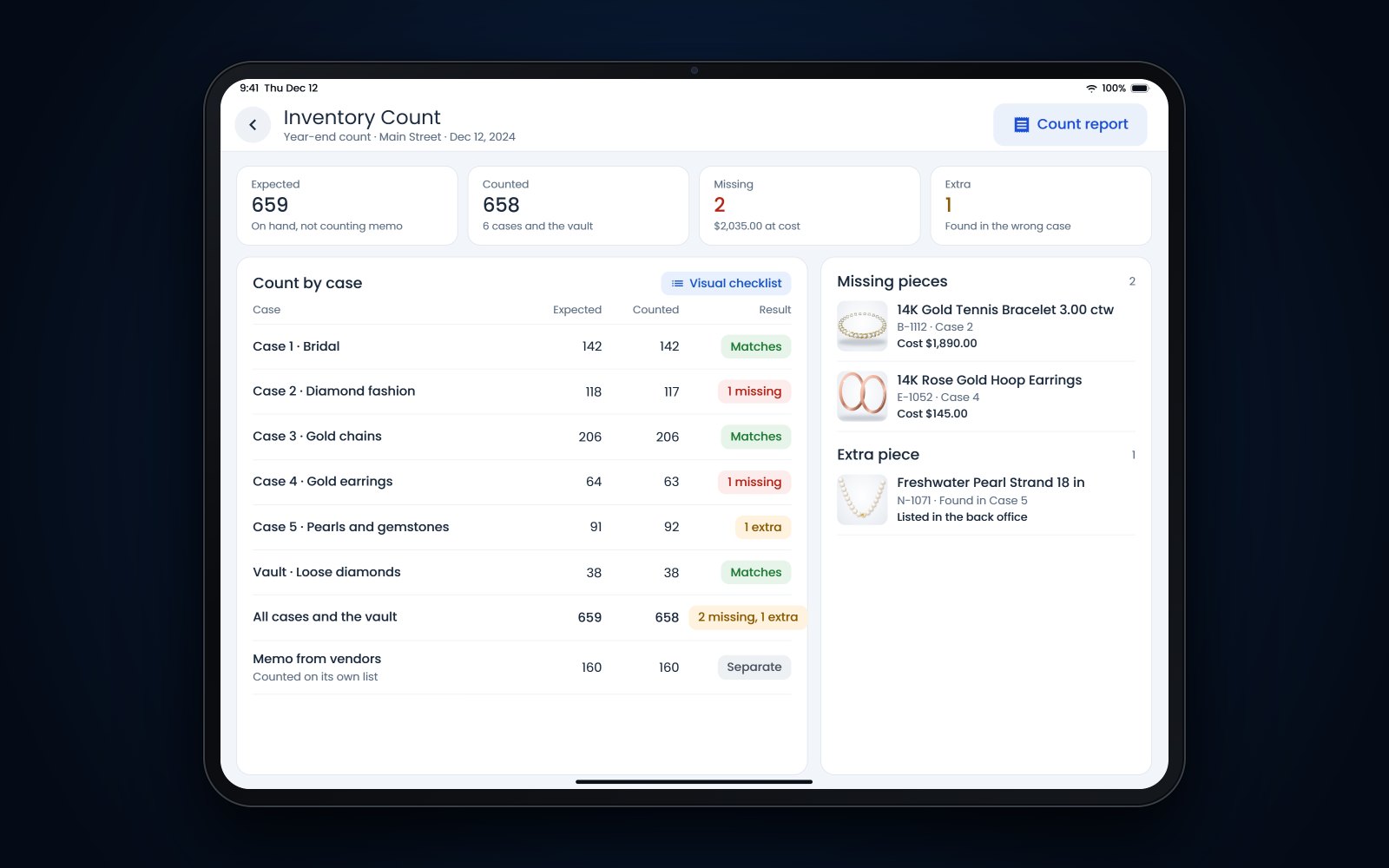
Short answer: A jewelry store inventory count goes best when you set the date, stop receiving and transfers until it is done, and count every case and tray in pairs, with one person reading tags and one recording. Count memo and consignment goods separately, and keep customer repairs out of the count. Then reconcile every difference, value what you own at cost and give the report to your accountant.
In this article
- Plan the date and freeze movement
- How to run a jewelry store inventory count, tray by tray
- Count memo goods, consignment and repairs separately
- Reconcile missing, extra and mis-tagged pieces
- Value the count and hand it to your accountant
- Act on aged stock after the count
- How Flawless POS helps with the year-end count
- Frequently asked questions
Plan the date and freeze movement
The night before a count, someone usually finds a vendor box nobody opened and a transfer that left one store but never showed up at the other. Loose ends like these cause a lot of the differences you end up chasing, so the planning matters as much as the counting. If you kept up the case counts on your holiday prep checklist, there should be fewer surprises.
Pick a date close to the end of your tax year, when the store is closed or before it opens. For a calendar-year store, that usually means after close on the last business day of December or before opening on the first business day of January. If you count on a different day, tell your accountant, who will need the sales and receipts between the count and year-end to roll the numbers forward or back.
The IRS says a business that keeps inventory must take a physical inventory at reasonable intervals and adjust its book amount to agree with the actual count (IRS Publication 538 (opens in a new tab)). Your accountant can tell you what that means for your store. This is general information, not tax advice.
Freeze receiving, transfers and memo returns
- Stop receiving 1 to 2 days before the count. Put anything that arrives in a sealed bin marked "received after count" and enter it afterward.
- Finish every transfer between stores, or cancel it, before counting starts.
- Hold memo returns to vendors until after the count, or ship them early enough that the vendor confirms receipt first.
- Ring up every sale, return and layaway payment before counting starts, so the books match the cases.
- Move customer repairs and appraisal pieces into their own area so nobody counts them by mistake.
Tell your memo vendors the count date too. A vendor who knows you are counting on December 31 can send a current memo statement for you to check against.
How to run a jewelry store inventory count, tray by tray
Count in pairs. One person reads each tag and looks at the piece, and the other records it or scans it. A pair catches the mistakes one tired person makes, and the pairing protects both of them if a piece turns out to be missing.
- Map the storeList every place that holds stock: each case and tray, the safe, back stock, window displays, the photo area, pieces out on approval, pieces at vendors and pieces staff are wearing. Give each one a number.
- Count one tray at a timeTake a tray out, count it and mark it done on the map before the next tray comes out. Never have 2 trays open on the same counter.
- Check the piece as well as the tagMake sure the metal color, stone and size match the tag. A white gold ring wearing a yellow gold ring's tag is a problem even when the count is right.
- Handle loose goods by weight and paperCount loose stones by parcel paper and weigh each parcel. Weigh gold findings and scrap. Write the weight next to the parcel number on the count sheet.
- Recount the high-value casesHave a second pair recount the cases that hold your most expensive pieces without looking at the first pair's numbers.
- Close and sign each caseWhen a case is done, the pair signs the sheet. Nothing goes in or out of that case until the whole count is closed.
Tip: Do a test run on one case a week ahead. Time it, multiply by your number of cases and you will know how many pairs and how many hours you need.
Count memo goods, consignment and repairs separately
Not everything in your cases belongs to you. Memo goods usually stay the vendor's property until you buy them, and customer consignment pieces belong to the customer. IRS Publication 538 lists "goods consigned to you" among the merchandise you do not include in inventory, and lists goods you have sent out on consignment as merchandise you do include. The table shows how each group is usually handled on count day.
| What it is | Who owns it | In your inventory? | What to do on count day |
|---|---|---|---|
| Stock you bought | You | Yes | Count it and value it at cost |
| Vendor memo goods | The vendor | No (goods consigned to you) | Count separately and check against the vendor's memo statement |
| Customer consignment pieces | The customer | No | Count separately and match each piece to its agreement |
| Your pieces out on memo or approval | You | Yes (goods out on consignment) | Get written confirmation from whoever holds them |
| Purchased goods in transit to you | You, if title has passed | Yes, if title has passed | Check the vendor's terms before you include it |
| Customer repairs and appraisals | The customer | No | Keep out of the count and check against open job envelopes |
Count memo goods in their own trays or with their own tag color, and send each vendor a list of what you hold. If a memo is overdue, this is a good time to settle it: return the piece, buy it or get a new memo date in writing.
Customer repairs need the same care. Count the open repair envelopes against your list of open jobs and make sure every one is accounted for. That is a separate count from your stock and should never be mixed into it. If your repair board is still full at year-end, the envelope routine in our guide to the holiday repair rush helps here too.
Reconcile missing, extra and mis-tagged pieces
When the count is done, compare it with your records. Each difference falls into a few familiar types, and each type has its usual causes.
| Difference | Common causes | Where to look |
|---|---|---|
| Missing | Sold but not rung up, transferred, sent for repair or photos, out on approval, theft | Recent sales and returns, transfer records, repair envelopes, the approval log, the safe |
| Extra | Received but never entered, a return not processed, a duplicate item number | The received-after-count bin, vendor packing slips, recent returns |
| Mis-tagged | Tags swapped during try-ons, a sizing that changed the item, a typo at receiving | The piece itself under a loupe, the receiving record, the job record if it was sized |
| Wrong quantity of a style | Identical pieces sharing one item number, or one item split across 2 trays | Both trays and the item's history |
For each difference, recount first, then check the records, then search the store. Only adjust your records once you have looked everywhere, and write down the reason for every adjustment and who approved it. A missing piece that turns up in a repair envelope in February is much easier to sort out when the adjustment note says what you already checked.
If you think something was stolen, follow your insurer's reporting rules and file a police report if your policy requires one. Then check when the piece was last recorded, and by whom.
Value the count and hand it to your accountant
IRS Publication 538 describes the methods a business can use to value inventory, including cost, lower of cost or market, and the retail method. Your accountant decides which one applies to your store. If you use lower of cost or market, the publication says each item is valued separately, which is one more reason to count piece by piece. It also describes a small business exception, based on a gross receipts test, that lets some businesses skip keeping inventories in the usual way, so ask whether it applies to you.
Then hand over a short, clean package:
- Owned stock at cost, totaled by category such as bridal, diamond fashion, gold and watches
- Memo and consignment goods on a separate list, left out of the total
- Every adjustment with its reason and who approved it
- The count date and, if it was not year-end, the sales and receipts between the count and year-end
- Pieces out on approval or at vendors, with the written confirmations
This is general information, not tax or accounting advice. Your accountant may ask for more, or for a different format.
Act on aged stock after the count
The year-end count is the one time a year you handle every piece, so use it. While the pieces are fresh in everyone's mind, pull a list of what has been in stock the longest and decide what to do with each piece before buying starts for the new year.
- Reprice it, if your cost or the market has moved since you bought it.
- Move it to another store where it may sell better.
- Return it to the vendor, if your terms allow.
- Remake it, or sell it for scrap if the style is past saving.
- Give it a better spot in the case, or run a short staff incentive on it.
Some stores are starting to look at RFID tags for counts. A handheld reader picks up many tags at once without scanning each barcode, which can make counts quicker and more frequent, so you may want to read up on it before next year's count. It would still depend on the habits in this guide: every piece tagged, every move recorded and memo goods kept apart.
How Flawless POS helps with the year-end count
Flawless POS includes a visual inventory checklist for physical counts, and mobile inventory, so a counting pair can work at the case.
Every item keeps an audit history of every move, so when a piece comes up missing you can see when it was last sold, transferred or adjusted. If you run more than one store, each location's stock is tracked on its own and transfers between stores are recorded, which makes a transfer that left one store and never arrived easier to spot. Reports pull their totals from the same records.
See the full list of Flawless features, or book a demo and bring your count-day questions.
Frequently asked questions
Do memo goods count as part of our inventory?
Generally no. IRS Publication 538 lists goods consigned to you among the merchandise not included in inventory, and memo goods usually stay the vendor's property until you buy them. Count them separately, confirm the list with each vendor and ask your accountant about your specific memo terms. This is not tax advice.
Should we close the store for the count?
If you can, count before opening or after closing so nothing sells mid-count. If you must stay open, keep a log of every sale from a case that has already been counted. Sales from cases not yet counted are fine as long as they are rung up before that case is counted.
How long does a full count take?
It depends on how many pieces you carry, how many cases you have and how many pairs you put on it. Time a test count of one case, multiply by your number of cases, and add time for loose goods and the safe. That estimate is more useful than any average from another store.
What do we do about a piece we cannot find?
Recount the tray, then check sales, transfers, repair envelopes, pieces out on approval and the photo area. If it still has not turned up, adjust the record with a note on what you checked and who approved it. If theft is likely, follow your insurer's reporting rules.