
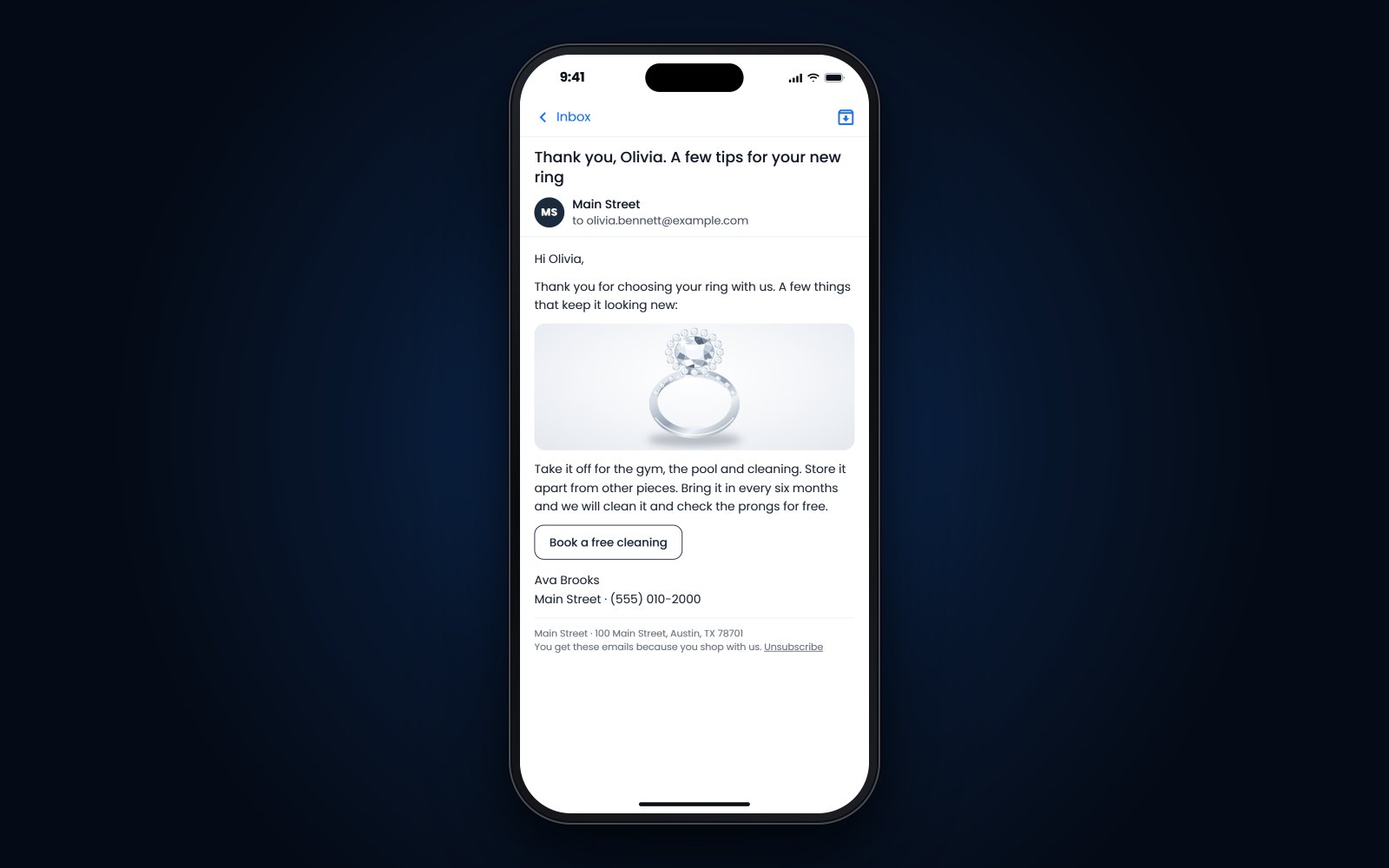
Short answer: A good jewelry customer follow-up plan after Valentine's Day has 4 touches: a thank-you within 48 hours, a care tip at 2 weeks, a free cleaning invite at 3 to 6 months and an anniversary reminder about 11 months out. Record who the piece was for, the occasion, the ring size and style notes at the sale so every message can be personal. Send the thank-you yourself and use templates for the routine reminders.
In this article
- Why the week after Valentine's Day matters
- A jewelry customer follow-up timeline for the next 12 months
- What to record at the counter
- Personal messages versus automated ones
- Sample follow-up messages you can adapt
- Consent, opt-outs and a few ground rules
- How Flawless POS keeps the follow-up on track
- Frequently asked questions
Why the week after Valentine's Day matters
For example, a customer comes in on his lunch break the day before Valentine's Day, picks out a pair of sapphire studs and leaves with a gift bag and a receipt. If the next thing he hears from your store is a holiday email in November, you have treated a gift buyer like a stranger. The week after Valentine's Day is the easiest time to start a real relationship with him, because the purchase is fresh and he already knows how the gift went over.
There is real money behind those visits. In its survey released January 28, 2025, the National Retail Federation projected a record $27.5 billion in Valentine's Day spending this year, with $6.5 billion of it on jewelry and 22% of consumers planning to buy jewelry. Some of those buyers were in your store, and some of them were planning a proposal.
Good follow-up is how the buyer of a $300 pendant comes back for a cleaning, then birthday earrings, and one day an anniversary band. If you set up wish lists and important dates with your holiday prep checklist, you already have a head start.
A jewelry customer follow-up timeline for the next 12 months
This timeline works for most Valentine's Day purchases. Adjust it to the piece: a $40 bracelet does not need 4 touches, and a $9,000 engagement ring may deserve more.
| When | What to send | How | Who sends it |
|---|---|---|---|
| Within 48 hours | A thank-you that names the piece and asks how it was received | Handwritten card, call or a personal text | The salesperson who made the sale |
| 2 weeks | A care tip for that piece and an offer to check the fit | Email or text | The store, from a saved template |
| 3 to 6 months | An invitation for a free cleaning and prong check, if you offer one | Email or text | The store, signed by the salesperson |
| 11 months | An anniversary reminder with 2 or 3 ideas in their price range | Personal text, call or email | The salesperson |
| Any time | A note when a wish-list piece or a matching item comes in | Call or text | The salesperson |
The thank-you, within 48 hours
For Valentine's Day sales the 48-hour window has already passed, so send it this week. A late thank-you is still better than none. Keep it about the gift and the person, with no offer attached. If the salesperson knows how the proposal went, mention it.
The care tip, at 2 weeks
This is the most useful message in the plan, because it helps the customer and asks for nothing. Tell them how to store the piece, what to keep it away from (chlorine pools, hand lotion, the gym) and when to come in. For rings, mention your sizing window if you have one. Plenty of gift buyers guess the size, and a quick resize in the first weeks is a better experience than a return.
The cleaning invite, at 3 to 6 months
If you offer free cleanings and prong checks, this is when to invite people in. It gives them a reason to visit that has nothing to do with buying, and a ring on the bench is a natural moment to talk about the matching band. It is much easier to tighten a loose stone at a cleaning than to replace a lost one in June. If the check turns into a repair, take it in properly with a repair intake checklist so there is no confusion later.
The anniversary reminder, at 11 months
About a month before the date, remind the buyer. Give 2 or 3 specific ideas that fit what they bought last time and the budget they were comfortable with. A short note from the salesperson who remembers them is hard to ignore.
What to record at the counter
Every message above depends on notes taken at the sale. Ask while you wrap the gift, when the customer is relaxed and talking. Write the answers on the customer record, not on the receipt or a sticky note by the register.
- Who the piece was for, and their first name
- The occasion: Valentine's Day, a proposal, an anniversary, a birthday, an apology
- Important dates: the recipient's birthday, the anniversary, the proposal date
- Ring size, and whether the buyer guessed it
- Metal and color preferences: white, yellow or rose gold, platinum, silver
- Style notes: classic or modern, dainty or bold, any metal allergies
- Pieces they looked at but did not buy, saved to a wish list
- How they want to be contacted, and whether they agreed to marketing texts or emails
- Whether the gift was a surprise, so nobody contacts the recipient by mistake
For an engagement ring, add the stone details, the certificate number, the appraisal date if you did one, and the wedding date if they know it. Those notes are the start of the wedding band sale and an updated insurance appraisal later on.
Tip: Ask one question per sale and write the answer down. "Who is the lucky person?" usually gets you a name and an occasion in one go.
Personal messages versus automated ones
Some messages need a person behind them, and some are fine as templates. As a rule of thumb, the bigger the purchase and the more emotion behind it, the more personal the message should be.
- Personal: the thank-you for any engagement ring or large gift, the anniversary reminder for your best customers, and anything after a problem such as a wrong size, a late pickup or a complaint.
- From a template: the 2-week care tip, the cleaning invite, birthday and anniversary reminders for smaller purchases, and wish-list notices when many customers are waiting on the same piece.
A template can still sound warm. Write it in the salesperson's voice, sign it with their name and keep it short. A personal message can be short too. Two sentences from the person who helped them are enough.
Give the list one owner. In a small store that is often the owner or a manager. In a larger store, each salesperson looks after their own customers and a manager checks once a week that nobody was missed.
Sample follow-up messages you can adapt
These are examples for an imaginary buyer, Mark, and a salesperson, Dana. Change the wording so it sounds like your store.
Thank-you text or card (example)
"Hi Mark, it's Dana from (store name). Thanks again for coming in for the sapphire studs. I hope Julie loved them. If they ever need a cleaning or the backs feel loose, bring them by any time."
2-week care tip email (example)
Subject: "Keeping Julie's studs bright." Message: "Hi Mark, a quick tip for the sapphire studs: have Julie take them off for the gym, the pool and the shower, and keep them in their box so they don't scratch other pieces. If the backs ever feel loose, stop in and we'll check them while you wait. Dana"
Cleaning invitation (example)
"Hi Mark, it's been a few months since you picked up the sapphire studs. We offer free cleanings and a quick check of the posts and backs. Stop by any weekday, it only takes a few minutes. Dana"
Anniversary reminder (example)
"Hi Mark, Valentine's Day is a month away. Last year it was the sapphire studs. I set aside a sapphire pendant and a pair of diamond huggies that would go with them, if you'd like to look before the rush. Dana"
Consent, opt-outs and a few ground rules
A few ground rules keep your messages welcome and keep you on the right side of texting and email rules. This is not legal advice; check your state's rules.
- Get permission to text. Federal rules require prior express written consent for marketing texts sent with automated tools (47 CFR 64.1200 (opens in a new tab)), and the wireless industry's CTIA Messaging Principles (opens in a new tab) expect a customer to agree before a business sends informational texts, and to agree in writing before promotional ones. Ask at the counter and note the answer on the customer record.
- Watch what you add to a text. Under the CTIA guidelines, adding a coupon code or a sale to an informational message, like a care tip, may turn it into a promotional text that needs written consent.
- Emails that sell need an opt-out and your address. The FTC's CAN-SPAM compliance guide (opens in a new tab) says commercial email needs a working opt-out, honored within 10 business days, a valid physical postal address and a subject line that matches the content. When one email mixes a care tip with a sale, its primary purpose decides whether it counts as commercial.
- Protect surprises. If the gift was a surprise, or the buyer and the recipient share a phone or an email address, send follow-ups only to the buyer and never mention the price.
- Respect a no. If a customer asks you to stop, stop, and note it on their record the same day so nobody else on the team sends the next message.
- Keep the count low. For most gift buyers, 4 planned messages a year plus an occasional wish-list note is plenty.
How Flawless POS keeps the follow-up on track
Flawless POS keeps important dates, such as a recipient's birthday or a couple's anniversary, on the customer record, where anyone on the team can find them when it is time for the anniversary reminder.
Texts and emails sent to the customer stay in the communication history on their profile, so anyone at the counter can see that Mark already got his care tip. Wish lists hold the pieces a customer looked at, which gives the anniversary reminder something specific to suggest, and rewards give repeat buyers a reason to keep shopping with you.
Flawless also includes email and text campaigns for routine messages such as the cleaning invite. You can see the rest of the customer tools in the full list of Flawless features, or book a demo to walk through it with your own customers in mind.
Frequently asked questions
How soon should a jewelry store follow up after a sale?
Send the thank-you within 48 hours, while the gift is still fresh. After that, space messages out: a care tip at about 2 weeks, a cleaning invite at 3 to 6 months and a reminder before the next occasion. If you missed the 48-hour window, send the thank-you anyway.
Should the follow-up be a text, an email or a handwritten card?
Use the channel the customer chose and agreed to. Handwritten cards and calls suit engagement rings and large gifts, email works well for care tips and invitations, and texts are best for short notes from the salesperson. Marketing texts need the customer's written consent first.
How do I follow up when the buyer and the wearer are different people?
Send follow-ups to the buyer unless the wearer has become your customer too. Never mention price, and if the gift was a surprise, make sure nothing goes to a shared phone or email before the occasion. When the wearer comes in for a cleaning, ask whether they would like their own record and reminders.
What should I do if a customer was unhappy with the purchase?
Call them instead of sending a template. Find out what went wrong, offer a fix such as a resize, an exchange or a repair, and note the outcome on the customer record. Take that customer off the routine messages until the problem is solved.
Sources
- National Retail Federation - Valentine's Day spending reaches record $27.5 billion (January 28, 2025) (opens in a new tab)
- FTC - CAN-SPAM Act: A Compliance Guide for Business (opens in a new tab)
- CTIA - Messaging Principles and Best Practices (May 2023) (opens in a new tab)
- 47 CFR 64.1200 - Delivery restrictions (FCC telemarketing and text rules) (opens in a new tab)