
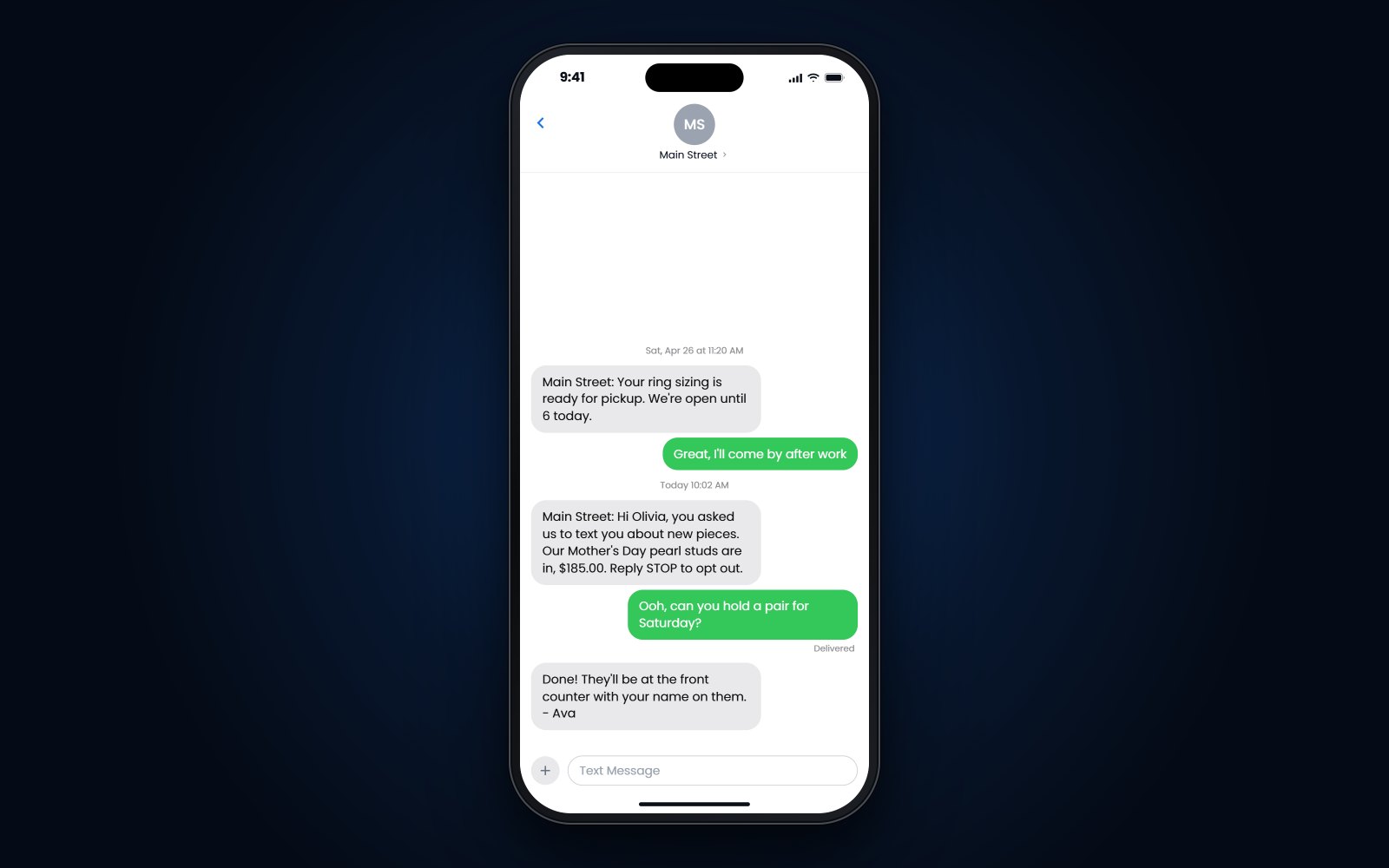
Short answer: Text marketing for jewelry stores starts with written consent: a customer has to agree in writing before you send promotional texts, and they must be able to opt out at any time, including by replying STOP. Federal rules bar telephone solicitations before 8 a.m. or after 9 p.m. in the customer's time zone, and Florida and Oklahoma set an earlier 8 p.m. cutoff for sales calls. Business texts from a local 10-digit number also need A2P 10DLC brand and campaign registration, which your texting provider handles.
In this article
Which texts count as marketing
Your store probably texts customers more than you think. A ring sizing is ready, a special order came in, a customer asks if the pendant comes in rose gold, and now and then you send everyone a note about the Mother's Day case. The rules treat these texts differently, so sort them first. This is not legal advice; check your state's rules and have a lawyer review your consent wording.
| Type | Jewelry store example | Consent expected |
|---|---|---|
| Conversational | A customer texts to ask whether the pendant comes in rose gold, and you reply | Implied, because the customer started the conversation |
| Informational | "Your ring sizing is ready for pickup" or an appointment reminder | Express consent: the customer gave you the number for that purpose |
| Promotional | "New Mother's Day pieces are in the case this week" or a coupon code | Express written consent before the first message |
Watch the mix. CTIA notes that adding a call to action, such as a coupon code, to an informational text may put it in the promotional category. "Your sizing is ready, and take 20% off watch bands this week" is a marketing text, even though it started as a repair update.
Federal rules under the Telephone Consumer Protection Act apply to texts as well as voice calls. FCC rules require prior express written consent for marketing messages sent with an autodialer, and the National Do Not Call rules cover marketing texts to cell phones (47 CFR 64.1200 (opens in a new tab)). Whether a given texting tool counts as an autodialer is a legal question, which is one more reason to get written consent for every marketing text, whatever tool you use.
What written consent for marketing texts looks like
Under FCC rules, prior express written consent is a signed agreement that clearly authorizes you to send marketing messages to a specific phone number. It must also tell the customer they are not required to agree as a condition of buying anything. The signature can be electronic, as long as federal or state law recognizes it. CTIA lists common ways to opt in, including a web form, a keyword the customer texts to you and a sign-up at the point of sale.
Sample consent wording (example)
"Yes, send me marketing texts from (store name) at the number above, including automated texts. Up to 4 messages a month. Consent is not a condition of purchase. Message and data rates may apply. Reply STOP to opt out or HELP for help. Privacy policy: (link)"
That example follows the FCC's required disclosures and CTIA's call-to-action guidance. Have a lawyer look at your final version.
Records to keep
If a customer ever disputes a text, your consent records are what you will point to. CTIA recommends keeping:
- The date and time consent was given
- How it was given: paper form, tablet at the counter, web form or text keyword
- The exact wording the customer agreed to
- Which program it was for, such as store news or repair updates
- The phone number and the customer's name
- The IP address, for web sign-ups
Tip: Never load numbers from a bought or shared list. CTIA says to build and vet your own opt-in list, and consent given to one business does not carry over to another.
STOP, HELP and the new FCC opt-out rules
New FCC rules on revoking consent took effect on April 11, 2025, just last month, alongside a confirmation-text rule that has applied since 2024. In plain terms:
- A customer can opt out in any reasonable way, such as a reply text, a phone call or an email, and you cannot make one method the only option. Treat a request made in person at the counter the same way.
- A reply of stop, quit, end, revoke, opt out, cancel or unsubscribe counts as an opt-out. So does other wording a reasonable person would read as one, such as "please stop texting me."
- You have a reasonable time, no more than 10 business days, to honor the request.
- You may send one confirmation text with no marketing in it. If it goes out within 5 minutes, it is presumed to be fine.
If the customer has agreed to more than one kind of text, that confirmation may ask whether they also want to stop the others, such as repair updates. One related piece is on hold: the FCC delayed until April 11, 2026 the part of the rule that would make an opt-out from one type of message apply to a sender's messages on unrelated topics.
HELP is the other keyword to support. CTIA says the confirmation you send after someone opts in should include customer care contact information, such as HELP instructions, plus how to opt out and how often you will text. For example: "(Store name): You're signed up for store news, up to 4 texts a month. Reply HELP for help or STOP to opt out. Message and data rates may apply."
TCPA quiet hours and stricter state rules
FCC rules bar telephone solicitations to a residential subscriber before 8 a.m. or after 9 p.m., local time at the called party's location. That is the customer's time, not yours. A Colorado store texting a customer who moved to New York has to count in Eastern time.
Some states are stricter. Florida limits commercial telephone solicitation calls to between 8 a.m. and 8 p.m. and to no more than 3 calls to a person in 24 hours on the same subject (Fla. Stat. 501.616 (opens in a new tab)). Oklahoma's Telephone Solicitation Act, in effect since November 1, 2022, sets the same 8 p.m. cutoff and 3-call limit. Both states' telephone solicitation laws count text messages as sales calls for their consent rules, and Oklahoma presumes that a sales call to an Oklahoma area code reaches someone in Oklahoma.
There is also an open question at the FCC. In March 2025 the agency asked for public comment on a petition about whether consumers who gave written consent can still sue over marketing texts received outside 8 a.m. to 9 p.m. (FCC DA 25-216 (opens in a new tab)). Until that is settled, keep every marketing text inside those hours.
Tip: One house rule covers the federal and state limits above: send marketing texts between 10 a.m. and 7 p.m. in the customer's time zone.
How A2P 10DLC registration works
If your store texts from a regular 10-digit local number through software, carriers treat it as application-to-person (A2P) messaging. The Campaign Registry (opens in a new tab) describes 10DLC as a channel where brands and their messaging providers are verified before they are allowed to send. There are 2 registrations, and your texting provider files both.
- Register your brandThis is your business: legal name, EIN, address and contact details. The Campaign Registry asks that the name and address match the records tied to your tax ID, so use the name on your IRS paperwork, not only the name on your sign.
- Register a campaignThis describes what you will send: the use case, a clear description, sample messages and how customers opt in. The Registry warns that vague descriptions can get a campaign rejected, so write it the way you would explain it to a new employee.
- Wait for approvalStores cannot register directly. The Campaign Registry works through registered messaging providers, called campaign service providers, and they handle approval with the carriers.
Fees and review times vary by provider, so ask yours what they charge and how long approval takes. If the same number will send repair updates and marketing, tell your provider, so the campaign registration covers everything you plan to send. If you are comparing systems, add these to your questions for any POS demo.
What good text marketing for jewelry stores looks like
Customers give you their number because they trust you, and a busy gift season is when that trust gets tested. The National Retail Federation projected $6.8 billion in Mother's Day jewelry spending this year, so plenty of stores will be texting the same people this week.
- Name the store first. Start every message with your store name, so nobody wonders who is texting.
- Give one clear reason. Mother's Day on Sunday, May 11, is a good reason. So are graduation gifts under $200 or a designer trunk show next month. "Check out our sale" is a weak one.
- Say how often, then stick to it. If the sign-up said up to 4 messages a month, send 4 or fewer, even in a holiday week.
- Use links people recognize. CTIA asks senders who shorten links to use a shortener dedicated to their own business, with links that clearly identify who owns the site. A plain link to your own website is simplest.
- Keep texting off personal phones. When a salesperson texts customers from their own cell, the consent records, opt-outs and history leave with them.
Texts work best as part of a plan, alongside the thank-you notes and care tips in a customer follow-up plan. Repair updates are some of the most useful texts you send, and during the holiday repair rush they save your staff a lot of phone calls.
- The customer gave written consent for marketing texts
- The message starts with your store name
- Opt-out wording is in the message or was in the opt-in confirmation
- It will arrive between 10 a.m. and 7 p.m. in the customer's time zone
- Your brand and campaign registration is approved
- Everyone who opted out has been removed
How Flawless POS fits in
Flawless POS keeps the communication history on each customer's profile, so when a salesperson is off, anyone else can see what was sent and when, without searching someone's personal phone.
Flawless includes email and text campaigns too, and the rules above apply whatever software you use. When you look at any texting tool, ask where it records each customer's consent and opt-outs, and whether staff can see them before they send. To see the customer profile with your own examples, book a demo.
Frequently asked questions
Do I need consent to text a customer that their repair is ready?
Yes, but it is a lighter kind of consent. Under the CTIA guidelines, a customer who gives you their number and agrees to hear about the repair by text has given the express consent expected for informational texts. Keep those texts about the repair, and get written consent before adding any promotion.
Does a purchase count as consent for marketing texts?
No. Buying something, or leaving a phone number on a receipt, is not written consent for marketing texts. The FCC's definition requires a signed agreement, which can be electronic, that clearly authorizes marketing messages and says consent is not a condition of purchase.
What happens if we skip 10DLC registration?
The Campaign Registry describes 10DLC as a channel where brands and providers are verified before they can send, so expect your texting provider to require registration before it sends marketing texts from a local number. Ask where your registration stands well before a big send like Mother's Day.
Can we text customers whose numbers are on the Do Not Call list?
The National Do Not Call rules apply to marketing texts to cell phones. If the customer gave you prior express written consent, you can text them within what they agreed to. Without it, do not send marketing texts. This is not legal advice; check your state's rules.
Sources
- 47 CFR 64.1200 - FCC rules on telemarketing calls and texts, consent and calling hours (opens in a new tab)
- Federal Register - Strengthening the Ability of Consumers To Stop Robocalls, final rule (March 5, 2024) (opens in a new tab)
- Federal Register - Effective date of April 11, 2025 for the consent revocation rules (October 11, 2024) (opens in a new tab)
- FCC - Order DA 25-312 delaying part of the revocation rule to April 11, 2026 (April 7, 2025) (opens in a new tab)
- FCC - Public Notice DA 25-216 seeking comment on the quiet hours petition (March 11, 2025) (opens in a new tab)
- CTIA - Messaging Principles and Best Practices (May 2023) (opens in a new tab)
- The Campaign Registry - 10DLC overview (opens in a new tab)
- The Campaign Registry - Resources: registering brands and campaigns (opens in a new tab)
- Florida Statutes 501.616 - Unlawful acts and practices (calling hours and call limits) (opens in a new tab)
- Florida Statutes 501.059 - Telephone solicitation (text messages as sales calls) (opens in a new tab)
- Oklahoma HB 3168 (2022) - Telephone Solicitation Act, enrolled text (opens in a new tab)
- National Retail Federation - Mother's Day spending expected to reach $34.1 billion (April 28, 2025) (opens in a new tab)