
Short answer: When the gold price moves this fast, base your jewelry pricing on replacement cost, using each piece's metal weight and what it would cost to restock today. Put a metal clause and an expiry date on every custom quote, price repair metal by weight, and write down your rules for buying gold and taking trade-ins. Then explain the changes to customers plainly, before they notice a new tag.
In this article
- What a $4,000 gold price means for jewelry pricing
- How to reprice gold jewelry by weight and replacement cost
- Quoting special orders and custom work when gold moves
- Pricing repairs that use gold or platinum
- Buying scrap gold over the counter
- Trade-in credit policies for old gold
- How to talk to customers about gold price increases
- How Flawless POS helps with gold repricing
- Frequently asked questions
What a $4,000 gold price means for jewelry pricing
Say a customer asks about a 14k rope chain in your front case. It came in last fall, and the tag was set when gold cost far less than it does today. If it sells at that price, you'll pay much more to replace it than you did the first time, and the margin you planned on shrinks.
This week gold crossed $4,000 an ounce for the first time. U.S. gold futures got there on October 7, 2025, while spot gold was still just under $3,960 (Reuters, via Khaleej Times (opens in a new tab)). Spot gold followed on October 8 (Marketplace (opens in a new tab)). NPR reported that gold was already up about 50% this year (NPR (opens in a new tab)).
Gold shows up in 4 places in a jewelry store: the replacement cost of every gold piece in the cases, the quotes you give for custom work, the metal your bench uses on repairs and the price you pay when you buy gold over the counter. Each one needs a written rule. Nobody knows where gold goes next, so write rules that work if it rises or falls, and decide how often you'll review them.
How to reprice gold jewelry by weight and replacement cost
Start with pieces where metal is most of the value: chains, bands, hoops, bracelets and plain gold fashion pieces. For a diamond solitaire, the stone drives the price. For a heavy curb chain, the gold does.
- Get the weightUse the gram weight from the tag or your inventory record. Weigh any piece that doesn't have one.
- Work out the gold content14k is 58.3% gold and 18k is 75% gold. Multiply the weight by that share to get grams of fine gold.
- Price the metalDivide by 31.1 to convert grams to troy ounces, then multiply by today's gold price. That's the raw metal value, before labor, finishing or margin.
- Get today's replacement costAsk the vendor what the same piece costs to reorder now, including labor and any metal surcharge.
- Compare and decideIf the replacement cost leaves less margin than your target for that category, reprice the piece or flag it for review.
For example, a 10-gram 14k chain holds about 5.83 grams of fine gold, or about 0.19 troy ounces. At $4,000 an ounce, that's about $750 of gold before any labor. If the tag was set when gold was much lower, check it against today's replacement cost.
Set a trigger and a schedule, then stick to them. For example, review every gold piece over 5 grams when gold moves 10% from the price you last used, and check the list monthly while prices are moving fast. Our post on jewelry store KPIs covers tracking gross margin by category, which tells you whether the new prices are holding.
Tip: Change the price in your system first, then print the new tag, so the register, the tag and the website show the same number. If your website pulls from your inventory, as described in our post on inventory-synced websites, the online price follows.
Quoting special orders and custom work when gold moves
Custom work takes weeks, and gold can move a long way in that time. Put these 2 lines on every quote:
- A metal clause. The price is based on a stated gold price. If gold moves more than a set amount before you buy the metal, the price changes by the difference in metal cost.
- An expiry date. The quote is good for a short time, such as 7 days. After that, you quote again.
Example wording (have your attorney review it): This price is based on gold at $4,000 per ounce. If the gold price changes by more than 5% before we order your metal, we will adjust the price by the change in metal cost and confirm the new price with you before we continue. This quote expires on October 15, 2025.
Take a deposit that covers the metal, and order the metal as soon as the customer approves the design. Once you've bought it, your cost is fixed. For special orders from a vendor, ask whether the vendor's price is locked when you order or set when the piece ships. If it's set at shipping, your quote to the customer needs the same clause.
Pricing repairs that use gold or platinum
Sizing a ring up, rebuilding a shank, retipping prongs and replacing a clasp all use metal. If your repair price list was set when gold was much cheaper, sizing up a heavy band may now cost you more in metal than you charge for the whole job.
- Price jobs that add metal as labor plus metal, with the metal charged by weight at the day's price.
- Set a minimum metal charge so small jobs still cover their cost.
- Review the repair price list monthly while gold is moving, and date it so staff know which list is current.
- Write the estimate at intake and say on it that metal is priced on the day the work is done, if that's your policy.
A written estimate at intake means nobody is surprised at pickup. Our repair intake checklist covers what to record at the counter.
Buying scrap gold over the counter
When gold is this high, more people want to sell: class rings, broken chains, single earrings, pieces from an estate. Buying can be good business. It's also where a store can end up holding stolen goods, or paperwork that doesn't satisfy the police.
A basic buying procedure
- Check a government-issued photo ID and record it.
- Test each piece for karat, weigh it on a legal-for-trade scale and record the weight.
- Photograph each item and describe it, including metal, markings, stones and any engraving.
- Have the seller sign a statement that they own the items.
- Pay by check or another traceable method where you can.
- Hold the items as long as your state requires before you melt or resell them, and keep the records as long as required.
Rules vary by state. Florida, for example, treats a business that buys used jewelry and precious metals as a secondhand dealer. It must record the seller's government photo ID and right thumbprint, send a record of each purchase to local law enforcement within 24 hours, and hold precious metals, gemstones and jewelry for 30 days before selling or melting them (Florida Statutes 538.04 and 538.06). Check your own state's law, and ask your local police department what reports it expects.
There's also a federal rule to watch. Under FinCEN's anti-money laundering rule for dealers in precious metals, stones and jewels, a retail jeweler may need a written anti-money laundering program if, in the prior year, it bought more than $50,000 of jewelry and precious metals from the public and also sold more than $50,000, both measured by the value of the metal and stones. FinCEN's FAQ says trade-ins credited to the customer's account, with no money paid out, don't count when deciding if the rule applies (FinCEN FAQ (opens in a new tab)). If your buying is growing this year, talk to your accountant or attorney. This is not legal advice.
Trade-in credit policies for old gold
A trade-in keeps the value in your store. For example, a customer brings in an old 14k bracelet and puts its value toward a new necklace instead of taking cash. Write down how that works before the next one walks in:
- How you value it. By weight and karat at a stated share of the day's gold price, or as a piece you can resell, priced like estate stock.
- Credit versus cash. Paying a higher rate as credit toward a purchase than as cash keeps more of the value in the store.
- Minimum purchase. For example, credit applies only toward a new piece that costs more than the trade-in.
- Paperwork. The same ID, photos and ownership statement as a cash purchase, unless your state's law clearly says otherwise. In Florida, for example, a trade-in for a similar item of greater value is exempt from the secondhand dealer rules (Florida Statutes 538.03).
- Approvals. A cap on how much credit a salesperson can give without the owner.
Set the gold price used for trade-ins once a day, from the same source, so 2 salespeople don't quote the same bracelet differently.
How to talk to customers about gold price increases
Customers have seen the headlines, which makes this easier than it sounds. Give staff a few plain sentences they're comfortable saying, for example:
- Gold is up about 50% since January, and this piece is mostly gold, so its price went up when we restocked.
- If you'd like the same look for less, we have it in 10k, in a lighter weight or in silver.
- For a custom piece, a deposit today locks in the metal price on your quote.
Don't guess where gold is going, and don't blame the customer's timing. If someone wants to wait for gold to fall, offer to add the piece to their wish list and call them if the price changes.
How Flawless POS helps with gold repricing
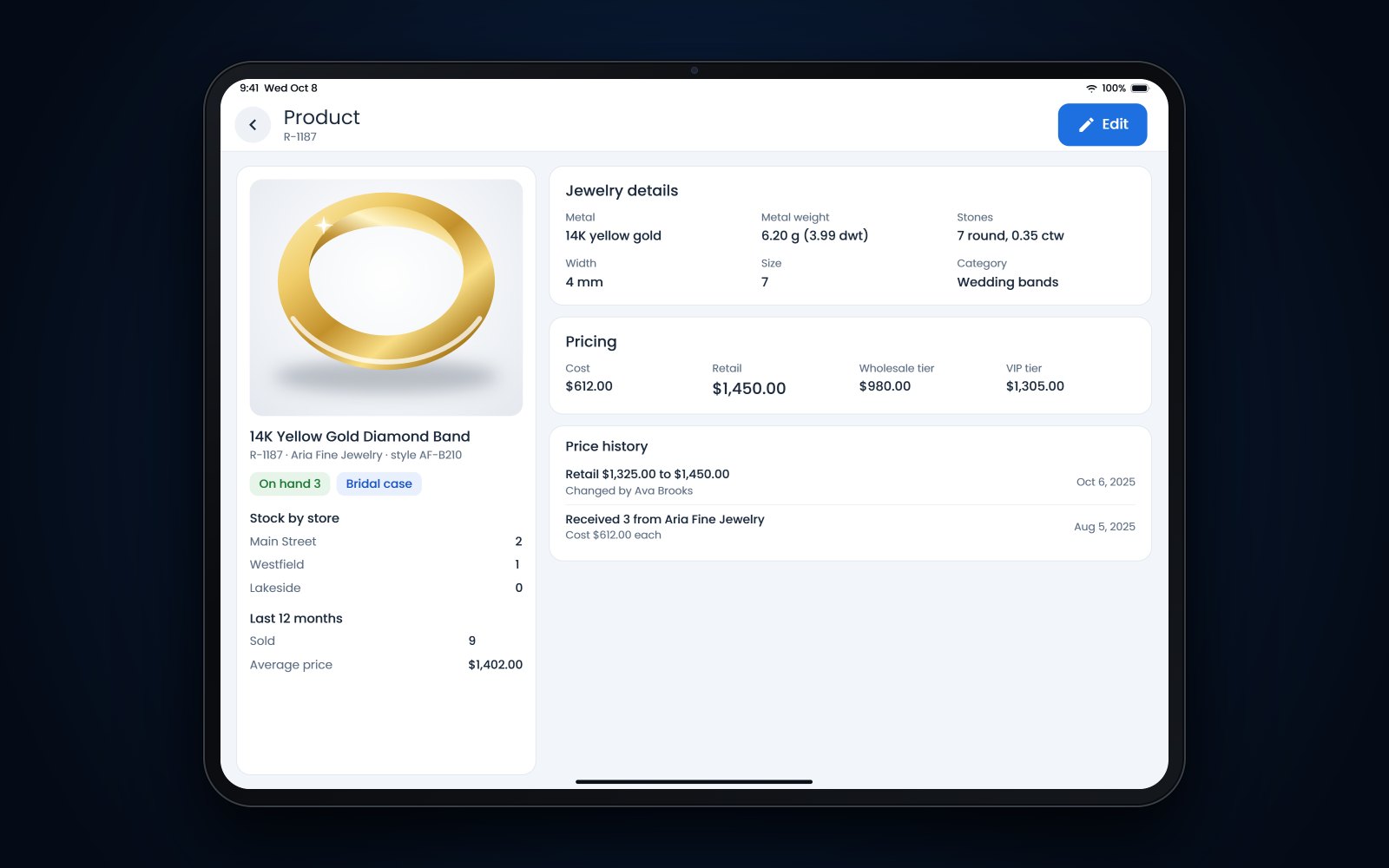
Flawless POS stores jewelry details such as metal and weight on each item, next to its cost and retail price, and its inventory reports help you find the gold pieces to review.
- One price, everywhere. Change the price on the item and print a new tag. Your website is built from the same inventory, so you aren't updating prices twice.
- Wholesale and VIP price tiers for stores that sell to the trade or give their best clients special pricing.
- Special orders and custom builds are tracked with their deposits from intake to pickup.
- Reports let you check sales and inventory after you reprice.
To see how your gold pieces, custom quotes and repairs would look in Flawless, book a demo.
See also: All Flawless POS features.
Frequently asked questions
How often should a jewelry store reprice gold jewelry?
Use a trigger instead of a fixed calendar, for example a review whenever gold moves 10% from the price you last used, plus a monthly check while prices are moving fast. Reprice in your system first, then print new tags, so the register, the tag and the website match.
Should we raise prices on gold pieces already in stock?
That's your decision, but pricing at replacement cost protects your ability to restock. If a chain sells for less than it costs to replace, the next one costs you more than the sale brought in. If you choose to let older stock sell at its old price, set an end date for that.
What is a metal clause on a custom jewelry quote?
It's a line saying the price is based on a stated gold price and may change if gold moves more than a set amount before you buy the metal. The customer knows the rule up front, and you don't absorb a jump in metal cost. Have your attorney review the wording.
Do we need a license to buy gold from customers?
It depends on your state. Florida, for example, treats businesses that buy used jewelry as secondhand dealers, with ID, thumbprint, reporting and 30-day holding rules. Check your state's law and ask your local police department before you start buying. This is not legal advice.
Sources
- Reuters via Khaleej Times - US gold futures hit $4,000 an ounce for the first time (October 7, 2025) (opens in a new tab)
- Marketplace - Gold prices surge to a new record (October 8, 2025) (opens in a new tab)
- NPR via KWBU - Gold tops $4K an ounce for the first time as economic concerns grip investors (October 8, 2025) (opens in a new tab)
- Florida Statutes 538.03 (2025) - Secondhand dealers: definitions and exemptions (opens in a new tab)
- Florida Statutes 538.04 (2025) - Secondhand dealers: recordkeeping and reporting (opens in a new tab)
- Florida Statutes 538.06 (2025) - Secondhand dealers: holding period (opens in a new tab)
- FinCEN - Frequently asked questions: anti-money laundering programs for dealers in precious metals, stones or jewels (opens in a new tab)