
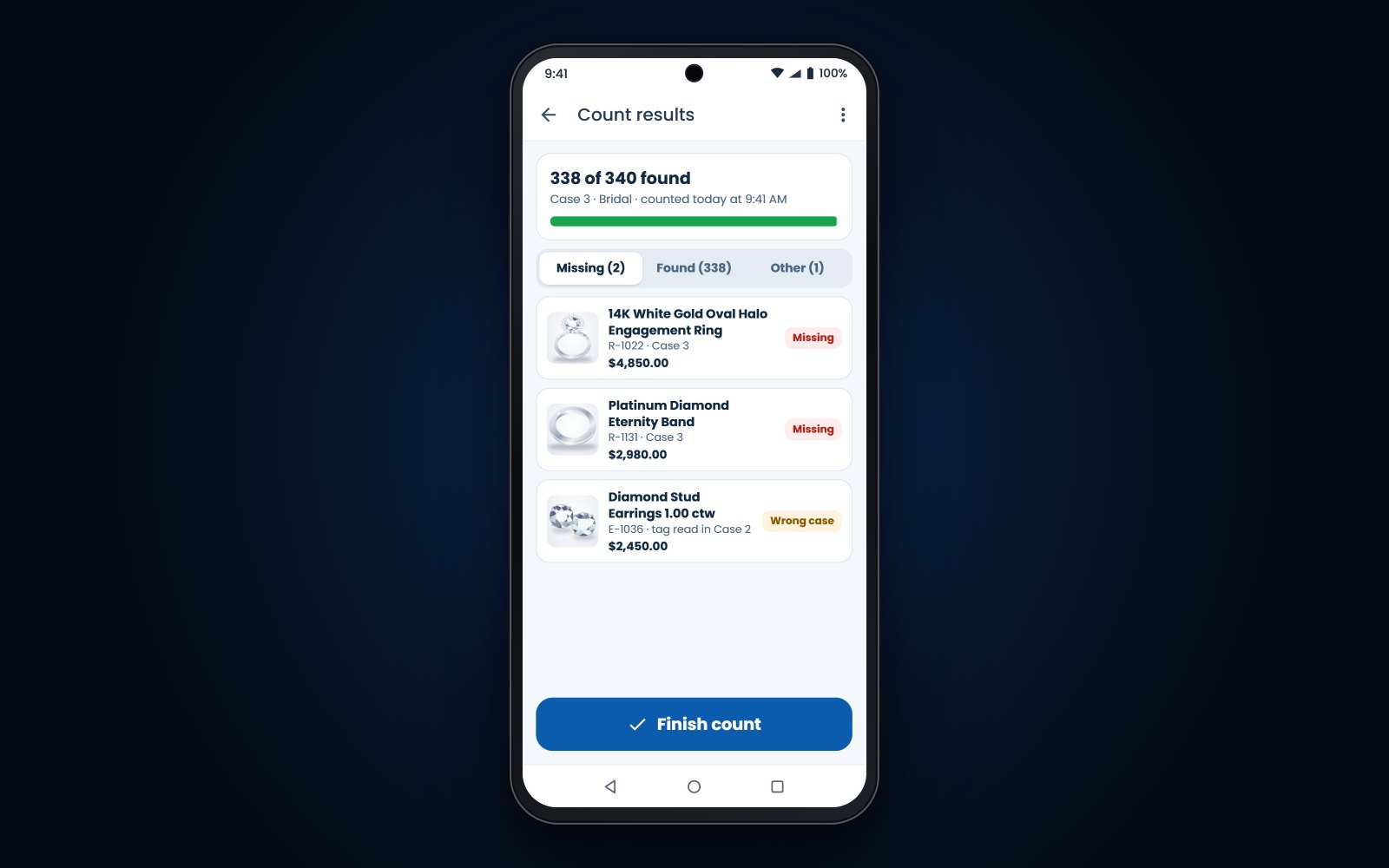
Short answer: RFID for jewelry stores means a small passive tag on every piece, so a handheld reader can count a tray or a whole case by radio without scanning each barcode or needing a line of sight. That makes frequent counts practical and shows you sooner when something is missing. It only counts pieces that carry a tag, and metal, tag placement and read range all affect how well it works.
In this article
How passive RFID works
Take a full ring tray. With barcodes, someone picks up each piece, finds the tag and scans it. With RFID, they hold a reader over the tray and it picks up the tags it can reach, many at once, without anyone turning a tag over.
The kind of RFID used for retail inventory is passive UHF RFID, also called RAIN RFID. It uses the GS1 UHF Gen2 protocol, which the international standards bodies ISO and IEC publish as standard 18000-63 (GS1 (opens in a new tab)). A system has 3 parts:
- The tag. A tiny chip and antenna inside the price tag. Passive tags have no battery; they draw their power from the reader's radio waves (GS1 (opens in a new tab)).
- The reader. For a jewelry store, usually a handheld. It sends out the radio signal and listens for the tags' replies.
- The software. Each tag carries a number. Your inventory system ties that number to the item record and compares what the reader found with what should be there.
Because it works by radio, RFID does not need a line of sight, and many tags can be read at the same time (RAIN Alliance (opens in a new tab)). GS1 puts the read range of passive UHF tags at typically several meters, depending on the reader, the antenna and the tag's orientation (GS1 (opens in a new tab)). In a jewelry store, you will usually want to turn that range down.
| Question | Barcode tags | RFID tags |
|---|---|---|
| How is a piece read? | One at a time, by scanning the printed code | Many at a time, by radio |
| Does the tag have to face the scanner? | Yes | No line of sight needed |
| What does a tray count look like? | Pick up and scan each piece | Hold the reader over the tray |
| What gets missed? | Pieces nobody scanned | Pieces with no tag, or tags the reader cannot reach |
| Does every piece need a tag? | Yes | Yes |
What changes in daily counts and audits
The biggest change is how often you can count. When counting a case no longer means handling every piece, you can count your highest-value cases every day and the whole store far more often than once a year.
- Opening and closing counts of the cases that hold your most expensive pieces.
- Spot audits of one category, such as all bridal or all pieces from one vendor, when something looks off.
- Memo checks before a vendor's statement is due, so you know exactly what you still hold.
- Quicker year-end counts, with hand counting saved for loose stones and anything the reader misses.
Frequent counts also change what a missing piece means. If you count once a year, a missing ring could have gone any time in the last 12 months. If you count the case every morning, you know it went yesterday, and you can check yesterday's sales, try-ons and staff schedule while people still remember.
The counting habits in our year-end inventory count guide still apply with RFID. You just use them more often.
What RFID for jewelry stores does not fix
A reader counts tags. It knows nothing about a piece that has lost its tag, and metal makes jewelry harder to read by radio than most retail goods.
Pieces without tags
As far as the reader is concerned, a piece with no tag does not exist. Every piece needs one, including the awkward ones: studs on cards, loose stones in parcel papers, consignment pieces and the ring that came back from sizing with its tag cut off. If a tag comes off, re-tag the piece before it goes back in the case.
Metal and tag placement
According to GS1, metal reflects and diffracts radio waves and can stop ordinary tags from working, and liquids absorb the signal and detune tags (GS1 (opens in a new tab)). A tag folded flat against a wide gold cuff, buried inside a coiled chain or pressed under a heavy bracelet may not read. Keep tags hanging away from the metal where you can, and test your hardest pieces before you buy anything.
Too much read range is a problem too
Too little range and the reader misses the pieces at the back of a deep tray. Too much and it picks up the case next door or the back stock behind the wall, so your count looks complete when it is not. Count one zone at a time, keep other trays away, and use reader settings that suit the size of a case. A steel safe also blocks reads, so count trays as they come out of the safe or before they go back in.
Store habits RFID depends on
- Remove the tag at the sale and keep removed tags off the sales floor. A sold piece's tag left in a drawer keeps showing up as stock.
- Tag every new piece at receiving, before it goes into a case.
- Re-tag pieces that come back from the bench without their tags.
- Spot-check high-value pieces by eye. RFID tells you a tag is in the case. It cannot tell you the right piece is still attached to it.
If a piece is stolen, a daily count shows it missing within a day, while the camera footage is easy to find and staff still remember who tried what on.
Roll out RFID with new receipts first, then case by case
Trying to tag a whole store in one weekend tends to leave half-tagged cases and a count nobody trusts. Go in stages.
- Clean up your item recordsEvery piece needs one record with a correct description, cost, retail price and location before it gets a tag. Fix duplicates and mystery item numbers first.
- Tag new receipts from day oneEvery piece you receive from now on gets an RFID tag at receiving, so the untagged pile stops growing.
- Tag one case at a timeStart with your highest-value case. Hand count it, tag every piece, then run an RFID count and compare. Move on only when the two match.
- Set a count routineFor example, high-value cases at opening every day and the full store every week. Write it down and assign it to people.
- Train the habitsTags come off at the sale, removed tags go in one bin away from the floor, and pieces back from the bench get re-tagged before they go in a case.
- Review differences every weekLook at what the counts flagged and fix the cause, whether it was a missed tag, a stray read or a real loss.
Tip: Tag memo goods in their own color so they are easy to separate in a count. Our guide to memo vs consignment explains why those pieces should never be mixed with your own stock.
What to ask any RFID vendor
An RFID system is tags, printers, readers and software working together, and a weak spot in any one of them shows up on count day. Ask every vendor the same questions, and ask to see a count run on one of your own trays.
| Area | What to ask |
|---|---|
| Tags | What sizes and colors are there? How do they attach to rings, chains and earrings? What does a roll cost, and how long do tags last? |
| Printers | Can we print and encode RFID tags in the store? Can the same printer print standard tags? |
| Readers | Which handheld readers work with the system? How long does a battery last? Can we turn down the read power for a small case? |
| Software | Does a count compare found against expected, case by case? What happens with an unknown tag? Is every count saved with who ran it? |
| Records | Does each item keep a history of its moves, sales and adjustments? |
| Support | Who sets it up and trains the staff? What happens if a reader breaks the week before a count? |
If you are choosing a whole system and not only RFID, our list of questions to ask in a jewelry POS demo covers the rest.
How RFID works in Flawless POS
Flawless POS has RFID built in, for quick inventory audits and shrinkage control. Flawless supplies RFID or standard tag printers, and tags can be custom color-coded, so memo goods or one vendor's line can carry their own color. The Flawless team handles setup and training.
Flawless also has an Android checkout and inventory app, and counts, item records and the audit history of every move sit in the same system as your sales.
The RFID tracking system is an enormous time saver along with the sales, ordering, clienteling, job tracking, etc. all while being able to work in the cloud from anywhere.
See how counts work on our RFID jewelry inventory page, or book a demo and ask to see a count.
See also: Jewelry inventory software.
Frequently asked questions
Does RFID work on gold and platinum jewelry?
It can, but metal makes it harder. GS1 notes that metal reflects radio waves and can stop ordinary tags from working, so placement matters and the tag should hang away from the piece. Test your widest bands, cuffs and heavy chains before you commit.
Do we still need barcodes once we have RFID?
Yes, keep a printed description and barcode on the tag as a backup. If a tag stops reading, staff can still scan or look up the piece one at a time. It also helps at the counter, where you only need one piece and not a whole case.
How often should we count with RFID?
That is up to you, but counting more often is the main reason to have RFID. For example, you might count your highest-value cases daily and the full store weekly. Start with a routine your team will keep up.
What happens to the tag when a piece sells?
Take it off at the sale and keep removed tags in one place away from the sales floor, or destroy them. A sold piece's tag left in a drawer will read as if the piece were still in stock. Make tag removal part of every sale.
Is RFID worth it for a small jewelry store?
It depends on how many pieces you carry, how often you want to count and how long a count takes you today. Ask a vendor to run a test count on one of your cases and compare it with a hand count. RFID tends to help most in stores that skip counts because counting takes too long.
Sources
- GS1 - What is RAIN RFID? (opens in a new tab)
- GS1 - What is the difference between passive and active tags? (opens in a new tab)
- GS1 - What is the read range for a typical RFID tag? (opens in a new tab)
- GS1 - Does RFID work around metal and water? (opens in a new tab)
- RAIN Alliance - What is RAIN (opens in a new tab)