
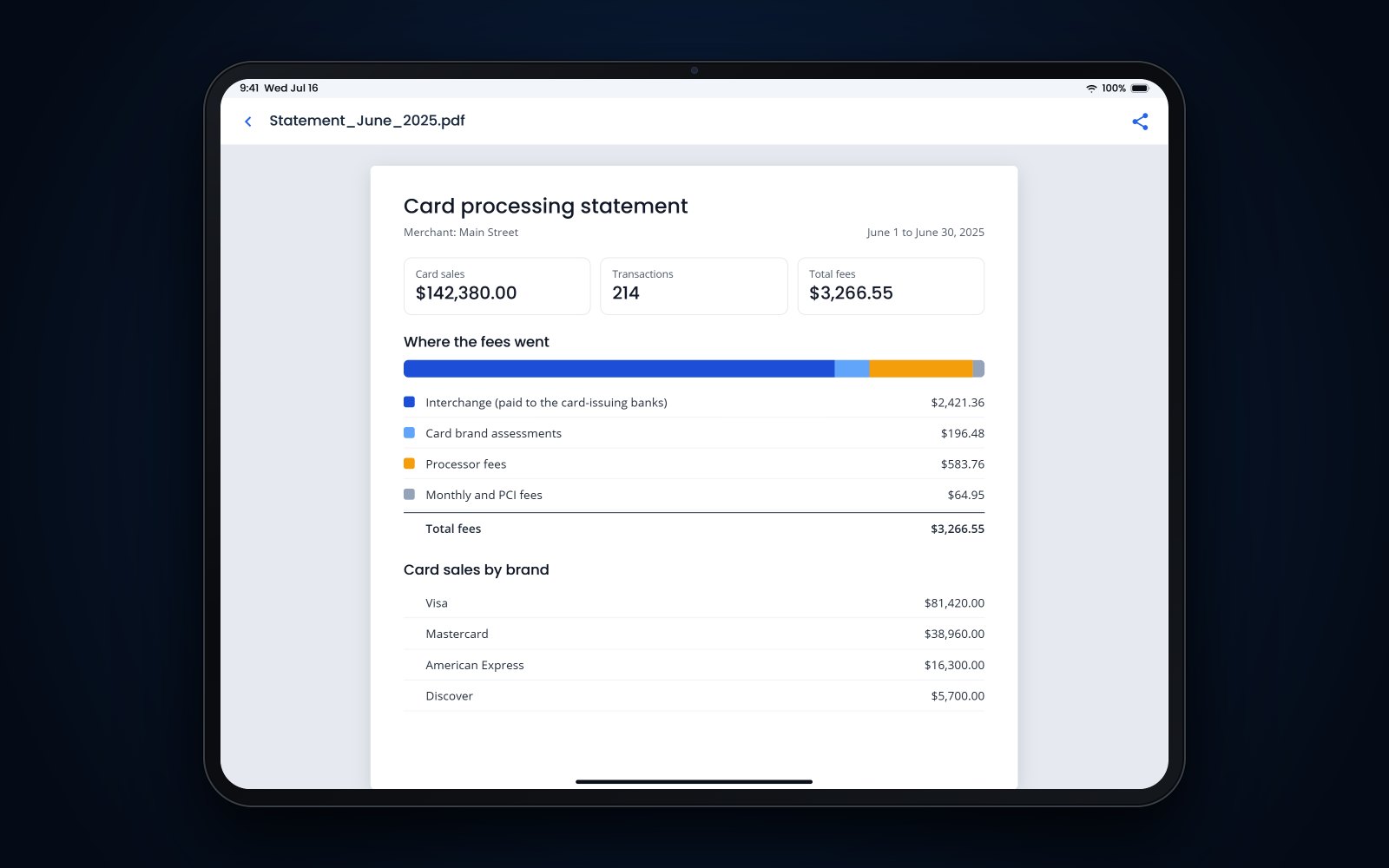
Short answer: Credit card processing for jewelry stores is made of 3 layers of fees: interchange paid to the bank that issued the card, network fees charged by the card brands, and your processor's markup. Interchange and network fees are the same whoever processes your cards, so what you can negotiate is the markup and the processor's own fees. Interchange plus pricing shows you exactly what that markup is, while a flat rate can hide a wide margin on debit cards and big tickets. Start by working out your effective rate from a recent statement.
In this article
- How to read a merchant statement
- Flat rate, tiered and interchange plus pricing
- Why credit card processing for jewelry stores is different
- Practical ways to lower card fees
- Contract traps to check before you sign
- What about surcharges and cash discounts?
- Card processing with Flawless POS
- Frequently asked questions
How to read a merchant statement
Pull last month's merchant statement and find 2 numbers: total card sales and total fees. Say you took $80,000 in card sales and paid $2,400 in fees. Your effective rate is 3%, which is $2,400 divided by $80,000. That one number lets you compare your current setup with any offer, and it belongs on the list of monthly numbers you track.
Then sort the fees into groups. Most statements have the same building blocks, even if every processor names them differently.
| Fee | Who sets it | Negotiable? |
|---|---|---|
| Interchange | Visa, Mastercard and the other networks; it goes to the bank that issued the card | No |
| Network fees, often called assessments | The card brands | No |
| Processor markup, as a percentage and a per-sale fee | Your processor | Yes |
| Monthly, statement and gateway fees | Your processor | Often |
| PCI fees, including non-compliance fees | Your processor | Often |
| Chargeback and retrieval fees | Your processor | Sometimes |
| Equipment rental or lease | Your processor or a leasing company | Before you sign |
Interchange is usually the largest piece. Visa and Mastercard both publish their US interchange tables, with different rates by card type (basic, rewards, premium and business cards) and by how the card was accepted. Visa points out that merchants don't pay interchange directly. You pay a merchant discount to your bank or processor, and interchange is folded into it.
Mastercard says each of its rates comes with requirements a sale must meet, including the merchant category, the time between authorization and clearing, and the data sent with the transaction. A sale that misses them falls into a costlier rate.
Flat rate, tiered and interchange plus pricing
Flat rate
One rate for every card, for example 2.9% on everything. It's easy to understand and easy to forecast. You pay the same rate on a debit card, where interchange is low, as on a premium rewards card, where it's high.
Tiered
The processor sorts each sale into buckets, usually called qualified, mid-qualified and non-qualified, each with its own rate. The processor decides which sale lands in which bucket, and the statement rarely says why. That makes tiered pricing hard to check and hard to compare.
Interchange plus
You pay the actual interchange and network fees, passed through at cost, plus a fixed markup written into your contract. The markup is usually a small percentage and a few cents per sale. Statements are longer, but you can see exactly what the processor earns, and your cost follows your real card mix.
| Model | What works | What to watch |
|---|---|---|
| Flat rate | Simple and predictable | You overpay on debit and basic cards |
| Tiered | Looks simple on the proposal | Buckets you can't check, and sales pushed into higher tiers |
| Interchange plus | Transparent, and cost follows your card mix | Longer statements, and the markup still needs negotiating |
Why credit card processing for jewelry stores is different
A coffee shop's fees are driven by per-sale cents. Yours are driven by percentages. On a $5,000 engagement ring, 10 cents doesn't matter, and half a percentage point is $25.
Debit cards show how wide the gap can be. For debit cards issued by banks with $10 billion or more in assets, the Federal Reserve's Regulation II caps interchange at 21 cents plus 0.05% of the sale, plus up to 1 cent for fraud prevention. On that $5,000 ring, interchange on a regulated debit card is at most $2.72. On a flat rate of 2.9%, used here as an example, the same sale costs you $145, and most of the difference stays with the processor.
Premium rewards cards work the other way. Their interchange is much higher, so a flat rate leaves the processor less on those sales. For a jeweler, 2 things matter more than they do for most retailers: the markup you pay above interchange, and how your card volume splits between debit, basic credit and premium credit. A statement priced at interchange plus shows both.
To see your card mix, look at the interchange detail on an interchange plus statement, or ask your processor for a report by card type. If most of your volume is debit and basic credit, a flat rate is probably costing you more than it looks.
How to compare 2 offers
Take one recent statement and price it both ways. Interchange and network fees stay the same under any processor, so only the markup and the fixed fees change. Here is an example with made-up numbers: $80,000 in card sales across 160 sales, with $1,700 in interchange and network fees. A flat rate of 2.9% costs $2,320. An interchange plus offer with a markup of 0.30% plus 10 cents per sale costs $1,700 plus $240 plus $16, or $1,956. Add each offer's monthly fees before you compare.
Practical ways to lower card fees
- Dip or tap every card in the storeKeyed card numbers cost more and carry more fraud risk. Keep the terminal where the customer can reach it, and train staff not to key in-store sales.
- Collect address and security code on phone ordersTake the billing ZIP code and street number for address verification, plus the card's security code. It cuts fraud, and the card brands tie rates to the data you send. On a big phone order, call the customer back at a number you already have on file.
- Settle your batch every dayMastercard lists the time between authorization and clearing among its rate requirements. Close and settle each night so sales don't age into a costlier rate.
- Send invoice details on business cardsIf retail accounts pay your wholesale invoices with business cards, ask whether your system sends the extra invoice data, often called Level 2 and Level 3, that can qualify for lower commercial rates.
- Finish your PCI questionnaireIf your statement shows a PCI non-compliance fee, completing your annual PCI self-assessment usually ends it.
- Keep paperwork that wins chargebacksFor big sales, keep the receipt, the item description, any signed policy, and the shipping or pickup confirmation. One lost chargeback on a $5,000 ring is a $5,000 problem.
- Recheck your effective rate every yearFees can change during a contract. Compare this year's effective rate with last year's, using statements from the same month.
Contract traps to check before you sign
- Early termination fees. Some contracts charge a set fee if you leave early, or damages based on your expected fees for the rest of the term. In 2022 the FTC sued a processor whose sales reps told merchants they could cancel any time, while the contract had a 3-year term and a $495 cancellation fee. The company agreed to pay $4.9 million.
- Automatic renewal. Find the renewal clause and the window to cancel, and put that date on your calendar.
- Equipment leases. A terminal lease can be a separate contract with a leasing company that runs for years, even after you stop processing. Compare the total lease cost with buying the device.
- Fee increases. Check whether the processor can raise the markup or add fees during the term, and how much notice you get. The same FTC case cited savings promises that left out the processor's regular price increases.
- Minimums and annual fees. Monthly minimums, annual fees and vague service fees add up in a slow month.
Questions to ask any processor
- Is this interchange plus, and what exactly is the markup?
- What are all the monthly, annual and PCI fees?
- Is there an early termination fee, and how is it calculated?
- Does the contract renew automatically, and how do I cancel?
- Is the terminal bought, rented or leased, and from whom?
- How fast do deposits arrive, and what does a chargeback cost?
- Can I see a sample statement?
Before any fee review, gather your last 3 statements, your current contract, any equipment lease, and a rough split of your in-store, phone and online card sales. With those in hand, a processor can price your real business instead of a guess.
These belong on your list next to the questions to ask in a POS demo, since processing is part of what you're buying.
What about surcharges and cash discounts?
Some stores add a surcharge to credit card sales or post a lower cash price. Both are possible in many places, with conditions. Visa and Mastercard allow surcharges on credit cards only, never on debit or prepaid cards, and they require caps, advance notice to your processor, signs and receipt disclosures. Several states ban or limit surcharges. Talk to your processor and check your state's rules before you try either one.
Card processing with Flawless POS
Flawless POS offers card processing built into the point of sale, alongside the inventory, repairs, customer records and reports jewelers already run in Flawless. The payment processing page has the details.
If you'd like a second opinion on what you pay today, bring a recent statement and the Flawless team will walk through it with you. To set that up, book a demo.
Frequently asked questions
What is a good effective rate for a jewelry store?
There's no single right number, because it depends on your card mix, your average ticket and how you take cards. Work out your own effective rate each month (total fees divided by total card sales) and watch the trend. To compare offers, run your last 3 statements through each proposal.
Is interchange plus always cheaper than flat rate?
Not always. Interchange plus is more transparent, so you can see what you pay. Whether it costs less depends on the markup and your card mix, so compare the total cost using your own statements.
Why do some card sales cost more than others?
Interchange depends on the card (basic, rewards, premium or business), how it was taken (dipped, tapped, keyed or online) and whether the sale met the card brand's requirements, such as settling on time. Premium cards and keyed sales generally cost more than basic cards that are dipped or tapped.
Can I get out of my current processing contract?
Read the termination section for the early termination fee, how it's calculated and the notice period. Check any separate equipment lease too. If a new processor offers to cover your exit fee, get that in writing.
Sources
- Visa - Credit card processing fees and interchange rates (opens in a new tab)
- Visa - Visa USA Interchange Reimbursement Fees (opens in a new tab)
- Mastercard - Interchange rates and fees for merchants (opens in a new tab)
- 12 CFR 235.3 - Regulation II debit interchange fee standard (Cornell LII) (opens in a new tab)
- 12 CFR 235.4 - Regulation II fraud-prevention adjustment (Cornell LII) (opens in a new tab)
- 12 CFR 235.5 - Regulation II small issuer exemption (Cornell LII) (opens in a new tab)
- FTC - Action against a payment processor over exit fees and hidden charges (July 29, 2022) (opens in a new tab)
- Visa - U.S. Merchant Surcharge Q and A (opens in a new tab)
- Mastercard - Merchant surcharge rules (opens in a new tab)