
Short answer: Wholesale jewelry software should carry a piece from proposal to payment without retyping, through outgoing memos, memo returns, memo-to-invoice conversion, sales orders with allocation, statements, credits and RMAs. It should apply the right price tier for each account and give retailers a portal where they see their own memos and invoices. Most of all, it should tell you at any moment where every piece is and who owes what.
In this article
- The jewelry wholesale workflow, step by step
- Proposals, line sheets and outgoing memos
- Memo returns and turning memos into invoices
- Sales orders and allocation
- Statements, payments, credits and RMAs
- Price tiers and a client portal
- What to look for in wholesale jewelry software
- How Flawless POS handles wholesale
- Frequently asked questions
The jewelry wholesale workflow, step by step
Say a retailer in Denver calls on a Monday. A customer wants to see sapphire rings, and the store wants 3 choices by Thursday. You send a proposal, the store picks 2, and you ship them on memo. One sells and one comes back. That's a proposal, a memo, a memo return, an invoice and a payment for one phone call, and each document has to agree with the others.
Most wholesale work follows the same path:
- Proposal or line sheet
- Memo sent to the retailer
- Memo return, piece by piece
- Memo to invoice when a piece sells or the retailer keeps it
- Sales orders and allocation for reorders and production
- Statements, payments and credits
- RMAs and returns
Software earns its keep at the handoffs, when a proposal line becomes a memo line, a memo line becomes an invoice, and an invoice becomes a payment. Every time someone retypes a piece, there's a chance of a wrong price, a wrong stone weight or a piece billed twice.
Proposals, line sheets and outgoing memos
A proposal lists specific pieces for one account, with photos, descriptions and that account's price. A line sheet does the same for a whole collection. Good software builds either one from inventory in a few clicks, applies the account's price tier and turns accepted lines into a memo or an order without retyping.
Descriptions on proposals and line sheets are marketing. The FTC's Jewelry Guides apply at every level of the trade, including promotional materials, so describe metal, stones and treatments as carefully as on a retail tag. For example, the Guides give laboratory-grown and laboratory-created as ways to make clear that a stone was not mined.
Sending goods on memo
A memo records which pieces went to which account, at what price, and when they're due back. Before you ship, get the account's signature on a memo agreement. The Jewelers Board of Trade also recommends filing a UCC-1 financing statement and notifying any lender with a lien on the retailer's inventory, so your goods stay yours if the retailer fails. Our post on memo vs consignment covers how memo goods look from the retailer's side.
Set memo terms for each account before the first shipment: how many days a memo runs, how much value can be out at once, and who pays shipping and insurance each way. A memo limit works like a credit limit, and your software should warn you before a new memo goes over it.
If the goods include diamonds, the World Diamond Council's System of Warranties statement belongs on your invoices and memos each time diamonds change hands, loose or set in jewelry. The council asks companies that use it to complete an online self-assessment every year.
Memo returns and turning memos into invoices
When goods come back, check each piece against the memo by item number. Look at it under a loupe before you accept it, and photograph anything that came back damaged or with a loose stone. Then close those lines on the memo so the account's balance is right that same day.
When the retailer sells or keeps a piece, the memo line becomes an invoice. The software should carry the price and terms over, close the line on the memo and leave a trail, so the same piece can't be billed twice or sit on memo after it's sold.
Watch aged memos. A weekly list of memos past due, by account, with the value still out, tells you who to call before goods go missing or a sale goes unreported.
Tip: Agree with each account how and when they report a sale on memo, for example within 7 days of the sale, and put it in the memo terms.
Sales orders and allocation
Not every sale starts on memo. Reorders, production pieces and trade show orders come in as sales orders. Allocation decides which order gets which piece when stock is short, whether that's first come first served, your best accounts first, or a fair share for each.
For example, say 12 pieces of a new pendant arrive and 3 accounts have ordered 20 between them. Whatever rule you use, write it down and apply it the same way every time, so no account feels shorted.
Your software should show what's on order, what's allocated, what you still need to make or buy, and what ships when. When a new shipment arrives, filling backorders in the order you choose should take minutes.
Statements, payments, credits and RMAs
- Statements. Each account should get a clear statement of open invoices, payments, credits and what's still out on memo.
- Aging. An aging report (current, 30, 60 and 90 days and older) shows who's slow before it becomes a problem.
- Payments. Record checks, wires and card payments against specific invoices, and apply partial payments without losing track. If accounts pay by business card, ask whether invoice details are sent with the payment, a point covered in our guide to card processing fees.
- Credits and RMAs. A return merchandise authorization (RMA) gives a returned piece a number before it ships back, with the reason and its condition. When it arrives and passes inspection, the credit goes on the account.
- Resale certificates. Keep each account's resale or exemption certificate on file and current. The multistate sales tax exemption certificate known as Form F0003, for example, tells sellers to keep proper records of exempt sales. Rules vary by state, so check with your accountant.
Price tiers and a client portal
Different accounts pay different prices. Software should apply the right tier automatically, whether that's wholesale, VIP or a special rate for one account, and show it on proposals, memos and invoices without anyone looking it up.
Keep tiers few and clear. When a one-off deal for one account turns into a lasting discount, it should be a decision you made on purpose, and the account record should show when it started.
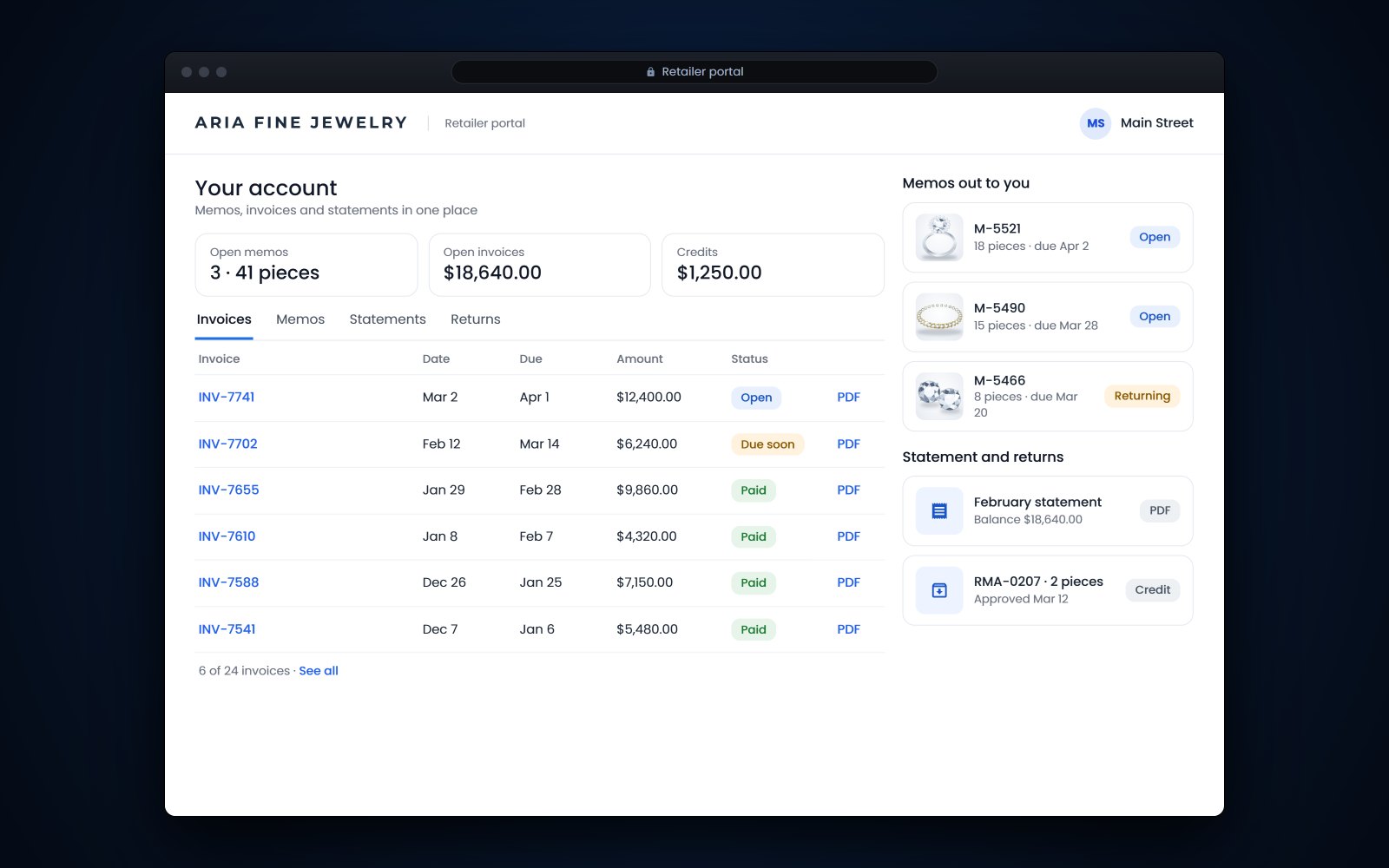
A client portal lets each retailer log in and see their own open memos, invoices and statements. Fewer calls asking what's still out on memo, and disagreements surface early, while they're easy to sort out.
What to look for in wholesale jewelry software
- Every piece tracked by item number from proposal to payment
- Memos that turn into invoices without retyping
- Memo returns checked line by line, with an aged-memo report
- Sales orders with allocation and backorders
- Statements, aging, payments and credits by account
- RMAs with a reason, a condition and a credit
- Price tiers for each account
- A client portal for memos and invoices
- Jewelry details, certificates and photos on every item
- Retail and wholesale in one system, if you sell both
- A sync with the accounting software your bookkeeper uses
In a demo, bring one real memo, one invoice and one statement from last month, and ask the vendor to rebuild them in front of you.
How Flawless POS handles wholesale
Flawless POS runs wholesale and retail in one system. Wholesale covers proposals, invoices and memos; sales orders and allocation; payments, credits and statements; RMAs and returns; and wholesale and VIP price tiers. Retailers get a client portal where they can see their memos and invoices.
Every item carries its jewelry details, such as shape, clarity, certification and carat weight, so a one-of-a-kind estate piece keeps its full description from the proposal through to the invoice.
It has truly changed our business and has allowed us to process a lot of one of a kind, unique sku's with less work than other platforms.
Read more customer stories, or book a demo and bring a real memo and last month's statement.
See also: Wholesale jewelry software.
Frequently asked questions
Can one system run both wholesale and retail?
Yes, and it helps if you do both. One inventory, one set of item records and one customer list mean each sale gets the right price tier without double entry. Ask any vendor to show a piece moving from wholesale stock to a memo and then to a retail sale.
What is the difference between a memo and an invoice?
A memo sends goods to a retailer while you keep ownership, and the retailer pays only if it sells or keeps them. An invoice is a sale, so ownership passes and payment is due on your terms. When a memo piece sells, the memo line becomes an invoice.
Should we file a UCC-1 for goods on memo?
The Jewelers Board of Trade recommends it, along with a signed memo agreement and notice to any lender that already has a lien on the retailer's inventory. It also says to renew the filing every 5 years. Talk to your attorney about where to file.
How long should a memo run?
Set it by account and by purpose. A memo sent so a store can show one customer might run a few days, while stock for a case might stay out for a season. Whatever you choose, put the due date on every memo and follow up the week it passes.
What should a wholesaler check every week?
Memos past due by account, open invoices by age, sales orders waiting on stock, and RMAs waiting for inspection. A short weekly review catches problems while they're small.
Sources
- Jewelers Board of Trade - Guide to memo transactions (December 22, 2023) (opens in a new tab)
- World Diamond Council - System of Warranties: how to implement it (January 2024) (opens in a new tab)
- 16 CFR 23.0 - FTC Jewelry Guides, scope and application (Cornell LII) (opens in a new tab)
- 16 CFR 23.12 - FTC Jewelry Guides, lab-created stones (Cornell LII) (opens in a new tab)
- Wisconsin Department of Revenue - Multistate sales tax exemption certificate, Form F0003 (opens in a new tab)