
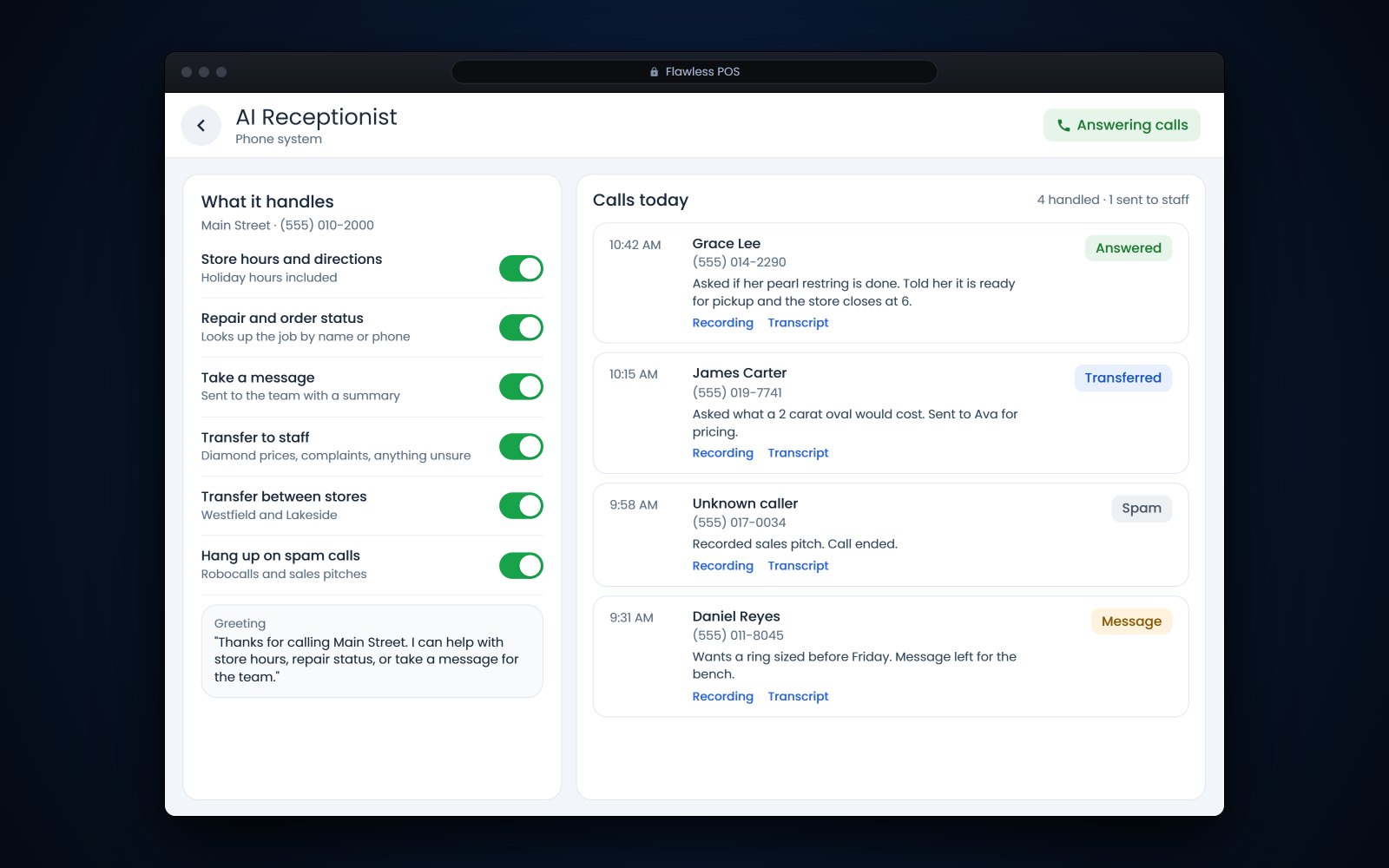
Short answer: An AI receptionist for jewelry stores should answer the routine calls: hours, directions, whether you buy gold, and the status of a repair or order once it has confirmed who is calling. It should hand anything that needs judgment to a person, including diamond and custom pricing, complaints, appraisal values and upset callers. Tell callers they are speaking with an automated assistant, get consent for recording and transcription, and read the transcripts every week.
In this article
The calls a jewelry store gets
For example, it is Saturday afternoon. A couple is at the bridal case, someone is waiting to pick up a watch, and the phone rings for the fourth time in 10 minutes. One caller wants your hours, one asks if a sizing is ready, one wants to know if you buy gold, and one is a robocall. Each call pulls someone away from a customer who is standing right there.
| Call | What the caller says | Who should handle it |
|---|---|---|
| Hours and directions | "Are you open until 6 today?" | The AI receptionist |
| Repair status | "Is my ring sizing ready?" | The AI receptionist, after it confirms who is calling |
| Order status | "Did my special order come in?" | The AI receptionist, after it confirms who is calling |
| Buying gold | "Do you buy gold, and what do I need to bring?" | The AI for the policy, a person for any offer |
| Appointments | "Can I come in Saturday to look at engagement rings?" | The AI takes the details, staff confirm |
| Prices | "How much is a 1-carat round diamond?" | A person |
| Problems | "The stone fell out of the ring you sold me" | A person, right away |
| Spam and robocalls | Recorded offers and fake warranty calls | Screened out |
Before you decide anything, count your own calls for a week. A simple tally by type shows how many calls a receptionist could answer, how many it would pass along, and how many calls your store misses when everyone is busy with customers.
What an AI receptionist for jewelry stores should answer
The best jobs for an AI receptionist are questions with one right answer that you can write down ahead of time.
- Hours, directions and parking, including the hours for the next few days, so callers hear the right answer the week you close early.
- Repair and order status, read from the job itself in your repair tracking, never from memory: "Your sizing is ready for pickup" or "It is with our setter and due back Thursday." It should confirm the caller is the customer first, for example by the phone number on file or a ticket number.
- Policy questions. Do you buy gold, do you size rings bought somewhere else, can you change a watch battery while I wait, do you engrave. These are yes-or-no answers with a sentence of detail.
- What to bring. If your state or your own policy requires a photo ID to sell gold, the receptionist can say so. Our post on gold prices and protecting margins covers the counter side of buying gold.
- Taking a message with the caller's name, number and reason, so the right person can call back.
- Screening spam. Robocalls and fake offers should never reach the counter.
What it must hand to a person
Anything that needs judgment, a price that depends on the piece, or a bit of empathy belongs with your staff.
- Diamond and custom pricing. A price on the phone sounds like a promise. Let a salesperson ask the questions that set the price: shape, size, quality, budget and timing.
- Complaints and problems. A lost stone, a late repair or a billing question goes to a manager quickly, with the caller's details already written down.
- Appraisal values and insurance questions. These depend on the piece and the paperwork.
- Changes to an order or a payment. Never let an automated system take card numbers or change who may pick up a piece.
- Security questions. Anything about when the safe is open, who works late or how many people are in the store gets a polite non-answer and a note to the manager.
- A caller who asks for a person. Let them reach one, or leave a message that someone returns the same day.
Make the handoff warm. The receptionist should say what happens next, such as "I'm transferring you to Maria in bridal" or "Someone will call you back within 2 hours." The staff member should get the summary before picking up, so the customer does not have to repeat the story.
Privacy, consent and honesty on the phone
Callers deserve to know who they are talking to and what happens to the call. This is not legal advice; check your state's rules.
- Say it is automated. Start with a line such as "You've reached (store name). I'm the store's automated assistant, and I can help with hours, directions and repair status." It sets the right expectation from the first sentence.
- Get consent for recording and transcription. Call recording and transcription require appropriate consent. Federal law allows recording with one party's consent (18 U.S.C. 2511(2)(d) (opens in a new tab)), but some states, such as Florida (Fla. Stat. 934.03 (opens in a new tab)) and Washington (RCW 9.73.030 (opens in a new tab)), require everyone's consent. Announce it at the start of every call.
- Keep outbound calls separate. The FCC has ruled that AI-generated voices count as artificial voices under the Telephone Consumer Protection Act, so calls placed to customers with an AI voice need their prior express consent (FCC 24-17 (opens in a new tab)). An assistant that answers your incoming calls is a different job from one that dials out.
- Limit what it says about a customer. Status updates should go only to the person on the record. If the caller cannot be confirmed, the receptionist should not share the price, the balance or even what the piece is, since it may be a gift.
How to set up an AI receptionist
- Write the fact sheetHours for the coming weeks, address, parking, the services you offer and do not offer, what you buy, your usual repair turnaround times and your policies. Short, plain sentences work best.
- Write the handoff listEvery topic that goes to a person, who it goes to, and what happens after hours.
- Set the greetingName the store, say it is an automated assistant, give the recording notice, and offer a way to reach a person.
- Test it yourselfHave 3 people call with real questions, including awkward ones: a price request, an angry caller, a question about the safe. Fix every wrong or vague answer.
- Go live and read transcriptsFor the first 2 weeks, read every transcript. After that, read a sample each week and update the fact sheet whenever something changes.
Tip: When your hours change, update the receptionist the same day you change the sign on the door.
How to check that it is helping
Measure your own store, before and after. You do not need anyone else's benchmark.
| Measure | Where to find it | What you want to see |
|---|---|---|
| Missed calls during open hours | Your phone system's call log | Fewer each month |
| Calls handled without staff | Call log and call summaries | Routine questions answered correctly |
| Handoffs that reached a person | Transfers and callback notes | Every handoff returned the same day |
| Wrong or vague answers | A sample of transcripts | Fixed in the fact sheet within a week |
| Repeat calls about the same repair | Customer record and call log | Fewer, because the status is clear |
| Complaints about the phone | Staff notes and online reviews | None, or one you can fix |
Go over the scorecard with the staff who answer the phone. They will tell you quickly which answers callers trust and which ones send them straight back to the counter.
How the Flawless POS AI receptionist works
Flawless POS includes an AI receptionist that answers your store's calls and can tell a caller the status of their repair, so the routine "is it ready yet?" calls do not pull someone away from the counter.
Each call's summary and transcript show next to the call and on the customer's record, so the salesperson who calls back can read what was asked before dialing. Call recording and transcription require appropriate consent.
The AI features are practical rather than gimmicky.
The receptionist works alongside the store phone system your team uses for calls and texts, covered in our post on a phone system for jewelry stores. To hear it answer a call, book a demo.
See also: AI phone receptionist for jewelry stores.
Frequently asked questions
Will customers know they are talking to an AI?
They should. Have the greeting say it is the store's automated assistant and offer a way to reach a person. That way nobody feels tricked, and nobody is surprised when it passes them to a person.
Can an AI receptionist quote diamond prices?
It should not. Diamond and custom prices depend on details a salesperson needs to ask about, and a number given on the phone sounds like a promise. Have it take the caller's details and pass them to a salesperson who calls back.
Is it legal to record and transcribe calls with an AI receptionist?
It can be, with the right consent. Federal law allows recording with one party's consent, but some states, including Florida and Washington, require consent from everyone on the call. Announce recording and transcription at the start of every call. This is not legal advice; check your state's rules.
Does an AI receptionist replace staff?
No. It takes routine questions off the counter so staff can stay with the customers in front of them, and it hands everything that needs judgment to a person. You still need someone to return messages and pick up handoffs quickly.
What should it say when it cannot answer a question?
It should say so and offer a person or a callback, and it should never guess. Add the question to your fact sheet afterward so the next caller gets a real answer.
Sources
- FCC - Declaratory Ruling FCC 24-17 on AI-generated voices under the TCPA (released February 8, 2024) (opens in a new tab)
- 18 U.S.C. 2511 - Interception of communications (one-party consent) (opens in a new tab)
- Florida Statutes 934.03 - Interception of communications (all-party consent) (opens in a new tab)
- Washington RCW 9.73.030 - Recording private communications (consent of all participants) (opens in a new tab)