
Short answer: Scrap gold buying at a jewelry store comes down to one formula: the weight of the metal times its purity times the spot price of pure gold, then your payout percentage. Weigh in grams or pennyweight on a scale your state's weights and measures office has inspected, test the karat instead of trusting the stamp, and show the customer the math. Check your state's ID, reporting and hold rules before you buy anything.
In this article
- How much gold is in 10k, 14k, 18k and 22k?
- Weighing scrap in grams and pennyweight
- How to price scrap gold from the spot price
- Testing gold before you pay
- Writing a jewelry trade-in policy for credit and cash
- State rules for scrap gold buying at a jewelry store
- How to explain an offer to the customer
- How Flawless POS handles trade-ins and scrap buys
- Frequently asked questions
How much gold is in 10k, 14k, 18k and 22k?
Karat is parts of pure gold out of 24. A 14k chain is 14 parts gold and 10 parts other metals, which is 58.3% gold. NIST's conversion sheet for precious metal sales uses the same scale: an item marked 24k is 99.9% gold, 18k is 75% and 12k is 50% (NIST (opens in a new tab)).
| Metal | Common marks | Pure metal | Factor |
|---|---|---|---|
| 10k gold | 10K, 417 | 41.7% | 0.417 |
| 14k gold | 14K, 585 | 58.3% (a 585 mark means 58.5%) | 0.583 or 0.585 |
| 18k gold | 18K, 750 | 75.0% | 0.750 |
| 22k gold | 22K, 916 | 91.7% | 0.917 |
| 24k gold | 24K, 999 | 99.9% | 0.999 |
| Sterling silver | 925, Sterling, Ster. | At least 92.5% | 0.925 |
| Coin silver | 900, Coin | At least 90.0% | 0.900 |
| Platinum | 950Pt, Plat. | At least 95.0% | 0.950 |
The FTC's Jewelry Guides set those minimums: "sterling" means at least 925 parts per thousand silver (16 CFR 23.5 (opens in a new tab)) and plain "platinum" at least 950 (16 CFR 23.6 (opens in a new tab)). For gold, the karat mark must be correct within small tolerances (16 CFR 23.3 (opens in a new tab)).
Tip: Pick one factor for 14k, 0.583 or 0.585, and use it on every ticket. If 2 salespeople use different factors, 2 identical buys come out at different prices.
Weighing scrap in grams and pennyweight
Spot gold is quoted per troy ounce of pure gold, and your scale probably reads grams or pennyweight (dwt). NIST's conversion factors:
- 1 troy ounce is 31.1035 grams, or 20 pennyweight
- 1 pennyweight is 1.5552 grams
- 1 gram is 0.6430 pennyweight
Weigh the way an honest buyer is expected to. Alaska's weights and measures division tells people selling gold to make sure they can see the scale reading, that the scale reads zero with any tray or paper on it, that it sits level and out of drafts, and that it carries a state approval sticker (Alaska Division of Measurement Standards (opens in a new tab)).
If you price in grams, check your state's method-of-sale rule. NIST's model regulation, which states can adopt, calls for a posted conversion chart to troy units when you sell by metric weight.
Weigh the metal and leave the stones out. If a piece has stones you are not buying, remove them with the customer's permission or price the piece as jewelry. The Alaska guide calls deducting an estimated stone weight for scrap pricing not a legitimate practice.
How to price scrap gold from the spot price
The math has 4 steps:
- Divide the spot price per troy ounce by 31.1035 to get the price of a gram of pure gold.
- Multiply by the purity factor for the karat.
- Multiply by the weight in grams. That is the melt value.
- Multiply the melt value by your payout percentage. That is your offer.
A worked example
For example, a customer brings in a broken 14k chain and a single 14k earring. Together they weigh 14.0 grams, and both test 14k. Spot gold is $4,500 a troy ounce when you quote. (That is an example figure. Always use the live price.)
| Step | Math | Result |
|---|---|---|
| Pure gold per gram | $4,500 divided by 31.1035 | $144.68 |
| 14k gold per gram | $144.68 times 0.583 | $84.35 |
| Melt value | $84.35 times 14.0 grams | $1,180.90 |
| Offer at an example 75% payout | $1,180.90 times 0.75 | $885.68 |
In pennyweight, the same lot is 9.00 dwt at $131.18 a pennyweight for 14k, which lands within a dollar of the gram math. The gap is rounding, so pick one unit and stick with it.
Why payout percentages vary
There is no standard payout. What you can afford to pay depends on:
- Your refiner's terms. What it pays on the recovered gold, its fees and any minimum lot charge.
- Price risk while you hold the metal. If your state requires a hold before you melt or sell, spot can move against you before you are paid.
- Testing risk. A plated or under-karat piece that gets past you costs the difference.
- What happens to the piece next. A piece you can resell as jewelry may be worth more to you than its melt value.
- Store credit. A buy that turns into a sale is worth more to the store, which is one reason to pay more in credit than in cash.
Write your cash and store credit percentages down so every salesperson uses the same ones, and review them more often when gold moves fast. Our post on protecting margins when gold moves covers repricing your own stock.
Testing gold before you pay
Treat a stamp as a starting point. Under-karat pieces, plated pieces and fake stamps all show up at the counter, so test every piece you buy. The common methods:
| Method | How it works | Watch for |
|---|---|---|
| Acid test | Rub the piece on a touchstone, or file a tiny spot, and apply acid made for each karat. | Leaves a small mark. A quick surface test can miss what is under thick plating. |
| Electronic tester | A probe measures how the metal responds and estimates the karat. | Plating can throw off the reading. |
| XRF analyzer | X-ray fluorescence reads the metal's composition without harming the piece. | It reads the surface, so gold plating over a lower-karat base can read high. |
GIA's lab has documented how plating can fool XRF. In one case, a pendant sold as solid 18k read 18k on its plated surface while the base metal was 10k, and GIA noted that XRF can identify such a piece as 14k or 18k "without detecting any of the plating" (GIA lab notes, Summer 2025 (opens in a new tab)). GIA's advice is to look under a microscope for color changes, worn plating and marks left by earlier tests. On GIA's pendant, wear had gone through the plating in places.
Writing a jewelry trade-in policy for credit and cash
A trade-in toward a new piece and a cash buy are different transactions, and some states treat them differently. Write one short policy that covers both:
- What you pay in store credit and in cash, as a percentage of melt value
- Whether credit must be used the same day or can be saved
- Minimum and maximum buys, and who approves a large one
- Whether you buy from walk-ins or only from known customers
- What you buy: scrap only, or also jewelry you will resell, coins and watches
- What ID you require and what you record
- How long you hold purchases before melting or reselling them
- Who can override a price, and how the reason is recorded
Bridal trade-ups are the common case. A client trades an old engagement ring toward a larger stone. Price the gold from melt value and the stone on its own, and show both lines on the receipt so the client sees what each part was worth. If the stone deserves a formal value, our guide to appraisal records covers what to write down.
State rules for scrap gold buying at a jewelry store
Rules for buying gold from the public come mostly from states and cities, and they vary. Here are 2 examples.
Florida
Florida's secondhand dealer law requires a transaction form completed at the time of purchase, with a description and photos of the goods, the seller's details, a right thumbprint and a government-issued photo ID, and the record goes to local law enforcement within 24 hours (Fla. Stat. 538.04 (opens in a new tab)). Precious metals, gemstones and jewelry must be held 30 calendar days before you sell or dispose of them (Fla. Stat. 538.06 (opens in a new tab)). The law does not apply to a person accepting a secondhand good as a trade-in for a similar item of greater value (Fla. Stat. 538.03 (opens in a new tab)).
Texas
Texas requires anyone in the business of buying and selling crafted precious metal to register with the Office of Consumer Credit Commissioner (OCCC (opens in a new tab)). Dealers must report crafted precious metal they purchase, take in trade or accept on consignment, record the seller's driver's license or ID number, and send a copy of the seller's list to the police chief or sheriff within 48 hours (Tex. Occ. Code 1956.062 (opens in a new tab)). The metal cannot be melted, altered or disposed of before the 11th day after the report is filed (Tex. Occ. Code 1956.064 (opens in a new tab)).
So Florida exempts a trade-in toward a similar item of greater value, while Texas counts trade-ins. Your city or county may add rules of its own.
Federal anti-money laundering rules
Retail jewelers are generally outside FinCEN's rule for dealers in precious metals unless, in the prior year, they bought more than $50,000 in covered goods from people other than dealers or other retailers, such as members of the public (31 CFR 1027.100 (opens in a new tab)). A store over that line needs a written anti-money laundering program, which only has to address those purchases (31 CFR 1027.210 (opens in a new tab)). A busy gold-buying counter can pass $50,000 in a year.
This is not legal advice. Check your state's secondhand or precious metal dealer law, your city's rules and the federal rule before you start buying, and look again each year.
How to explain an offer to the customer
A customer who looked up the spot price on the way in may expect to be paid that number. Walk them through the difference at the counter:
- Weigh and test in front of them, on a scale they can read, and write down the results.
- Show the spot price you are using and when you pulled it.
- Show the math: weight, purity, melt value, then your percentage for cash and for store credit.
- Put the offer in writing with the date and time, and say how long it stands.
A short script helps. Using the example numbers above: "Your pieces weigh 14 grams and test 14k, which is 58.3% gold. At this morning's spot price, the gold in them is worth about $1,180. We pay 75% of that in cash, or more if you put it toward something in the store." If the customer wants to shop around, hand them the written offer.
How Flawless POS handles trade-ins and scrap buys
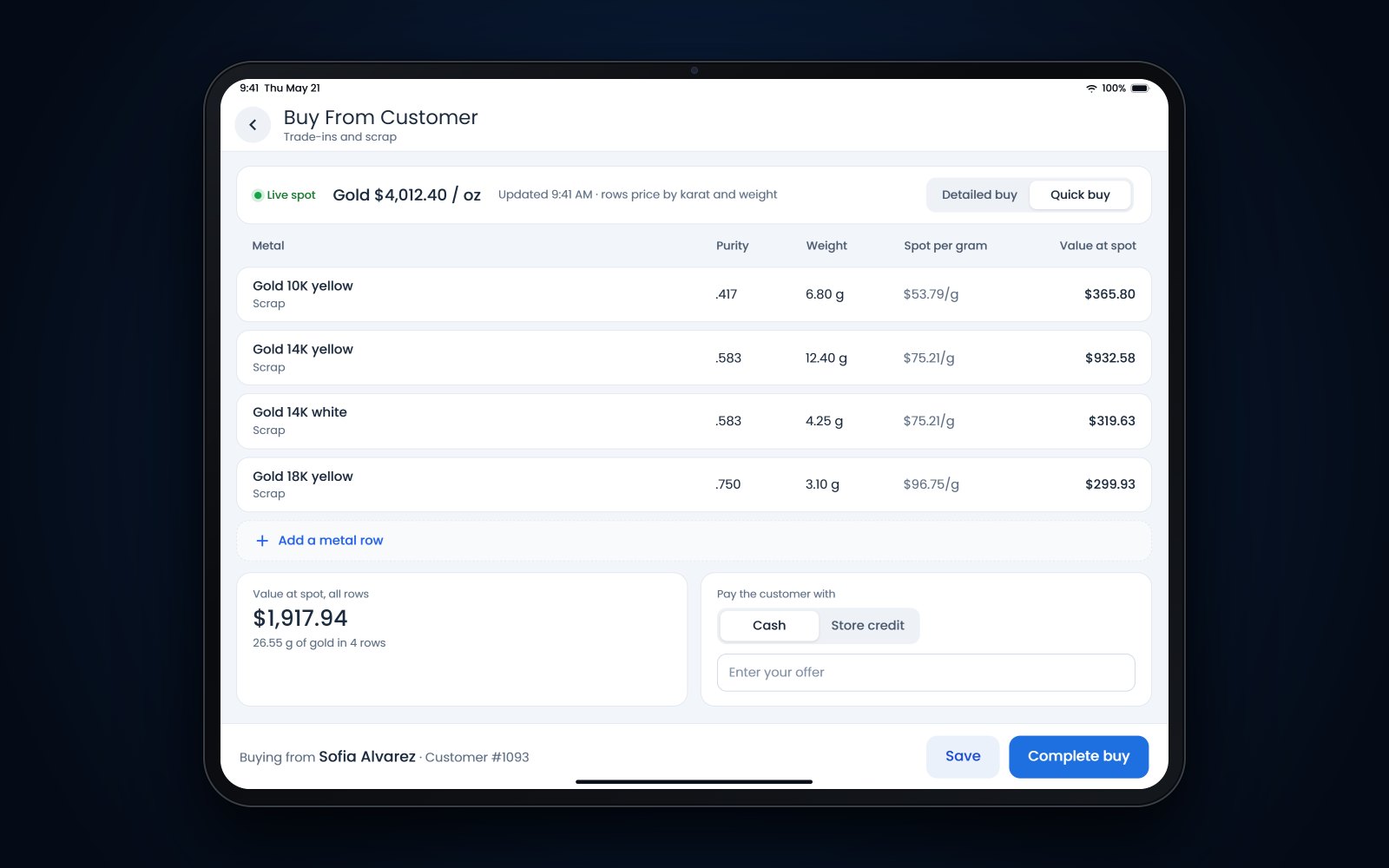
Trade-ins and buybacks are part of the sale in Flawless POS. Since May 14, 2026, a trade-in starts with a choice between a detailed buy and a quick buy, so trading in a single piece and buying a bag of mixed scrap do not have to go through the same steps.
On a detailed buy, each metal row prices from the live spot price by karat and weight. The counter works from the current market price instead of a number someone looked up earlier in the day.
To see a detailed buy on your own sale screen, book a demo.
Frequently asked questions
Is 14k gold 58.3% or 58.5% gold?
Fourteen parts out of 24 is 58.3%. Many pieces are marked 585, meaning 585 parts per thousand, or 58.5%. Pick one factor and use it on every ticket so your offers stay consistent.
Do I need a special scale to buy gold?
Use a scale approved for commercial use and inspected by your state or local weights and measures office, and let the customer see the reading. Ask that office which accuracy class it expects for weighing precious metals.
How long do I have to hold gold before I melt it?
It depends on the state. Florida requires 30 calendar days for precious metals and jewelry, and Texas requires a hold until the 11th day after the report is filed. Check your state and city rules; this is not legal advice.
Sources
- NIST Office of Weights and Measures - Conversion Factors for Precious Metal Sales (opens in a new tab)
- 16 CFR 23.3 - Misrepresentation as to gold content (FTC Jewelry Guides, Cornell LII) (opens in a new tab)
- 16 CFR 23.5 - Misrepresentation as to silver content (FTC Jewelry Guides, Cornell LII) (opens in a new tab)
- 16 CFR 23.6 - Misuse of the word platinum and related terms (FTC Jewelry Guides, Cornell LII) (opens in a new tab)
- GIA - Lab Notes, Summer 2025: Gold-Plated Gold (opens in a new tab)
- Alaska Division of Measurement Standards - Selling Your Gold or Silver Jewelry (opens in a new tab)
- Florida Statutes 538.03 (2025) - Definitions and exemptions for secondhand dealers (opens in a new tab)
- Florida Statutes 538.04 (2025) - Recordkeeping and reporting (opens in a new tab)
- Florida Statutes 538.06 (2025) - Holding period (opens in a new tab)
- Texas Office of Consumer Credit Commissioner - Crafted Precious Metals Dealers (opens in a new tab)
- Texas Occupations Code 1956.062 - Report of purchase (opens in a new tab)
- Texas Occupations Code 1956.064 - Holding period (opens in a new tab)
- 31 CFR 1027.100 - Definitions for dealers in precious metals, precious stones or jewels (Cornell LII) (opens in a new tab)
- 31 CFR 1027.210 - Anti-money laundering programs for dealers (Cornell LII) (opens in a new tab)