
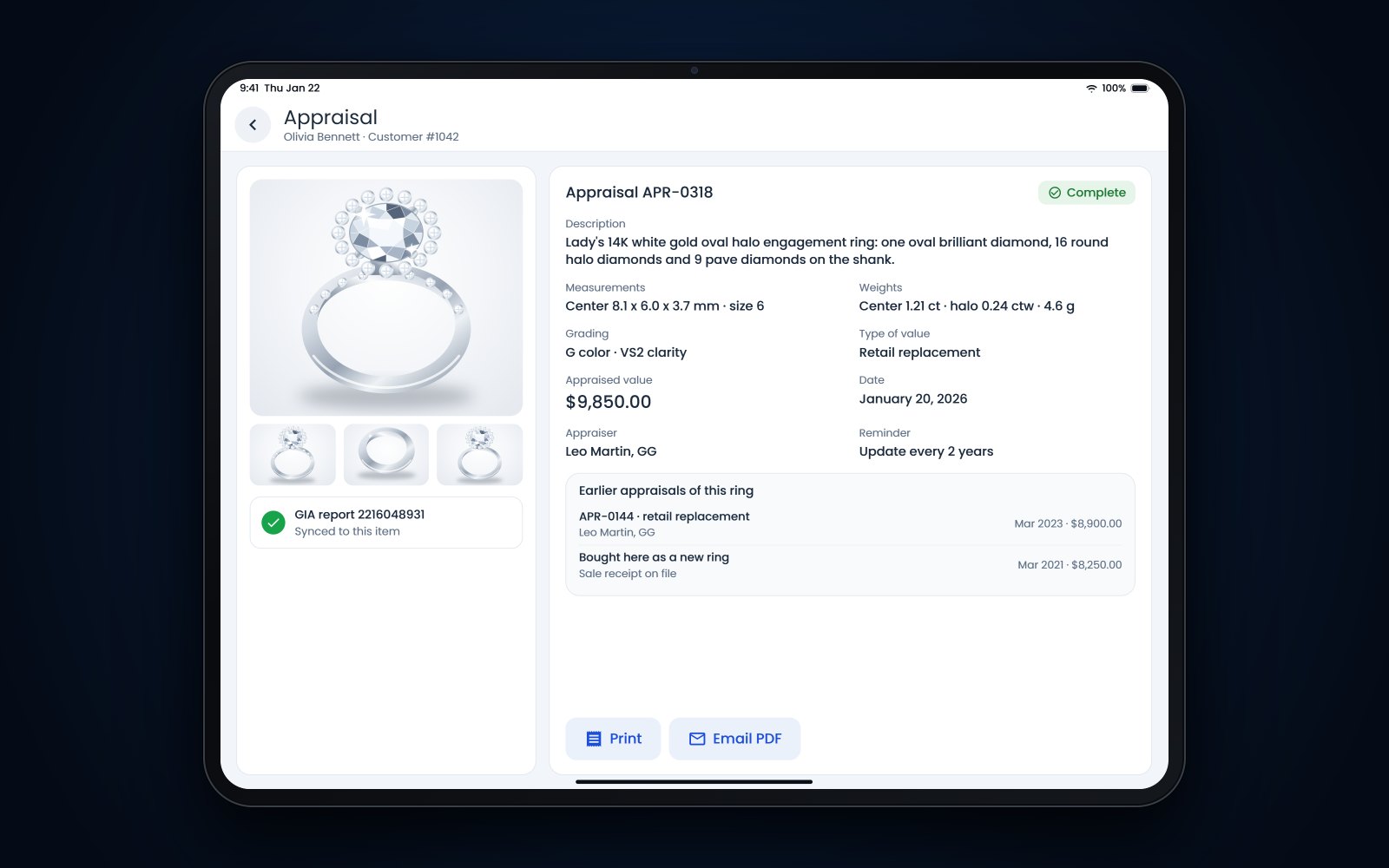
Short answer: Jewelry appraisal software should keep each appraisal tied to the customer and the piece, with the full description, measurements, weights, grading, photos, the type of value and its date, and the appraiser's signature. It should also keep the lab report with the record and help you remind customers when an update is due. Many appraisers recommend updating every 2 to 3 years, and some insurers ask for it more often.
In this article
- Why appraisal records matter years later
- What a jewelry appraisal should include
- Types of value: replacement, fair market and others
- Keep photos, copies and certificates with the record
- How often should insurance appraisals be updated?
- What to look for in jewelry appraisal software
- How Flawless POS handles appraisals
- Frequently asked questions
Why appraisal records matter years later
For example, a customer calls about a ring she bought from you 6 years ago. She lost it on a trip, and her insurer wants the appraisal. If your copy is a scan with no photos, the stone grading is vague and nobody can find the lab report, the claim gets harder for her and the call gets harder for you.
The file matters for updates too. When a customer brings a ring in for an update, a complete earlier record shows what has changed since: a worn prong, a new chip or a market that has moved. Gold passed $4,000 an ounce for the first time in October 2025 (Marketplace (opens in a new tab)), as we covered in our post on gold prices and store margins, so a gold piece appraised a few years ago may now be insured for less than it would cost to replace.
What a jewelry appraisal should include
There is no single required form. A consumer brochure from The Appraisal Foundation, hosted by the American Society of Appraisers, lists what a credible gem and jewelry appraisal report should contain, and GIA, insurers and the IRS add their own expectations. Put together, a solid record holds the following.
| Part of the record | What it contains |
|---|---|
| Client and purpose | Who owns the piece, who the report is for and what it will be used for, such as insurance or an estate |
| Type of value and its date | Retail replacement value, fair market value or another type, defined, with the effective date of the value |
| Inspection | The date and place the piece was examined |
| Description | Enough detail to identify the exact piece without a photo: item type, metal and how it was tested, marks, total weight, measurements and condition |
| Stones | Each stone's shape, measurements, actual or estimated weight, color, clarity, cut and any treatments |
| Lab reports | Report numbers and dates for any graded stones, with a copy on file |
| Photos | Clear color photos of the piece and its details |
| Method | How the value was reached and the market data behind it |
| Appraiser | Name, signature, certification statement, qualifications and any financial interest in the piece |
The Appraisal Foundation brochure also explains that mounted stones are measured and their weight calculated by formula, while loose stones are weighed on a scale. Say which it was on the record. A mounted center stone's weight is an estimate, and the next appraiser should know that.
Disclose your interest
If you appraise a piece your store sold, say so on the report. The brochure notes that an appraiser in a store selling jewelry may have a bias toward their own merchandise, and it lists a statement of any financial interest among the parts of a report. Being open about it protects your credibility with the customer and with their insurer.
Types of value: replacement, fair market and others
The same ring can carry very different values depending on what the appraisal is for, so every report should name its type of value.
- Retail replacement value is what it would cost to replace the piece with one of like kind and quality at retail today. It is the usual basis for insurance, and Jewelers Mutual describes the appraisal it wants as an estimate of current retail replacement value.
- Fair market value is used for donations, estates and some court matters. IRS Publication 561 defines it as the price property would sell for on the open market, agreed between a willing buyer and a willing seller who both know the relevant facts and are not required to act.
- Other values, such as liquidation value for a quick sale, come up less often. Name and define whichever one you use.
For donated jewelry, Publication 561 also says GIA certificates and color photos should be included in jewelry appraisals. That is a good habit for insurance appraisals too. This is general information, not tax or legal advice.
Keep photos, copies and certificates with the record
Appraisal files fall apart when the photos are on one computer, the lab report is in a drawer and the only signed copy went home with the customer. Decide where each part of the file lives, and keep it all together.
- Photos. Take them before any cleaning or repair, in steady light, from the top, side and back, plus close-ups of stones, marks and any damage. Keep the original files as well as the copy printed on the report.
- The signed copy. Give the customer the signed original or a PDF, and keep an identical copy. When you update an appraisal, keep the old version too, so you can show what changed.
- Lab reports. File the full report with its number and date. When the stone is in front of you, check that the report matches it, including any inscription on the girdle.
- Worksheets and notes. Measurements, test results and the market data behind the value. If the appraisal is ever questioned, these show how you reached it.
- A paper appraisal form, if you still use one. Scan it into the customer's record the same day, so the paper is never the only copy.
Tip: Name files the same way every time, such as customer last name, item and date. Searching for "Lopez ring 2026-01" beats scrolling through a folder of scans.
How often should insurance appraisals be updated?
There is no single rule, but most of the guidance lands in the same range. GIA notes that many appraisers recommend updating an appraisal every 2 to 3 years, and suggests checking the insurer's requirements. Jewelers Mutual recommends a new appraisal every 2 years, and says that once an appraisal is more than 2 years old it may adjust coverage automatically based on metal and gem market trends. The Appraisal Foundation brochure says insurers' timeframes range from every year to every 3 to 5 years.
A reminder at the 2-year mark lines up with that guidance, and a big move in metal or diamond prices is a reason to call sooner. GIA describes an update as re-examining the piece, noting its present condition and, where needed, revising the value for the current market, so book enough time for a proper examination.
How update reminders bring customers back
An appraisal update gives a customer a reason to visit with a piece they already own, and it does not feel like a sales call. Pair it with a free cleaning and prong check, and the visit may turn up a worn prong the customer is glad you caught.
- Send one reminder near the 2-year mark, by the customer's preferred channel.
- Mention what has changed, such as metal prices, without guessing at a new value.
- Book a time, so the piece gets the attention an appraisal needs.
- Follow up after the visit with the new copy and a thank-you.
Example reminder: "Hi Sam, the appraisal on your ring is now 2 years old, and metal prices have moved a lot since then. Would you like to book an update and a free cleaning next week?" Our guide to following up with jewelry customers has more on timing and tone.
What to look for in jewelry appraisal software
A word processor template and a folder of scans can work for a few appraisals a year. Once you do more than that, you want each appraisal to live in the same system as the customer and the piece. When the customer calls, you find it by name, and when the piece comes in for a repair, the bench can see the stones and condition on file, which makes the take-in from our repair intake checklist faster and harder to dispute.
Whatever you use, check for these:
- Each appraisal is attached to the customer and to the item
- Photos, lab reports and the signed copy are stored with it
- Old versions are kept when an appraisal is updated
- Stone details and grading are entered once and reused
- The report prints or emails cleanly on your letterhead with a signature
- Appraisals sit next to repairs and custom work for the same customer
- You can find appraisals that are due for an update and contact those customers
- Only the right staff can change a finished appraisal
- The owner on the record can be updated when a piece changes hands
If you are comparing systems, ask to see a full appraisal from start to finish in the demo, including how an update is created 2 years later.
How Flawless POS handles appraisals
In Flawless POS, appraisals are handled in the same system as repairs and custom builds, and job photos stay with the job. Jewelry details and certificates are kept on the item, and GIA reports can be synced to the item, so the lab's details are on file when a piece your store sold comes back to be appraised.
For follow-up, birthday and anniversary reminders give your team a reason to get in touch, and a good moment to mention a cleaning or an appraisal that is due for an update.
See how appraisals fit with the rest of the bench on our jewelry repair software page, or book a demo.
See also: Jewelry appraisal software and Free jewelry appraisal form template.
Frequently asked questions
How often should a customer update a jewelry appraisal?
Common guidance is every 2 to 3 years: GIA notes that many appraisers recommend that range, and Jewelers Mutual recommends every 2 years. Insurers set their own rules, from yearly to every few years, so the customer should check their policy. A big move in metal prices is a reason to update sooner.
What is the difference between replacement value and fair market value?
Replacement value is what it would cost to replace the piece with one of like kind and quality at retail, and it is the usual basis for insurance. Fair market value is the price a willing buyer and a willing seller would agree on, as defined in IRS Publication 561, and it is used for donations and estates. The two can be far apart for the same piece.
Should a store appraise jewelry it sold?
Many stores do, and it can be a good service. Disclose on the report that your store sold the piece, since The Appraisal Foundation notes that an appraiser in a store selling jewelry may favor its own merchandise. For a high-value piece or a dispute, an independent appraiser may be the better choice.
What should we keep after giving the customer the appraisal?
Keep an identical signed copy, the original photos, the lab reports and your worksheets with measurements and market data. Keep earlier versions when you update. Store it all on the customer's record so anyone at the store can find it.
Sources
- GIA 4Cs - Tips on Getting a Jewelry Appraisal (opens in a new tab)
- Jewelers Mutual - Jewelry appraisals (opens in a new tab)
- The Appraisal Foundation - A Valuation of Gems and Jewelry (consumer brochure, hosted by the American Society of Appraisers) (opens in a new tab)
- IRS - Publication 561, Determining the Value of Donated Property (opens in a new tab)
- Marketplace - Gold prices surge to a new record (October 8, 2025) (opens in a new tab)