
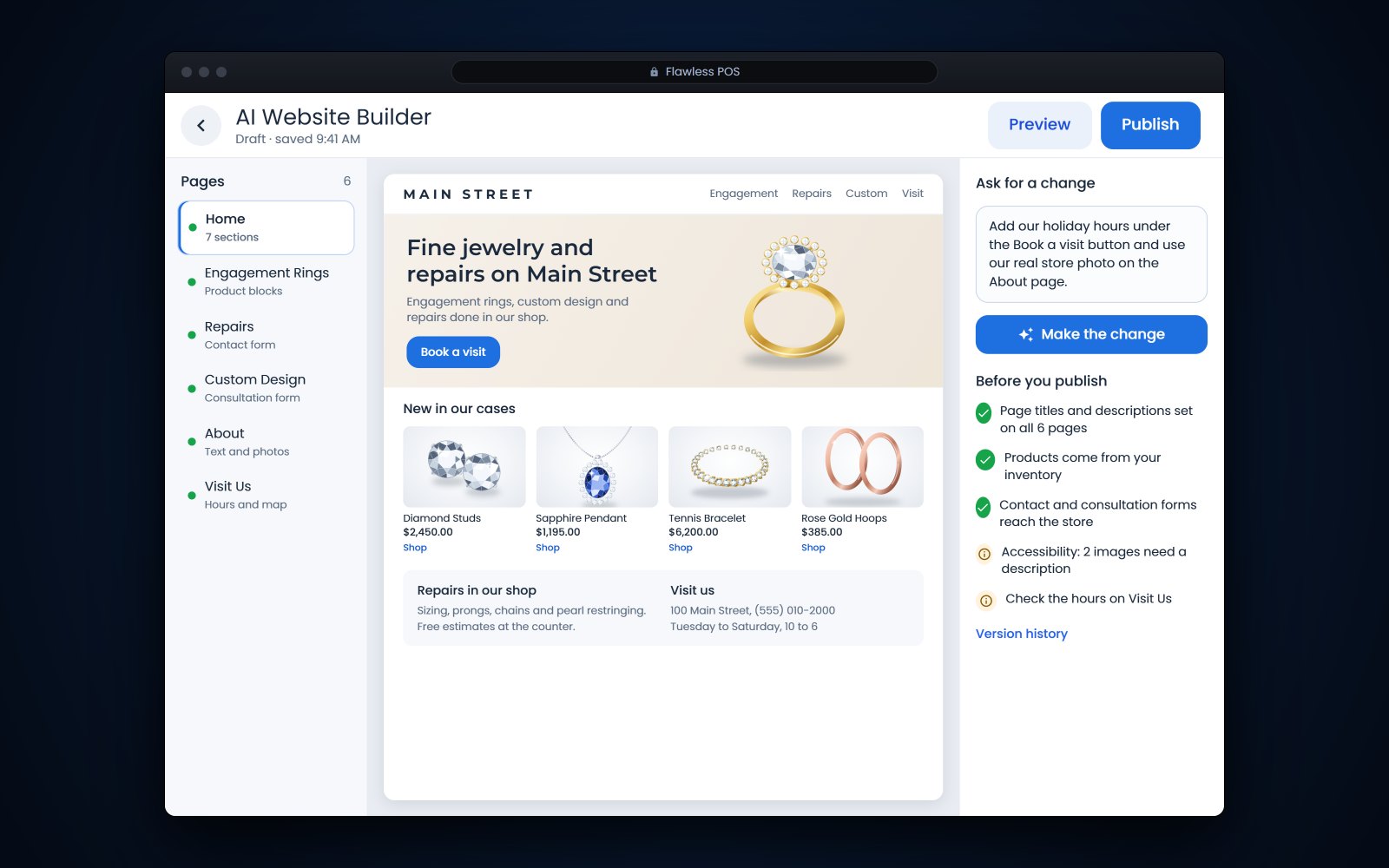
Short answer: An AI website builder for jewelry stores is good at the parts that used to take weeks: page layouts, site structure, first drafts of copy and a consistent look from page to page. It does not know your store. Before launch, someone at the store has to check every claim and price, make sure photos show the real piece, confirm hours and locations, test accessibility against WCAG, review page titles and descriptions, tie product pages to real inventory, and send a test through every form and the checkout.
In this article
- What an AI website builder for jewelry stores does well
- Check every claim, price and stone description
- Photos, hours and locations
- Accessibility basics from WCAG
- Page titles, descriptions and search
- Product pages, checkout and forms
- A launch checklist for an AI-built jewelry website
- How Flawless POS handles AI-built websites
- Frequently asked questions
What an AI website builder for jewelry stores does well
Ask an AI builder for a home page, a bridal page, a repairs page and an about page, and a few minutes later you have all 4 in the same style. With a designer, that used to mean weeks of back and forth. The better tools are good at:
- Layout and structure: a sensible page order, clear menus and sections that work on a phone.
- First drafts of copy: a starting point for your about page, service pages and FAQs.
- Consistency: the same fonts, colors and button styles on every page.
- Fast changes: "make the repairs page shorter" or "add a section on appraisals" takes seconds.
- Technical basics: some builders also write page titles and descriptions and add structured data for search.
What the builder does not have is knowledge of your store: your prices and policies, your hours, which pieces are in the case today. Supplying and checking that is your job, and it is most of what follows.
Check every claim, price and stone description
AI writes confident copy, and confident copy can be wrong. Read every sentence as if a customer will hold you to it. Watch for invented details such as "family owned since 1985," "graduate gemologist on staff," "lifetime warranty on all repairs" or "best prices in town." If it is not true, or you cannot back it up, cut it.
Stones and metals
The FTC's jewelry guidance applies to website copy too. In its advertising guide for diamonds, gemstones and pearls, the FTC says lab-created diamonds should be described with a word like "laboratory-grown" or "laboratory-created" immediately before "diamond," and just as prominently. Treated gemstones should be disclosed when the treatment is not permanent, needs special care or significantly affects value, including online, where buyers cannot see the stone first. Cultured pearls should be called cultured, and naming only the variety, such as freshwater or Akoya, is not enough.
AI copy can blur these lines, for example by calling a lab-grown stone a "diamond" with no qualifier or a plated piece "gold." Check metal, karat and stone type against the item record for every product.
Prices and policies
Delete any price the AI made up, including "starting at" figures on bridal or custom pages, unless you set them yourself. Return, warranty, financing and repair policies on the site must match the ones you use at the counter, ideally word for word.
Photos, hours and locations
Photos that show the real piece
A customer who buys a ring from a photo expects that ring. Use photos of the actual item, or of the same style in the same metal and stone, and check that color and size look true. If you add model or lifestyle images, keep the product's own photos on the page as well. Do not let a builder fill pages with generated images of pieces you do not sell.
Hours and locations that match Google
A builder may fill in placeholder hours or details from an old listing. Check every location page against your Google Business Profile: name, address, phone and hours, including holiday hours. Our local SEO guide explains why those details should match everywhere.
Accessibility basics from WCAG
The Web Content Accessibility Guidelines (WCAG) are the W3C's standard for accessible websites. The current version is WCAG 2.2, first published in October 2023. Each requirement has a level: A, AA or AAA. Level AA means meeting every A and AA requirement, and it is a sensible target for a store site. WCAG itself does not recommend requiring AAA across entire sites, because some content cannot meet every AAA criterion.
These are the checks most worth running on a jewelry site:
| Check | WCAG 2.2 | What to look for on a jewelry site |
|---|---|---|
| Text alternatives | 1.1.1, level A | Alt text that says what the piece is, such as "14k yellow gold solitaire with a 1 carat round lab-grown diamond," instead of a file name. |
| Color contrast | 1.4.3, level AA | At least 4.5:1 for normal text and 3:1 for large text. Thin gray or gold lettering on white or cream often fails. |
| Keyboard | 2.1.1, level A | Menus, filters, quick views and every checkout step work with a keyboard alone. |
| Visible focus | 2.4.7, level AA | You can always see where you are when you press Tab. |
| Page titles | 2.4.2, level A | Each title says what the page is, such as "Ring Sizing and Repairs" plus your store name. |
| Link purpose | 2.4.4, level A | Links say where they go. "Shop engagement rings" is clearer than a row of identical "Shop now" buttons. |
| Target size | 2.5.8, level AA | Buttons and links are at least 24 by 24 CSS pixels, which matters for thumbs on a phone. |
| Labels | 3.3.2, level A | Every field on contact, appointment and checkout forms has a visible label. |
| Resize text | 1.4.4, level AA | Text can be enlarged to 200 percent without breaking the page. |
The W3C's Easy Checks page is a good first pass. It also warns that a page can seem to pass quick checks and still have significant barriers, so have someone test the site with a keyboard and a screen reader before launch. Accessibility can also be a legal matter, and this post is not legal advice.
Page titles, descriptions and search
Google asks for page titles that are descriptive and concise, without repeated or boilerplate text across pages. For meta descriptions, it asks for a unique, accurate summary of each page, though it notes that snippets are mostly built from the page content itself. When one tool writes every page at once, titles and descriptions can come out sounding alike, so read them all together and rewrite any that blur.
Structured data helps Google understand a page, and Google says not to mark up information that visitors cannot see. If the builder adds structured data for your products or your store, it has to match the visible price, availability, address and hours.
Will Google mind that AI wrote it?
Google said in February 2023 that appropriate use of AI or automation is not against its guidelines, and that it rewards original, helpful content made for people. In March 2024 it added a spam policy against scaled content abuse: producing many pages mainly to manipulate rankings, no matter how the content is made. For a jewelry store, the risk is a stack of near-identical pages titled "Jeweler in" plus the name of every nearby suburb. Write real pages for real stores and services instead.
Product pages, checkout and forms
Product pages tied to real inventory
A beautiful page for a ring that sold last week leads to a disappointed shopper and a phone call. Product pages should come from your inventory, so price and availability change when the item does and a one-of-a-kind piece comes down when it sells. If the builder makes product pages you keep up by hand, decide who updates them and how often. See inventory-synced websites for more, and jewelry POS integrations if you also run a separate e-commerce platform.
Checkout
Place real test orders on a phone and on a computer, with a real card, then refund them. Check the sales tax, shipping options and confirmation email, and make sure the order shows up where your staff will see it. Try a gift card and a coupon if you accept them online.
Forms
Contact, appointment and consultation forms can fail without anyone noticing. Send a test from every form and confirm who receives it, how fast, and whether it landed in spam. A bridal consultation request that goes to an old inbox is a customer you never hear from.
A launch checklist for an AI-built jewelry website
- Every sentence read by someone at the store, and invented claims removed.
- Lab-grown, treated and cultured stones described the way the FTC guidance says.
- No prices, policies or warranties that differ from what you do at the counter.
- Photos of the real pieces, true to color and size.
- Name, address, phone and hours on every location page match your Google Business Profile.
- Alt text on every product image, and contrast, keyboard, focus, target size and form labels checked against WCAG 2.2.
- Unique page titles and meta descriptions, and no near-identical town pages.
- Structured data that matches what visitors can see.
- Product pages tied to inventory, so a sold piece comes down.
- Test orders placed and refunded on a phone and a computer.
- A test sent from every form and received by the right person.
- One person named to review the site every month.
How Flawless POS handles AI-built websites
Flawless POS includes an AI page builder for your store's website, and the site is synced with your inventory. You can generate all your pages at once or build a whole site in one pass, then edit any page with version history. For the checks in this post:
- Search: SEO settings for each page, plus structured data for search.
- Accessibility: built-in accessibility checks.
- Products: product blocks set to Shop, Contact for Pricing, Wholesale or Quote, plus cart, checkout, product pages with variants and quick view.
- Forms: built-in contact and consultation forms.
The AI features are practical rather than gimmicky.
The checks still need someone at your store to read the copy and act on the results. To see it with your own inventory, book a demo.
See also: Jewelry website and online store.
Frequently asked questions
Will Google penalize a jewelry website written with AI?
Google has said that appropriate use of AI is not against its guidelines, and that it looks for helpful content made for people, however it is produced. Its spam policies target producing many pages mainly to manipulate rankings. Accurate, useful pages written for your customers are what Google says it wants.
Which WCAG level should a jewelry store website meet?
Aim for WCAG 2.2 level AA, which means meeting every level A and AA requirement, including color contrast, visible focus and minimum target size. WCAG itself does not recommend requiring level AAA for entire sites, because some content cannot meet every AAA criterion. This is not legal advice.
Can AI write my product descriptions?
It can draft them, and it is good at keeping a consistent format. Someone still has to check each one against the item record: metal and karat, stone type and whether it is lab-grown or treated, measurements, and whether the piece is one of a kind.
Should I tell customers that AI helped build my website?
Google suggests a disclosure where readers might reasonably wonder how content was created, which fits articles more than product pages. For a shopper, what matters most is that the details are right.
Sources
- W3C - WCAG 2 Overview (opens in a new tab)
- W3C - Web Content Accessibility Guidelines (WCAG) 2.2 (opens in a new tab)
- W3C - Easy Checks: A First Review of Web Accessibility (opens in a new tab)
- FTC - In the Loupe: Advertising Diamonds, Gemstones and Pearls (July 2019) (opens in a new tab)
- Google Search Central - Influencing title links in Google Search (opens in a new tab)
- Google Search Central - Control your snippets in search results (opens in a new tab)
- Google Search Central - Intro to how structured data markup works (opens in a new tab)
- Google Search Central Blog - Google Search's guidance about AI-generated content (February 8, 2023) (opens in a new tab)
- Google Search Central Blog - What web creators should know about our March 2024 core update and new spam policies (March 5, 2024) (opens in a new tab)