
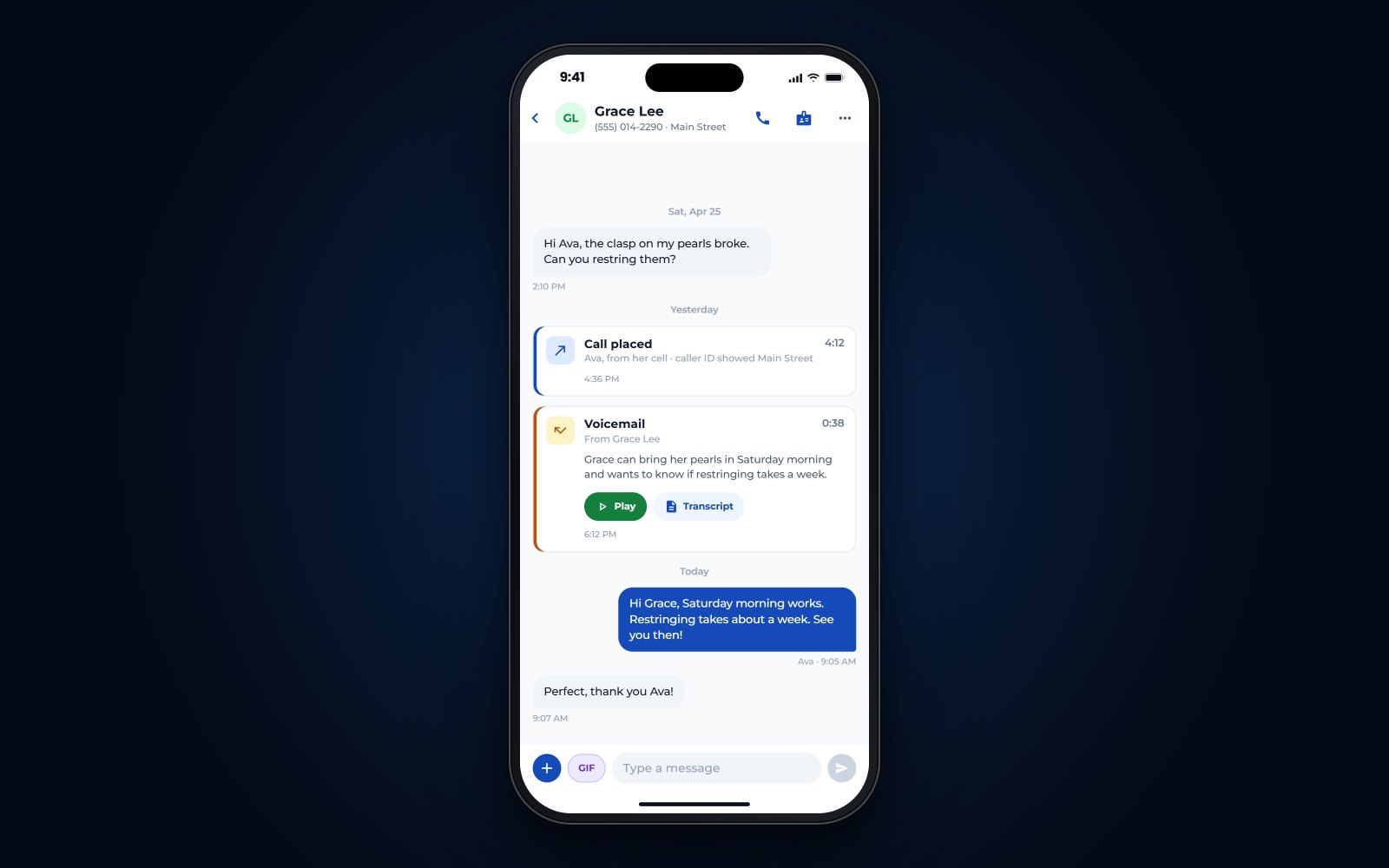
Short answer: To call customers from your cell with the business number showing, use a phone app tied to the store's phone system instead of your own dialer, so the client sees the store number and the call is logged on their record. Your personal number stays private, and when a salesperson leaves, the client relationship and the full history stay with the store. Set simple rules for calling hours, follow-up and recording consent before anyone starts.
In this article
- What goes wrong when salespeople use their own numbers
- How to call customers from your cell with the business number
- What should land on the client's record
- Call etiquette for jewelry clients
- Recording calls and getting consent
- A one-week plan to move the team to the store number
- How Flawless POS handles client calls from your cell
- Frequently asked questions
What goes wrong when salespeople use their own numbers
For example, take a bridal client who bought her engagement ring from your best salesperson. Over 2 years they texted about a wedding band, a resize and an anniversary pendant, all on his personal cell. Then he takes a job at another store. Her phone still has him saved as the person to text about jewelry, and her next message goes to him instead of to you.
Personal numbers are quick and familiar, and everyone already has a phone in their pocket. The cost shows up later:
- The history leaves with the phone. Calls and texts sit on one person's device. Nobody else can see what was said about a price, a promised date or a ring size.
- The client stays with the salesperson. When someone leaves, the number your client saved for your store leaves too.
- There is no record of promises. If a client says you promised the sizing for Friday, there is nothing to check.
- Staff give up their privacy. Some salespeople do not want clients to have their personal number at all. They should not have to choose between privacy and good service.
- Each phone sets its own tone. A personal voicemail greeting and replies sent at 10 p.m. are hard for a store to manage.
Calling clients is still worth doing. A call from someone who knows the client, the piece and the occasion is one of the best tools a jewelry store has. What needs to change is the number the client sees and where the record of the call ends up.
How to call customers from your cell with the business number
There are a few ways to make a call from a cell phone show the store's number. They differ in call quality and in how much ends up on the client's record.
| Method | How it works | What to watch |
|---|---|---|
| A store phone app, calling over Wi-Fi or data | An app on the salesperson's phone places the call through the store's phone system. The client sees the store number. | Quality depends on the connection. Test it in the back office, at the bench and anywhere you hold events. |
| A store phone app, calling over the cell network | The app connects the call through the store's phone system but carries the audio over regular cell service. | Useful where Wi-Fi or data is weak. Ask whether these calls are logged like any other call. |
| A second-number app on the salesperson's phone | Adds a separate number to that one phone. | Check who owns the number and whether anyone else at the store can see the history. |
| Blocking caller ID on each call | Hides the salesperson's number. | The client sees no number at all and may not answer. Nothing is logged. |
Showing your store's own number to your own clients is the ordinary use of caller ID. The federal Truth in Caller ID rules are aimed at caller ID that is misleading or inaccurate and used with the intent to defraud, cause harm or wrongly obtain anything of value (47 U.S.C. 227(e) (opens in a new tab)). Use a number your store owns or is authorized to use.
Tip: Before you roll it out, call a few staff phones from the app and check what shows up: the number, the store name if the carrier displays one, and whether the call lands on the right client record.
What should land on the client's record
The reason to use the store number is to make every conversation part of the store's history. Each client record should show:
- Every call in and out, with the date, time and length
- Who at the store made or took the call
- Texts, including photos sent either way
- Voicemails, saved where the whole team can find them
- Missed calls, so someone calls back the same day
- A short note after any call where a price, a date or a promise came up
- Calls from numbers that are not in your system yet
Don't skip that last item. A first-time caller asking whether you can size a ring by Saturday is a new client. If the call only lives in one person's recent calls list, the lead is gone by Monday.
Write a short note after the calls that matter. "Called about the 1.2 ct oval. Wants to see it in platinum. Back from vacation on the 15th." is something any salesperson can pick up and act on. Our repair intake checklist works on the same idea: write it down when it is said.
Call etiquette for jewelry clients
When to call
Keep client calls to business hours unless the client asked you to call later. For sales calls to homes, federal telemarketing rules set an outer limit of 8 a.m. to 9 p.m. in the client's time zone (47 CFR 64.1200 (opens in a new tab)). Calls to people you already do business with are treated differently under those rules, but the same hours make a sensible limit for any client call. Some states are stricter, so check yours.
How often
Give every call a reason the client cares about: a repair is ready, a piece they asked about came in, an anniversary is 2 weeks away. If a client stops picking up, switch to a text or an email and let them choose. Our follow-up plan for jewelry customers has a timeline you can borrow.
What to say on a first call
Say who you are and where you are calling from in the first sentence, then the reason, then one easy question. For example: "Hi Dana, this is Marcus at [store name]. Your ring sizing is finished and it looks great. Would you like to pick it up this week, or should I hold it for Saturday?"
When to text instead
- Pickup reminders and quick confirmations
- Photos of a finished piece or a new arrival
- Anything the client will want to look up later, like a price or a date
- Any client who has told you they prefer texts
Texts have their own rules on consent, opt-outs and quiet hours. Read our guide to texting customers from your jewelry store before you send anything that reads like marketing.
Recording calls and getting consent
Some phone systems can record calls or transcribe them. A recording can settle a dispute about what was promised, and it helps when you train new staff. It also brings in consent rules that vary by state.
Under federal law, a call can generally be recorded when one party to it consents (18 U.S.C. 2511(2)(d) (opens in a new tab)). Several states require the consent of everyone on the call. California, for example, makes it a crime to record a call involving a cell phone without the consent of all parties (California Penal Code 632.7 (opens in a new tab)), and Florida's law makes recording lawful when all parties have given prior consent (Florida Statutes 934.03 (opens in a new tab)). When the client is in a different state from your store, the safer course is to follow the stricter rule.
- Decide whether you record at all. If you do, record every call the same way so nobody has to remember to.
- Tell callers at the start. Use a short greeting on inbound calls, such as "This call may be recorded," and say it in your first sentence on outbound calls.
- Let clients say no. If a client asks you not to record, note it on their record and respect it.
- Limit who can play recordings, and do not keep them longer than you need.
- Never take a card number on a recorded call. Send the client a secure way to pay instead.
Call recording and transcription require appropriate consent. This is not legal advice; check your state's rules, and ask your attorney if many of your clients call from other states.
A one-week plan to move the team to the store number
- Pick the numberUse the main number your clients already know, or one number per location. The client should recognize what they see on the screen.
- Install the app on every salesperson's phoneSign each person in with their own login so every call shows who made it. Test one outbound and one inbound call on each phone.
- Move the conversationsAsk each salesperson to send their regular clients one short, non-marketing note from the store number: who it is, that this is the store's number, and that the whole team can help them here.
- Write the house rulesCalling hours, how fast you return a missed call, when a note is required, and whether calls are recorded, with the consent your state requires. One page is enough.
- Match the number everywhereUse the same store number on your website, Google Business Profile, receipts and repair tickets.
- Check the records after a weekOpen 5 client records at random. If calls are missing or notes are thin, fix the habit now.
How Flawless POS handles client calls from your cell
Flawless POS includes a store phone system, so calls and texts run on your business number. The Clientele app, on iPhone, iPad and Android, puts the client profile on the salesperson's own phone: balances, orders, purchase history and wish list, plus product search and call history.
With the April 24 update, the app's dialer can place a call over the phone's regular cell network while the client still sees your business number. Calls from numbers that are not in your customer list yet now land on the timeline, so a first-time caller does not disappear into someone's recent calls.
Since April 7, voicemail alerts show who called when that is known, a transcript and a short summary, so you know what the call was about before you call back. Call recording and transcription require appropriate consent.
To try it with your own team's phones, book a demo.
See also: Jewelry CRM and clienteling software.
Frequently asked questions
Is it legal to show the store's number when I call from my own phone?
Showing your own business number to your own clients is the ordinary use of caller ID. Federal law targets caller ID that is misleading or inaccurate and used to defraud, cause harm or wrongly obtain something of value. Use a number the store owns or is authorized to use. This is not legal advice.
Will clients be able to call my personal cell afterward?
Not if the call goes out through the store's phone system. The client sees and saves the store number, so when they call back, they are calling the store.
Should we record client calls?
Recording helps with disputes and training, but it adds consent duties, and some states require every party's consent. If you record, announce it at the start of every call and limit who can play the recordings. Call recording and transcription require appropriate consent.
What if a salesperson wants to keep texting clients from their own phone?
Explain why the store number matters: the client's history, promises and photos need to be where the whole team can see them. Put the rule in your employee handbook so it is a store policy rather than a personal request, and help them move their regular clients over in the first week.
Some clients see our calls labeled as spam. What can we do?
Ask your phone provider how to register the number with the services carriers use to label calls, and keep using the same number so clients learn to recognize it. A short voicemail with the store name also helps a client know it was you.
Sources
- 47 U.S.C. 227(e) - Prohibition on inaccurate caller identification information (Cornell LII) (opens in a new tab)
- 47 CFR 64.1200 - Delivery restrictions, including calling hours for telephone solicitations (Cornell LII) (opens in a new tab)
- 18 U.S.C. 2511 - Interception of wire, oral or electronic communications (Cornell LII) (opens in a new tab)
- California Penal Code 632.7 - Recording cellular and cordless telephone communications (opens in a new tab)
- Florida Statutes 934.03 (2025) - Interception of communications (opens in a new tab)