
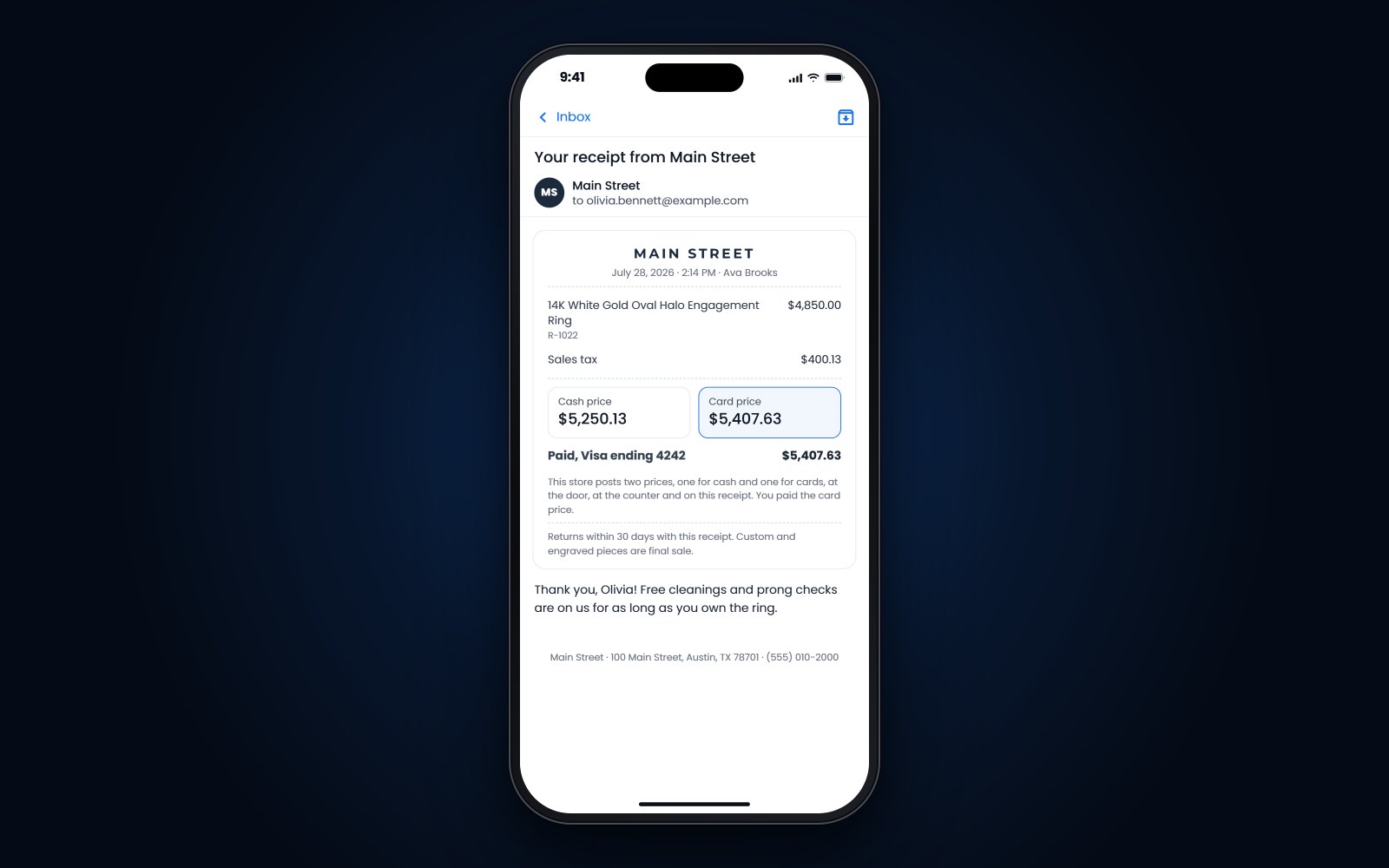
Short answer: Dual pricing for jewelry stores means posting 2 prices, a card price and a lower cash price, instead of adding a fee at checkout. A surcharge adds a fee to credit card sales only, Visa caps it at 3% or your cost, whichever is lower, and no surcharge may apply to debit or prepaid cards. Both need clear signs, and some states ban or limit surcharges, so check with your processor and your state first. This is not legal advice.
In this article
- What surcharging, cash discounts and dual pricing mean
- Visa and Mastercard surcharge rules
- States that ban or limit credit card surcharges
- How dual pricing for jewelry stores works on a $5,000 ring
- A rollout checklist for surcharging or dual pricing
- How Flawless POS handles card processing and dual pricing
- Frequently asked questions
What surcharging, cash discounts and dual pricing mean
Say a customer picks out a $5,000 anniversary ring and hands you a rewards card. Under a surcharge program, the receipt shows the ring plus a $150 credit card surcharge. Under dual pricing, the tag already showed 2 prices, $5,000 for cards and $4,850 for cash, and the receipt shows $5,000. Both programs pass card costs along, and customers feel them very differently.
- Surcharge. An extra fee added at checkout when a customer pays with a credit card. Card brand rules allow it on credit cards only.
- Cash discount. A lower price for paying with cash, or another method that isn't a card, taken off your regular posted price.
- Dual pricing. A cash discount where you post both prices, the card price and the cash price, side by side on tags, signs, your website and the checkout screen.
The name on the program doesn't decide which rules apply. Visa's merchant Q and A says a cash discount program should display either the card price only or both prices side by side for each item, and the card total must come from those posted prices. If the card total is reached by adding a fee at the end, Visa may treat it as a surcharge.
Connecticut's consumer protection department makes a similar point: a receipt line labeled "transaction fee," "processing fee" or "non-cash adjustment" signals a surcharge.
Visa and Mastercard surcharge rules
Here is where the card brand rules stood in July 2026. Your processor applies them, but your store is the one posting the signs and answering customers.
| Rule | Visa | Mastercard |
|---|---|---|
| Which cards | Credit cards only. No debit or prepaid cards, even when a debit card is run as credit. | Credit cards only. No debit or prepaid cards. |
| Cap | Your merchant discount rate for that card, or 3%, whichever is lower | Your average cost of accepting Mastercard credit, or 4%, whichever is lower |
| Advance notice | Tell your acquirer (your processor) at least 30 days before you start | Tell Mastercard and your acquirer at least 30 days before you start |
| Signs | At the point of entry and the point of sale, in the store and online | Clear disclosure at the point of sale, including the surcharge amount |
| Receipt | The surcharge as a separate line on every receipt | The dollar amount of the surcharge on the receipt |
| All cards or some | All Visa credit cards, or certain Visa credit products, but not both | All Mastercard credit cards, or a particular credit product |
If you charge one rate on all credit cards, Visa's 3% cap sets your ceiling. If you also take American Express or Discover, those brands have their own rules, and Visa and Mastercard both set conditions on surcharging their cards when you accept other brands. Visa also says it runs yearly mystery shopping and can fine the processor of a store that surcharges improperly. Ask your processor to review your setup before the first sale.
A change may be coming. On June 9, 2026, a federal judge in Brooklyn gave preliminary approval to a revised settlement between Visa, Mastercard and merchants. Among other things, it would give merchants more room to surcharge and to decline some premium cards, according to Visa's statement on the ruling (opens in a new tab). It still needs final approval, so the rules in the table still apply.
States that ban or limit credit card surcharges
State law sits on top of the card brand rules. A few states ban surcharges outright, and others cap them or set their own sign rules. Here is how several states stood in July 2026, from each state's own statute or agency page. This isn't a complete list, and laws change, so check with your processor and your state.
- Connecticut. Surcharges are not allowed. Cash discounts are allowed with a posted sign or dual pricing (Conn. Gen. Stat. 42-133ff).
- Massachusetts. No surcharge on a customer who pays by credit card. Discounts for cash are allowed when offered to everyone and clearly disclosed (Mass. Gen. Laws ch. 140D, section 28A).
- Maine. Sellers may not surcharge credit or debit card payments. A discount from the regular price is not a surcharge (Maine Rev. Stat. title 9-A, section 8-509).
- Colorado. The law gives 2 options for a credit card surcharge: up to 2% of the total, or up to the processing fee you actually pay. It sets the wording for a sign in the store and before online checkout, requires a separate line on the receipt, and bars surcharges on cash, checks, debit cards and gift card redemptions (C.R.S. 5-2-212).
- New York. Post the total price for paying by credit card, surcharge included, clearly and conspicuously. The surcharge can't exceed what the card company charges you (General Business Law section 518).
- New Jersey. A credit card surcharge can't exceed your actual cost to process the payment. Post the amount (a percentage is fine) at the entrance and at checkout, show it on the checkout page online, and say it out loud on phone orders (N.J.S.A. 56:8-156.1 and 156.2).
- Oklahoma. Since November 1, 2025, credit card surcharges are allowed up to 2% or your actual processing cost, whichever is less. Post the amount at the entrance and point of sale, show it online and say it on phone orders. No surcharge is allowed if you accept only credit cards (14A O.S. section 2-211, as amended by SB 677).
- California. The attorney general says the state's surcharge ban (Civil Code 1748.1) can't be enforced against the merchants who won a 2018 federal case, and it generally treats similar merchants the same way. Misleading pricing is still illegal, so get advice before you surcharge.
These are summaries, so read your own state's statute or agency page before you act. Some states also have laws against hidden fees in advertised prices. Ask how those apply to a surcharge or a posted cash price where you sell.
How dual pricing for jewelry stores works on a $5,000 ring
| The customer pays with | Surcharge program | Dual pricing |
|---|---|---|
| A rewards or other credit card | $5,000 plus a $150 surcharge, $5,150 in total | $5,000, the card price |
| A debit card | $5,000, since debit can't be surcharged | $5,000, the card price |
| Cash | $5,000 | $4,850, the cash price |
With a surcharge, the extra $150 shows up at the very end, after the customer has already said yes. For a bridal or anniversary customer, that is an awkward moment for a surprise. With dual pricing, the card price is the price on the tag, and the cash price reads as a reward for paying cash.
Dual pricing has its own work. Every tag, sign, web listing and quote needs both prices, and staff need to explain them the same way every time. Look closely at a few kinds of sales before you start:
- Layaway payments and deposits, since each card payment follows the same rules
- Special orders quoted weeks ahead, so the quote shows the right price for each way of paying
- Refunds and exchanges, so you know how the surcharge or the cash price is handled and your return policy says so
- Phone and online orders, which need their own disclosures
Tip: Give staff one sentence and use it every time, for example: "Our tag prices are card prices. If you pay cash, you save 3%."
If the real goal is lower fees, look at your pricing model first. Our guide to interchange plus and flat rate pricing shows how to read your statement and work out your effective rate.
A rollout checklist for surcharging or dual pricing
- Check the law in every state where you have a store
- Choose one program: a surcharge on credit cards only, or dual pricing with a posted cash price
- Tell your processor in writing at least 30 days ahead, and confirm who notifies the card brands
- Confirm your cost of acceptance, so a surcharge never exceeds it
- Set up the terminal so debit and prepaid cards are never surcharged
- Post signs at the entrance and at checkout, and add notice to your website checkout
- Make sure receipts show the surcharge on its own line, or show the cash discount clearly
- Update tags, price lists, quotes and your website if you choose dual pricing
- Write a short script for the counter and for phone orders
- Decide how refunds, layaway payments and deposits will work
- Review complaints, card mix and net savings after 30 and 90 days
This is not legal advice. Rules differ by state and change over time, so check with your processor and your state before you start.
How Flawless POS handles card processing and dual pricing
Flawless POS offers card processing with Interchange Plus or dual pricing, on PAX A920 Pro, A77, A3700 and L1400 payment devices supplied by Flawless. We match or beat your current processing rates, the agreed rate is locked for 3 years, and there are no hidden or additional fees.
Bring a recent statement for a 5-minute fee review. In most cases, what you save on card processing covers the cost of Flawless. Processing savings depend on your current costs and card mix.
If you're weighing dual pricing, ask us to show you how it works at checkout, and check your state's rules before you turn it on. The payment processing page and the hardware page have the details.
Frequently asked questions
Can I surcharge debit cards?
No. Visa and Mastercard allow surcharges on credit cards only, and Visa says that includes a debit card run as credit. Some state laws, such as Colorado's and Maine's, also bar surcharges on debit cards.
Is dual pricing allowed in states that ban surcharges?
Connecticut, Massachusetts and Maine ban surcharges but allow discounts for cash, as long as they're offered and posted the right way. A fee added at checkout can still be treated as a surcharge, whatever it's called. This is not legal advice, so check with your processor and your state.
How much notice do I need to give before I start surcharging?
At least 30 days. Visa asks you to tell your acquirer, which is usually your processor, 30 days before you start, and Mastercard asks for 30 days' notice to both Mastercard and your acquirer. Your processor can tell you exactly what they need from you.
Will the Visa and Mastercard settlement change the rules?
It may. A revised settlement received preliminary approval on June 9, 2026, and it would give merchants more room to surcharge and to decline some premium cards. Until it's final and the card brands update their rules, the current rules apply.
Can I surcharge only some credit cards?
Visa and Mastercard both let you surcharge all of their credit cards or only certain credit products, and Visa says you can't combine both approaches. American Express and Discover have their own rules, so ask your processor.
Sources
- Visa - Merchant credit surcharging, processing fees and interchange rates (opens in a new tab)
- Visa - U.S. Merchant Surcharge Q and A (version February 15, 2024) (opens in a new tab)
- Mastercard - Merchant surcharge rules (opens in a new tab)
- Connecticut Department of Consumer Protection - Credit card surcharge (opens in a new tab)
- Massachusetts General Laws, chapter 140D, section 28A (opens in a new tab)
- Maine Revised Statutes, title 9-A, section 8-509 (opens in a new tab)
- Colorado General Assembly - SB21-091, credit transaction charge limitations (opens in a new tab)
- New York State Senate - General Business Law section 518 (opens in a new tab)
- New Jersey Division of Consumer Affairs - Credit card surcharges FAQ (revised March 6, 2026) (opens in a new tab)
- Oklahoma Legislature - SB 677 (2025), surcharges and discounts (opens in a new tab)
- California Attorney General - Credit card surcharges (opens in a new tab)
- Visa - Statement on the U.S. District Court granting preliminary approval of the MDL settlement (June 9, 2026) (opens in a new tab)