
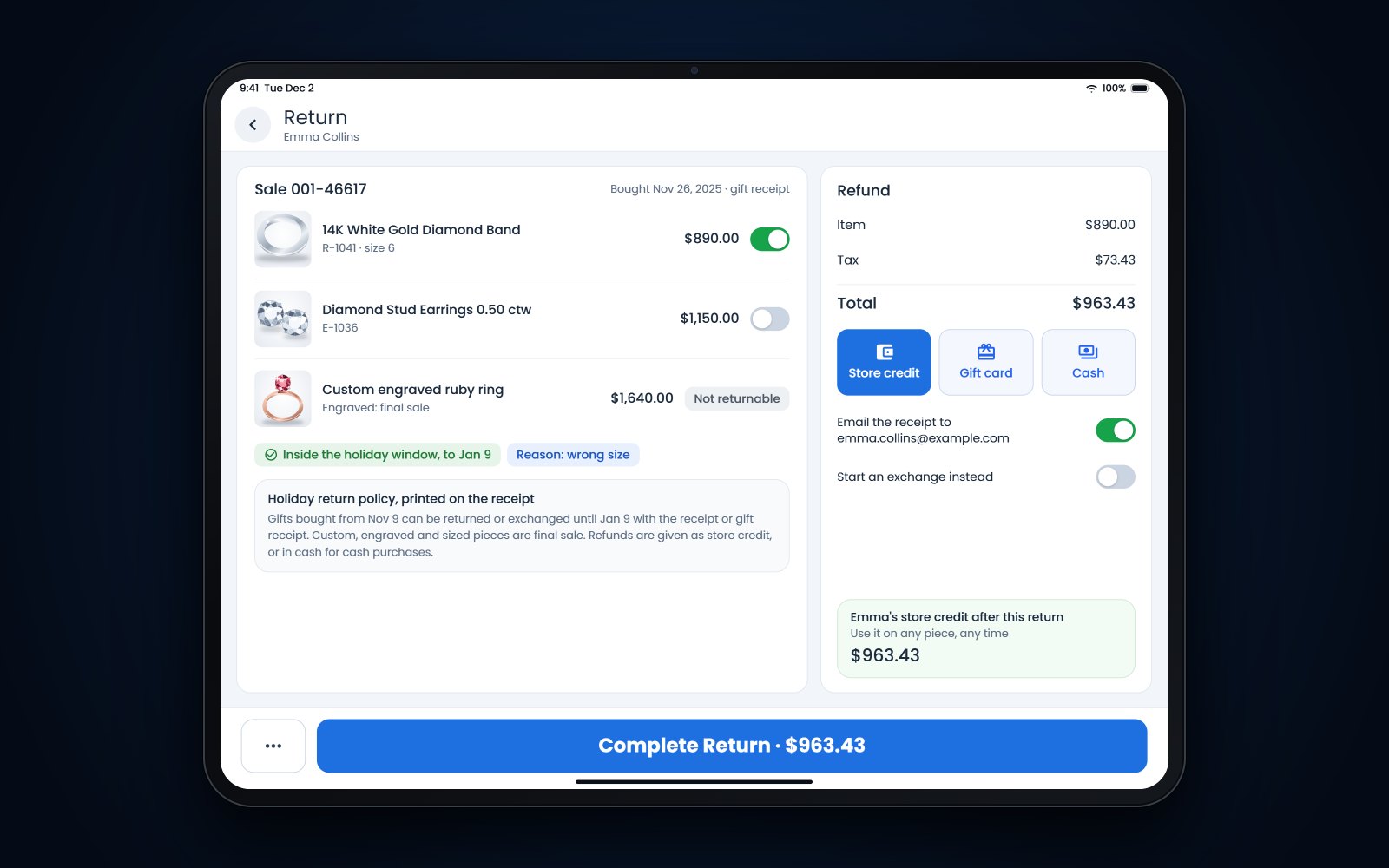
Short answer: A clear jewelry store return policy states the return window, the condition items must be in, what can't be returned (custom, engraved and sized pieces), how gift receipts work, and whether a return gets a refund to the original payment or store credit. For the holidays, consider one extended return date in January for all November and December purchases. Post the policy on the receipt, on your website and at the counter, because some states, including California, New York and Florida, have rules about how return policies are posted.
In this article
- What a jewelry store return policy should cover
- Returns on custom, engraved and sized pieces
- Gift receipts, store credit and refunds to the original card
- Setting an extended holiday return window
- Where to post your return policy, and state rules
- How staff should handle return exceptions
- Sample holiday return policy for a jewelry store
- How Flawless POS handles returns and store credit
- Frequently asked questions
What a jewelry store return policy should cover
For example, on December 27 a woman brings back diamond studs her husband bought on December 12. She has a gift receipt and wants a larger pair. Your salesperson should know, without calling you, whether that's an exchange, store credit or a refund to his card.
A written policy answers that. It should cover:
- The window. How many days after purchase, and whether holiday purchases get longer.
- Condition. Unworn, with tags, box and paperwork such as a grading report or appraisal.
- Exclusions. Custom pieces, engraved items, rings sized or altered for the customer, special orders, and final-sale or estate pieces if that's your rule.
- Gift receipts. What a gift recipient can get, such as an exchange or store credit.
- Refund method. Card refunds go back to the card. Say how you handle cash and check purchases, for example a check once the original check has cleared.
- Store credit. Whether it expires and whether it can be combined with other offers.
- Exceptions. Who can approve them.
Keep it short enough to fit on the receipt and simple enough that a new salesperson can explain it in a minute.
Returns on custom, engraved and sized pieces
Name each of these cases in the policy, because they're the hardest pieces to resell:
- Custom work. Made to the customer's design or with their stone. No returns once production starts. Put it on the order and have the customer initial it.
- Engraving. No returns on engraved pieces. For gifts, suggest engraving after the holiday, so the piece can still be exchanged.
- Sizing. A ring sized for a guess may need to be sized back before you can resell it. Decide whether you charge for that, or offer a free resize on gifts instead of a return.
- Special orders. Items ordered for one customer follow your special-order terms. Our post on layaway and special orders covers deposits and what's non-refundable.
Some state rules allow for this. California's posting law doesn't apply to customized goods received as ordered, and Florida's no-refund sign rule doesn't cover custom-made or custom-altered goods. A clear written exclusion still saves an argument at the counter.
Gift receipts, store credit and refunds to the original card
Gift receipts
Offer one with every sale from November on. A gift receipt shows the item and the date but not the price, and it lets you find the original sale when the gift comes back.
Refund or store credit
Many stores keep it simple. The buyer, with the receipt, gets a refund to the original payment, and a gift recipient gets an exchange or store credit. If you want store credit only, for some items or all of them, say so at the time of sale.
| Situation | What the customer gets | Why |
|---|---|---|
| Buyer with the original receipt, inside the window | Refund to the original payment | It matches the sale and card brand guidance |
| Gift recipient with a gift receipt | Exchange or store credit | The buyer's card stays out of it |
| Return after the holiday return date | Store credit only | The value stays in the store |
| No receipt and no sale found | Store credit at your discretion, or a polite no | It limits fraud and leaves a record |
| Custom, engraved or sized for the customer | No return, but an offer to resize, repair or remount | The piece can't be resold as it is |
Card refunds go back to the card
Visa's merchant guidance is to refund a card purchase to the account used for it. It lets U.S. merchants give cash or another form of credit only in a few cases, one of which is a refund to a gift recipient who isn't the cardholder (Visa (opens in a new tab)). Refunding a card sale in cash also invites fraud: someone buys with a stolen card and returns the piece for cash. Check your processor's rules for the exceptions it allows.
Process card refunds promptly, hand the customer the credit receipt and tell them it can take a few days to show on their statement. Refunds and chargebacks both show up on your merchant statement; our guide to card processing fees explains how to read it.
Setting an extended holiday return window
A gift bought on December 2 may not be opened until December 25. With a 14-day window, the return period ends before the box is even opened.
- Pick one date for all November and December purchases, such as January 15, 2026, instead of counting days from each sale.
- Print the date on the receipt and the gift receipt.
- Keep your exclusions. The longer window doesn't cover custom, engraved or sized pieces.
- Decide what happens after the date, for example store credit only.
Tip: Mention the holiday return date in your December emails and at the counter, so gift buyers know it before they buy. Set it along with the other dates on your holiday prep checklist.
Where to post your return policy, and state rules
Post the policy in 4 places: on the receipt, on your website's product and checkout pages, on a sign at the register, and in the confirmation email for online orders.
Card brand guidance points the same way. Visa tells merchants to share the refund policy at the time of purchase and to print restrictions such as No Refund, Exchange Only or In-Store Credit Only on the receipt near the signature line.
Some states have their own posting rules. Here are 3 examples:
- California. A store that doesn't give full refunds, credit or equal exchanges for at least 7 days after purchase must post its policy at each register and sales counter, at each public entrance, on tags on the items or on its order forms. If it doesn't, a customer who returns the goods within 30 days can get the purchase price back (California Attorney General (opens in a new tab)).
- New York. Stores must post their refund policy conspicuously, on the item, at each register or at each entrance. If a store doesn't, a customer can get a refund or credit, at their choice, for unused goods returned within 30 days of purchase (N.Y. General Business Law 218-a (opens in a new tab)).
- Florida. A store that gives no refunds or exchanges must post a no-refund sign at the point of sale. A store without the sign must refund unused items returned within 7 days with proof of purchase (Florida Statutes 501.142).
This is not legal advice. Check your state's rules, and when the policy changes, update it everywhere on the same day.
How staff should handle return exceptions
Exceptions will come up: a regular customer on day 35, a ring that's still the wrong size after sizing, a gift with no receipt. Decide in advance who handles what.
- Give staff a short list they can approve on their own, for example an exchange of equal or higher value up to 7 days past the window.
- Send everything else to the manager or owner the same day.
- With no receipt, look up the sale by the buyer's name, phone number or email. If you can't find it, offer store credit or decline.
- Before any refund, compare the piece with the original sale record, including the stones and metal. A look-alike in the original box is easy to miss at a busy counter.
- Note every exception and the reason on the customer record, so the next person sees it.
Sample holiday return policy for a jewelry store
Example only. Adapt it to your store and your state's rules, and have your attorney review it.
- Holiday purchases made from November 1 to December 24, 2025 may be returned or exchanged until January 15, 2026.
- Other purchases may be returned within 30 days.
- Items must be unworn and in original condition, with the receipt or gift receipt and any grading reports or appraisals.
- Refunds go to the original form of payment. Card refunds go back to the card used for the purchase.
- Returns with a gift receipt receive an exchange or store credit.
- Custom pieces, engraved items, special orders and rings sized or altered at your request cannot be returned.
- Store credit does not expire.
Tip: Read your policy aloud to a new salesperson. If they can't explain it back in a minute, shorten it.
How Flawless POS handles returns and store credit
In Flawless POS, returns, store credit and gift cards are part of the register, and a sale with a customer attached lands in that customer's purchase history.
- Returns and voids are rung up at the register.
- Store credit and gift cards are issued and redeemed in the same system.
- Purchase history on the customer record helps with a no-receipt return, because you start from the customer instead of a guess.
- Communication history stays on the same record, so the next person who helps that customer can see what was said.
If you book a demo, bring your return policy and we'll walk through a return and an exchange for store credit.
See also: All Flawless POS features.
Frequently asked questions
Do jewelry stores have to accept returns?
Not always. In California, New York and Florida, for example, a store can limit or refuse returns as long as it posts its policy the way state law requires. If it doesn't post the policy, those states give customers a right to return goods within a set period. Check your state's rules; this is not legal advice.
Can we give store credit instead of a refund?
Yes, if your policy says so and you disclosed it at the time of sale. Visa lists In-Store Credit Only among the restrictions a merchant can print on the receipt. When you do refund a card purchase, the refund should go back to the card.
How should we handle a return without a receipt?
Look up the sale by the customer's name, phone number or email. If you find it, treat it as a normal return. If you don't, offer store credit or an exchange, or decline, and note the decision on the customer record.
Should store credit expire?
It's simplest if it doesn't. If you want an expiration date, check your state's gift card and unclaimed property rules first, and print the date on the credit itself.
Sources
- California Attorney General - Refund policies (opens in a new tab)
- California Civil Code 1723 - Posting of refund policies (opens in a new tab)
- New York General Business Law 218-a - Disclosure of refund policies (opens in a new tab)
- Florida Statutes 501.142 (2025) - Retail sales establishments; refund policy disclosure (opens in a new tab)
- Visa - Processing refunds to cardholders in a merchant store location (opens in a new tab)