
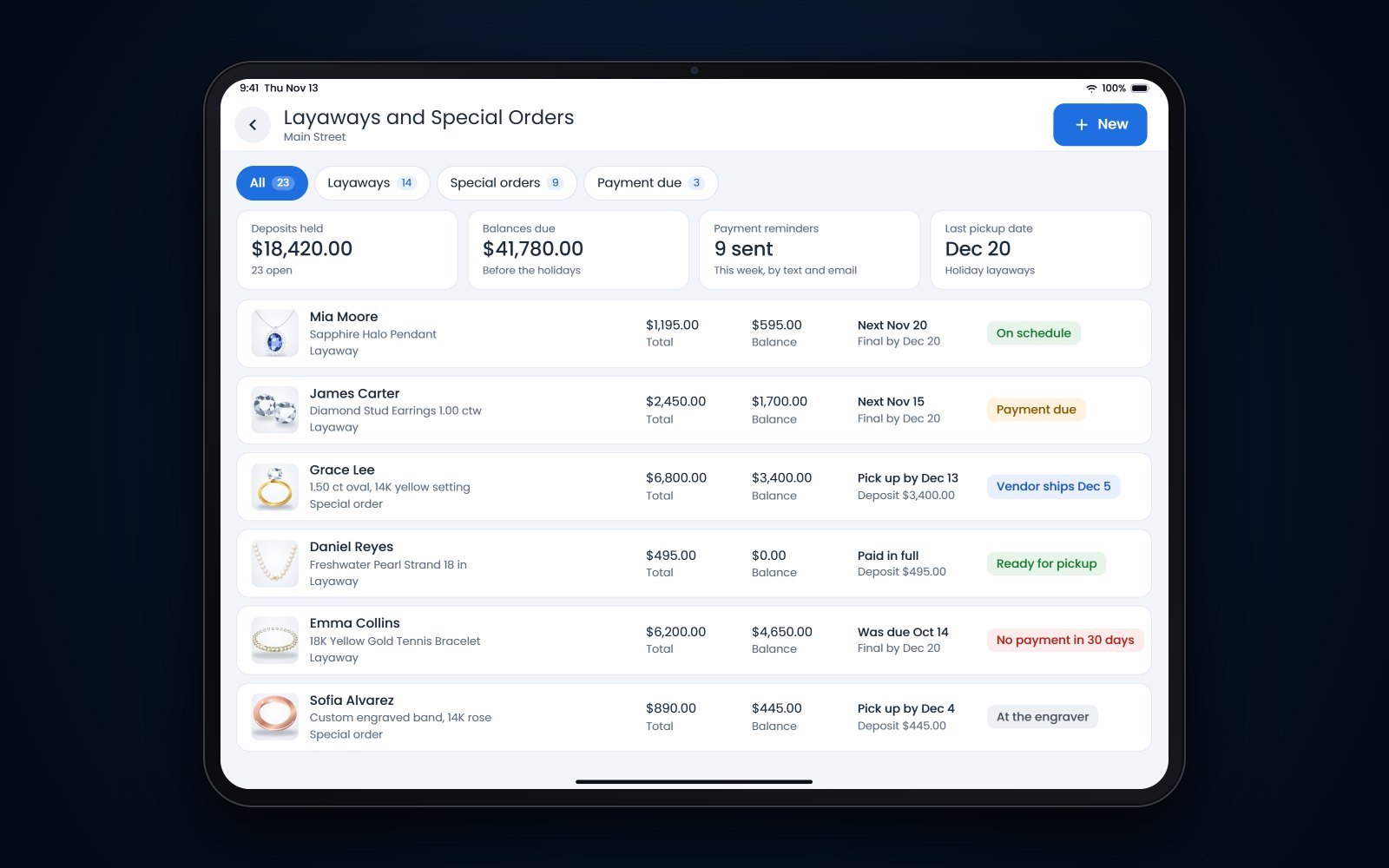
Short answer: A jewelry layaway policy should state the deposit, the payment schedule, a final pickup date before the holidays and what happens if the customer cancels or stops paying, and the customer should get it in writing before you take any money. Special orders need a deposit, a clear rule on non-refundable custom work and a promised date set from the vendor's holiday cutoff. Some states, including New York, Ohio and California, regulate layaway disclosures, so check your state's rules.
In this article
- What a written jewelry layaway policy should cover
- State layaway disclosure rules
- Special order deposits and non-refundable custom work
- Vendor lead times and holiday cutoff dates
- Payment reminders and keeping the piece reserved
- What to do when layaway payments stop
- How Flawless POS handles layaway and special orders
- Frequently asked questions
What a written jewelry layaway policy should cover
For example, a customer puts a $2,400 sapphire pendant on layaway in mid-November and plans to pay it off by Christmas. On December 22, $400 is still owed, the customer isn't answering, and the pendant has been off the floor for 5 weeks. A written policy settles most of that before it starts.
Cover these points, and give the customer a copy before you take the first payment:
- Deposit. A minimum taken at the start, for example 20% of the price.
- Payment schedule. How much and how often, for example every 2 weeks.
- Final pickup date. For holiday layaways, a firm date with the balance paid, such as December 20, 2025.
- Fees. Any service or cancellation fee, stated in dollars.
- Cancellation and refunds. What the customer gets back if they cancel, and how it's paid.
- Missed payments. How many days late before you call, and when the layaway is canceled.
- Where the piece is kept. Reserved from the first payment and tagged with the customer's name.
Have the customer sign or initial the terms, and give a receipt for every payment that shows the balance left.
Sample layaway policy
Example only (adapt it, check your state's limits on fees and have your attorney review it): Layaway requires a 20% deposit, with payments due every 2 weeks. Holiday layaways must be paid in full and picked up by December 20, 2025. If you cancel, we refund your payments to the original payment method, minus a $15 cancellation fee. If a payment is more than 14 days late and we can't reach you after a written notice, we will cancel the layaway and refund your payments minus the fee. Layaway pieces are held in our safe, tagged with your name, from the day of your first payment.
State layaway disclosure rules
Several states regulate layaway, and they differ on what you must put in writing, when you must hand it over and what you can keep if the layaway falls through. Here are 3 examples:
- New York. Before accepting any payment on a layaway over $50 paid in 4 or more installments, you must give a written disclosure of the item, the total cost, any layaway fees, how long the plan lasts, the payment schedule and what happens if a payment is missed, and your refund policy. A fee you didn't disclose can't be charged (N.Y. General Business Law 396-t (opens in a new tab)).
- Ohio. A layaway of goods priced over $500 needs a written contract, and the customer gets a copy when they pay the first deposit. The customer can cancel in writing within 5 days for a full refund, and the law limits how much of their payments a store can keep if the layaway falls through (Ohio Revised Code 1317.22 (opens in a new tab)).
- California. A store that offers layaway must give a written statement of the deposit, how long the item will be held, a description of it, the total price with any handling charges, and a promise to refund the deposit and payments if the item becomes unavailable before the layaway ends (California Civil Code 1749).
Some places also limit fees. The District of Columbia, for example, caps a layaway service charge at $1 and limits the cancellation fee (D.C. Code 28-3818). Check your state's rules before you print the policy. This is not legal advice.
Special order deposits and non-refundable custom work
A special order ties up the vendor's time and sometimes your money. Set the rules on the order form before the vendor gets the order:
- Deposit. Large enough to cover what you can't recover if the customer walks away, for example 50% on custom work.
- Non-refundable parts. Name what can't be refunded once ordered: a custom casting, a stone cut or set to order, engraving, a ring made in an unusual size.
- Vendor terms. Ask whether the vendor accepts returns on special orders and charges a restocking fee. Your terms for the customer shouldn't be looser than your vendor's terms for you.
- Metal price. Say whether the price can change if gold moves before the metal is bought. Our post on pricing after gold passed $4,000 has example wording for a metal clause.
Record the deposit, the terms and the promised date on the order, and give the customer a receipt that shows all of them. A special order form should capture:
- Customer name, phone and email
- Vendor, vendor style number and your purchase order number
- Metal, size, finish and stone details
- Price, deposit and balance due
- Non-refundable parts, initialed by the customer
- Metal clause, if the price can change
- Promised date and the vendor's confirmed ship date
- How the customer wants to be told when it arrives
Vendor lead times and holiday cutoff dates
This week, ask every vendor you use for special orders for its holiday cutoff, in writing. Then set your counter cutoff earlier, so there's time to fix a piece that arrives wrong.
| Order type | Lead time (example) | Counter cutoff (example) |
|---|---|---|
| Catalog item from a vendor | 5 to 10 business days | December 5 |
| Ring sized or set by the vendor | 2 to 3 weeks | November 21 |
| Custom casting with the customer's stone | 3 to 4 weeks | November 17 |
| Shipping to the customer by Priority Mail | USPS send-by date is December 18 | Ship by December 15 |
Post the cutoffs at the counter and in your email signature, and put them in the special-order notes so every salesperson quotes the same date. Repairs and sizings need their own bench cutoffs; our holiday repair rush guide covers those.
Payment reminders and keeping the piece reserved
Send a reminder a few days before each payment is due, by text or email if the customer agreed to hear from you that way. Keep it short: the item, the amount, the date and how to pay. Our post on texting customers from your store covers consent and opt-outs.
Example text: Hi Dana, it's Sam at (your store name). Your next layaway payment of $200 for the sapphire pendant is due Friday, November 28. Reply here or call us with any questions.
Take the piece out of the case at the first payment. Bag and tag it with the customer's name and layaway number, keep all layaways in one locked place, and mark the item as reserved in your system so nobody sells it online or transfers it to another store.
Tip: Once a week in December, check the layaway shelf against your list of open layaways. A tagged piece with no open layaway, or a layaway with nothing on the shelf, gets an answer that day.
What to do when layaway payments stop
- Call firstWhen a payment is a week late, call. Offer a new schedule if the customer still wants the piece.
- Send a written noticeIf you can't reach them, send a notice with the balance, the date the layaway will be canceled and what they'll get back under your policy.
- Follow your policy and your state's lawRefund or credit what your written terms and state law require, minus any fee you disclosed. In Ohio, for example, a customer who defaults can put what they paid toward other merchandise of equal price.
- Put the piece backReturn it to the case and the website only after the layaway is closed in your system.
- Record what happenedNote the calls, the notice and the refund on the customer record.
If you carry a lot of layaways, review them as a group each month: the count, the total value and the deposits you hold. It's one of the 10 numbers we suggest checking every month. A growing list of past-due layaways in January can mean the deposit or the schedule was too loose.
Special orders need a pickup deadline too. Say on the order what happens if a finished piece isn't picked up, for example after 2 written notices over 60 days, and check your state's unclaimed property rules before you keep any part of a deposit.
How Flawless POS handles layaway and special orders
Flawless POS handles layaway and special orders at the register, in the same system you use for every sale.
- Layaways are rung up at the register, with each payment recorded against the layaway.
- Special orders are part of the register too, and custom builds are tracked as jobs, with their status and deposits from intake to pickup.
- The customer record holds purchase history and communication history, so anyone at the counter can see the order and what was said about it.
- Texts and emails with the customer stay on their profile, next to the rest of their history.
- Tasks help staff keep track of follow-up calls on late payments.
To see a layaway and a special order run from deposit to pickup, book a demo.
See also: All Flawless POS features.
Frequently asked questions
How much deposit should a jewelry layaway require?
There's no single rule. Set it high enough that the customer is committed and you're covered for the weeks the piece is off the floor, for example 20%. Put it in the written policy, and check whether your state limits fees or cancellation charges.
Can we charge a layaway cancellation fee?
Check your state first. Where a fee is allowed, disclose it in writing before the customer pays: New York bars any layaway fee you didn't disclose, and the District of Columbia caps the cancellation fee. This is not legal advice.
Should a special order deposit be refundable?
Make the part that pays for custom work non-refundable once you've placed the order, and say so in writing. A deposit on a catalog item from a vendor that takes returns can reasonably be refundable, minus any restocking fee the vendor charges you.
What if a layaway customer wants the piece before it's paid off?
Ask for the remaining balance and complete the sale. Releasing the piece before it's paid means you're extending credit, which is a different arrangement with its own rules and risks.
Sources
- New York General Business Law 396-t - Lay-away plans (opens in a new tab)
- Ohio Revised Code 1317.22 - Layaway arrangements over $500 (opens in a new tab)
- California Civil Code 1749 - Layaway practices (opens in a new tab)
- District of Columbia Code 28-3818 - Layaway plans (opens in a new tab)
- USPS - Recommended 2025 holiday mailing and shipping dates (September 17, 2025) (opens in a new tab)