
Short answer: Jewelry clienteling is the daily habit of reaching out to individual customers based on what you know about them: their purchases, their important dates, their sizes and what they have been looking at. A CRM is the record that holds that information, and clienteling is what your salespeople do with it, one personal message or call at a time. A 20-minute routine each morning, working through birthdays and anniversaries, wish-list restocks, repairs ready for pickup, recent buyers and VIP clients, is enough to make it stick.
In this article
- Clienteling vs CRM, and why the difference matters
- A 20-minute jewelry clienteling routine for every morning
- What to capture at the counter
- Etiquette that keeps clients glad to hear from you
- Assigning clients to salespeople
- How to measure clienteling
- How Flawless POS supports a daily clienteling routine
- Frequently asked questions
Clienteling vs CRM, and why the difference matters
For example, a customer bought a diamond tennis bracelet from you 2 years ago, wears a size 6 ring, and keeps asking about the emerald ring in your front case. Her 40th birthday is next month. All of that is in your system. Whether anyone calls her husband before the birthday is clienteling.
A CRM, or customer relationship management system, stores the facts: contact details, purchase history, notes and dates. Clienteling is the work of using those facts, one customer at a time, to send the right message at the right moment. A store can have years of good data and still never call anyone. A short routine every morning gets those calls made.
| Question | CRM | Clienteling |
|---|---|---|
| What is it? | The customer record | The daily outreach that uses the record |
| Who uses it? | Everyone, for lookups and reports | Each salesperson, for their own clients |
| What does it produce? | Lists, reports and campaigns | A personal text, call or note |
| How is it measured? | Complete, accurate records | Conversations, visits and sales |
A 20-minute jewelry clienteling routine for every morning
Run it before the doors open or in the first quiet stretch of the day. Each salesperson works their own list. With the holidays about 2 months away, now is a good time to make it a habit, so it is automatic by the time the store gets busy.
- Birthdays and anniversaries (4 minutes)Look at the next 7 to 14 days. For a spouse's birthday, contact the buyer, not the person celebrating, and suggest 2 ideas based on what they bought before.
- Wish-list restocks (4 minutes)If a piece someone wanted is back, or something close to it arrived, tell them before it goes in the case. Offer to hold it until a set date.
- Repairs ready for pickup (3 minutes)Check jobs that are finished but not picked up. A friendly reminder clears space in your safe and brings the customer back through the door.
- Recent buyers (4 minutes)Thank anyone who bought in the last 2 days, and send a care tip to anyone who bought about 2 weeks ago. Our follow-up timeline has sample messages for both.
- VIP outreach (5 minutes)Pick 2 or 3 of your best clients and reach out with something specific: a new arrival in their style, an invitation to a trunk show, or a reminder that their ring is due for a cleaning.
Tip: Keep the daily target small enough to hit every day. For most teams, 5 to 10 personal messages or calls per salesperson is a realistic start.
Sample messages for the routine (examples)
- Birthday, to the buyer: "Hi David, it's Ana at (store name). Lisa's birthday is on the 14th. The emerald ring she keeps asking about is still here, and I can hold it for you until Friday if you'd like to see it."
- Wish-list restock: "Hi Karen, the diamond huggies you liked in rose gold just came back in. I can set a pair aside for you to try this week."
- Repair pickup: "Hi Tom, your watch is ready, with a new battery and gaskets. We're open until 6 today and 10 to 5 on Saturday."
Each one names the client, the piece and a next step, and none of them asks for anything the client did not already show interest in. Write your own versions in your store's voice and keep them where the whole team can use them.
What to capture at the counter
The routine depends on the notes behind it. Capture these during the sale, while the customer is talking:
- Ring sizes for the customer and the people they buy for
- Metal preferences, including allergies and white, yellow or rose gold
- Styles they like and dislike: vintage, modern, bold, delicate
- Who they buy for, with names, birthdays and anniversaries
- The occasions they shop for, such as an anniversary or a yearly holiday gift
- Pieces they looked at but did not buy, saved to a wish list
- How they like to be contacted, and whether they agreed to marketing texts or email
- Anything to avoid, such as "don't call at work" or "the anniversary gift is always a surprise"
Customers share more when they know why you are asking. A simple line works: "If you tell me her birthday, we'll remind you a couple of weeks ahead." Plenty of people are glad of the reminder, and anyone who would rather not can say so.
Tip: Use custom fields for details your store cares about, like a bracelet size or the designer a client collects, so the information is searchable later instead of buried in a notes box.
Etiquette that keeps clients glad to hear from you
- Lead with something useful. A restock, a reminder or a finished repair is welcome. A generic "just checking in" is easy to ignore.
- Use the channel they chose. Some clients love a text, others want a call, and a few only want email.
- Get consent for marketing texts. A personal reply to a client's question is one thing, but promotional texts need written consent. Our post on texting rules and 10DLC explains the details.
- Mind the clock. FCC rules bar telephone solicitations before 8 a.m. or after 9 p.m. in the recipient's time zone (47 CFR 64.1200 (opens in a new tab)), and Florida and Oklahoma set an 8 p.m. limit for sales calls. Keep outreach to business hours. This is not legal advice; check your state's rules.
- Protect surprises. Never mention a gift to the person receiving it, and keep prices out of messages a partner might see.
- Take no for an answer. When a client says they are not interested, note it on the record and move on.
- Keep it on the store's number. When salespeople reach clients from personal phones, the history and the opt-outs leave with them. A store phone system can keep calls and texts on the customer record instead.
Assigning clients to salespeople
Many stores give each salesperson their own book of clients. That works well as long as the store owns the record and the salesperson looks after the relationship.
- Assign every active client to someone, and reassign clients the day a salesperson leaves.
- Let anyone on the floor see the full history, so a client who walks in on someone's day off still gets the personal treatment.
- Agree in writing on how credit works when a teammate closes a sale that started in someone else's book, before it comes up.
- Review the unassigned list once a month. Those are the customers nobody is calling.
How to measure clienteling
Track a few numbers per salesperson every week, and compare each person with their own last month instead of with each other.
| Measure | What it tells you |
|---|---|
| Outreach sent | Whether the routine is happening |
| Replies and calls back | Whether the messages are relevant |
| Appointments and visits | Whether interest turns into store visits |
| Sales to contacted clients within 30 days | Whether outreach leads to purchases |
| Returning-customer share | Whether more of your sales come from people who bought before |
| Lifetime value of your top clients | Whether your best relationships are growing |
Spend 10 minutes on it in a weekly team meeting. Ask each salesperson for one conversation that went well and one that did not, and share the wording that worked.
Keep it simple at first. Once the routine has run every day for a month, check your monthly KPIs for changes in returning customers and average ticket.
How Flawless POS supports a daily clienteling routine
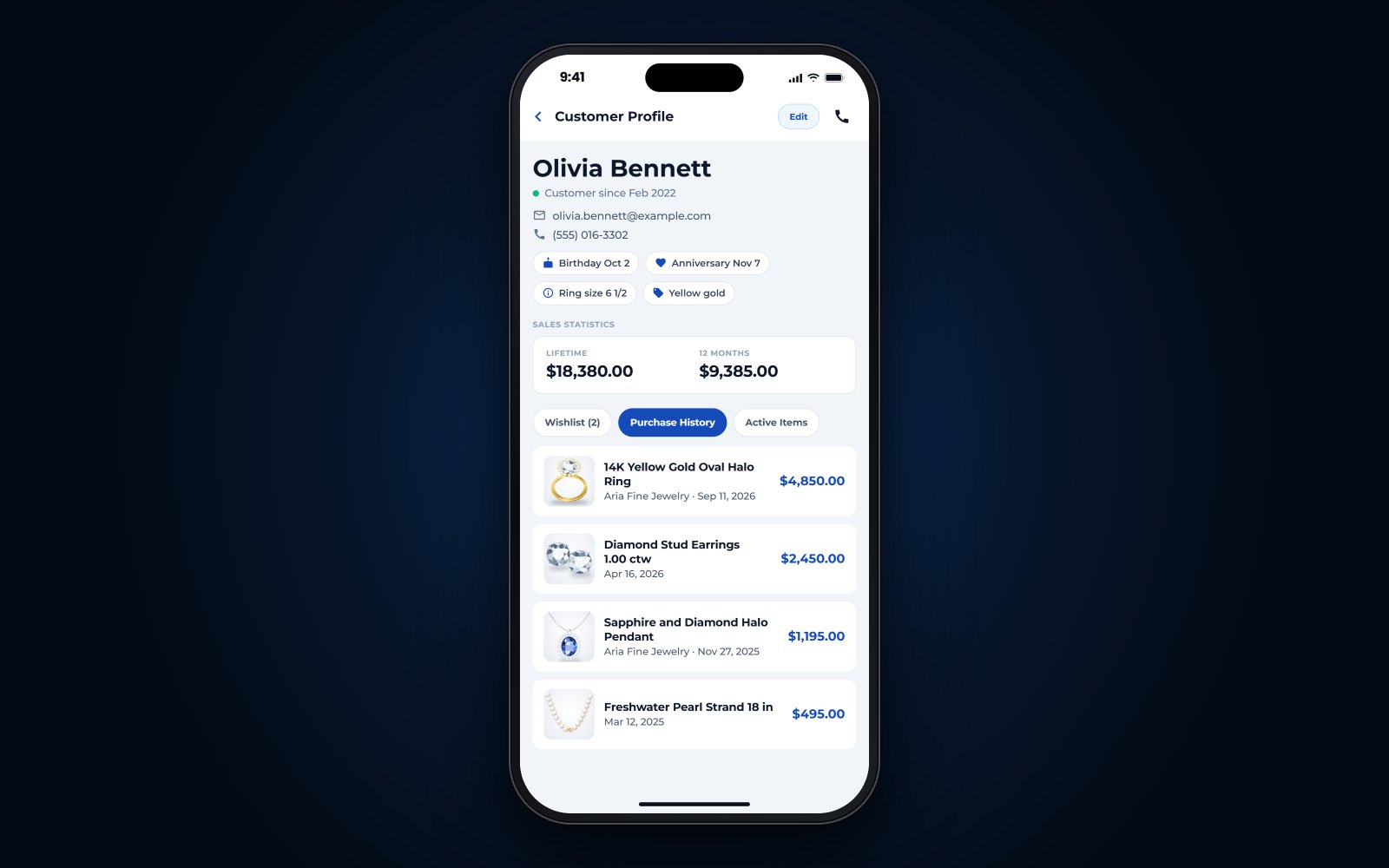
In Flawless POS, salespeople can work the routine from their phones. The apps for iPhone, iPad and Android open each client's record, and staff can text and call clients on the store number from the app. The record holds purchase history and lifetime value, ring sizes and the custom fields your store adds.
Birthday and anniversary reminders bring up the dates that are coming, wish lists include restock alerts for pieces a client is waiting on, and smart client lists and segments help each salesperson see who to contact. Repairs ready for pickup are in the same system, so the 3-minute pickup check does not mean a trip to the back.
To see the routine in the app with your own clients in mind, book a demo.
See also: Jewelry CRM and clienteling software.
Frequently asked questions
How many clients should a salesperson contact each day?
Pick a number your team can keep up every day, such as 5 to 10 personal messages or calls per salesperson. Raise it once the habit is steady and the messages are still personal.
Is clienteling only for high-end stores?
No. The routine is built on dates, sizes and wish lists that every jeweler already collects. The same steps work for a store that sells $200 gifts and one that sells $20,000 bridal; only the ideas and the pace change.
Should salespeople reach clients from their personal phones?
It is better if they don't. When outreach happens on personal phones, the history, the consent records and the opt-outs leave when the employee does. Use an app that texts and calls from the store number and saves everything to the customer record.
What should a clienteling app do?
It should show the client's history, sizes, dates and wish list on a phone, let the salesperson text or call from the store number, and save every contact back to the customer record. Reminders for upcoming dates and restocks save the most time. Ask any vendor to walk through a morning routine on the app during the demo.
Where do I start if our customer records are thin?
Start with the next 50 customers who walk in. Ask one or two questions per sale, such as who the gift is for and the ring size, and write the answers down. After a few months, the daily lists will have real names and dates on them.
Sources
- 47 CFR 64.1200 - FCC rules on telemarketing calls and texts, including calling hours (opens in a new tab)
- Florida Statutes 501.616 - Calling hours and call limits for commercial telephone solicitation (opens in a new tab)
- Oklahoma HB 3168 (2022) - Telephone Solicitation Act, enrolled text (opens in a new tab)