
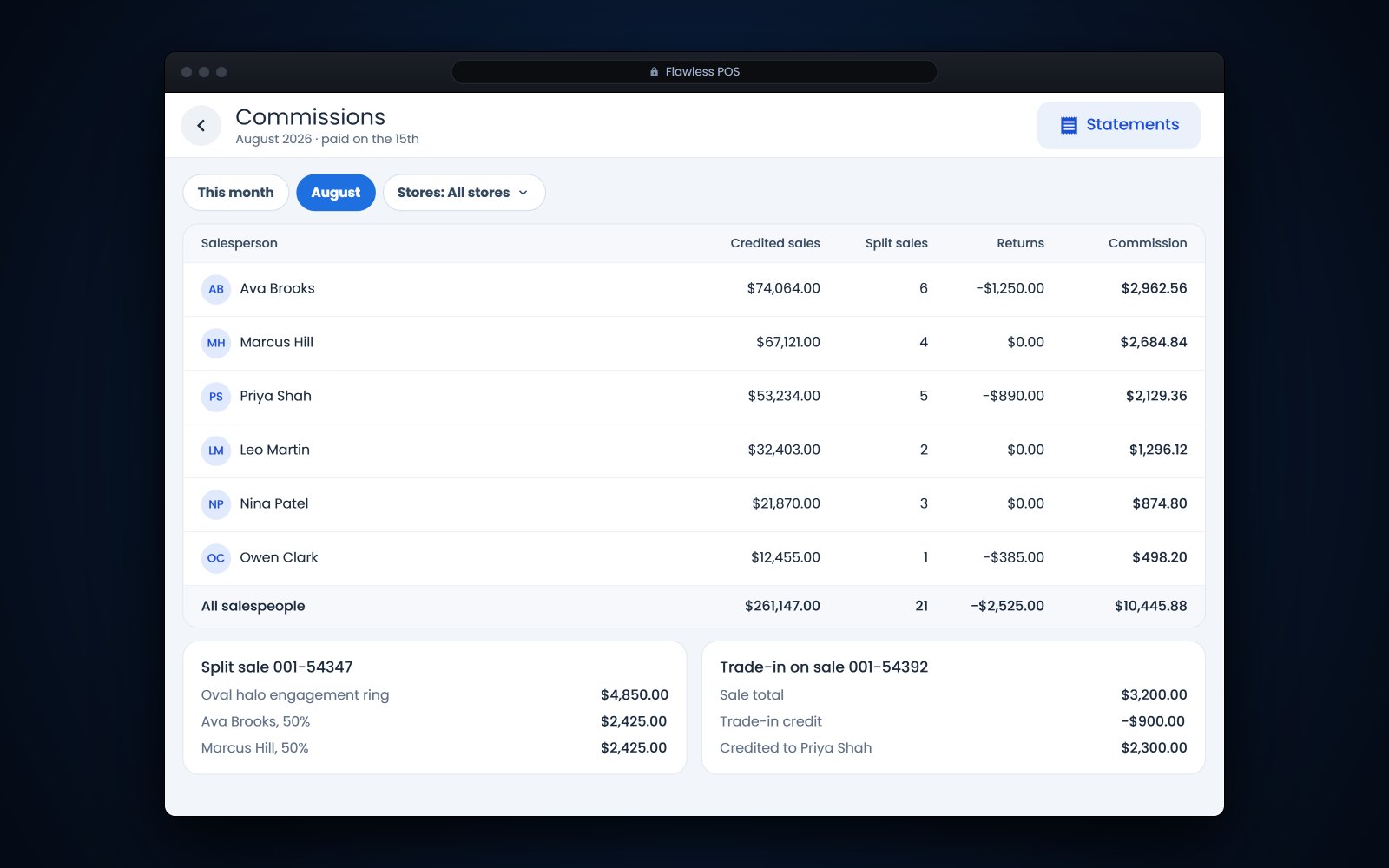
Short answer: A fair jewelry sales commission plan says how commission is calculated (a flat percent, tiers or a share of gross margin), when it's earned, and how split sales, returns, trade-ins, layaways and repairs count. Put it in writing, pay commission on layaways and special orders when the final payment is made or the piece is picked up, and give each salesperson a monthly statement they can check. Some states, including California, require commission plans to be in writing.
In this article
- Common jewelry sales commission structures
- How to split commission between 2 salespeople
- Returns, exchanges and commission clawbacks
- Commission on trade-ins and store credit
- Layaways, special orders, repairs and custom work
- Base pay, draws, spiffs and discounts
- A monthly commission statement salespeople can check
- How Flawless POS handles commissions
- Frequently asked questions
Common jewelry sales commission structures
For example, 2 salespeople work a Saturday bridal appointment together. One spent an hour with the couple in August finding the stone, and the other closed the $9,800 sale today. On Monday, both want to know how it counts.
Your plan should answer that before it happens. Start with the structure. Each example below uses made-up numbers.
Flat percent of sales
Every sale pays the same rate. At 3% of net sales, a salesperson with $40,000 in net sales for the month earns $1,200. It's easy to explain and easy to check, but it pays the same on a heavily discounted sale as on a full-price one.
Tiers
The rate rises as monthly sales pass set levels, for example 2% on the first $25,000, 3% on the next $25,000 and 4% above $50,000. A salesperson with $60,000 in net sales earns $500, plus $750, plus $400, for $1,650 in all. Paying the higher rate only on sales above each level, as here, costs less than raising the rate on the whole month, and it avoids a big jump at the line.
Share of gross margin
Commission is a percent of gross profit. At 10% of margin, a $5,000 ring that cost $2,500 pays $250. Sold at $4,000 after a discount, the same ring pays $150. Margin plans reward full-price selling, but staff need to trust your cost numbers, and some owners would rather not share them.
| Structure | How it pays | Works well for | Watch for |
|---|---|---|---|
| Flat percent | Same rate on every sale | Small teams and simple plans | Pays the same on discounted sales |
| Tiers | Higher rate above set monthly levels | Pushing volume in busy months | Sales shifted between months to reach a tier |
| Share of margin | Percent of gross profit | Protecting margin and limiting discounts | Staff need to see and trust cost |
How to split commission between 2 salespeople
Write the split rule down before the first argument. A workable version:
- Default split. When 2 people work a sale, they split it evenly, 50% each.
- Who counts. The people who worked with the customer on this piece. Ringing up the sale doesn't earn a share.
- Declare it at the sale. Both names go on the ticket when the sale is rung, not a week later.
- Uneven splits. Allowed, for example 70% and 30%, with a manager's approval at the time of sale.
- Absent salespeople. Decide who gets credit when a regular customer asks for a salesperson who is off that day.
In the bridal example, a 3% plan pays $294 on the $9,800 sale, so each salesperson gets $147.
Returns, exchanges and commission clawbacks
When a sale comes back, the commission should come back too. The simplest method is to subtract it from the next commission payment.
- Returns. Commission paid on a returned sale comes off the next statement.
- Exchanges. An even exchange changes nothing. An exchange for a pricier piece pays commission on the difference, and one for a cheaper piece takes the difference back.
- Timing. Another option is to hold commission until the return window closes. With a 30-day window, August commissions would be paid in late September.
- Holiday returns. If you extend returns into January, decide how December commissions are handled before December starts. Our holiday return policy guide covers the window itself.
State wage laws can limit deductions from pay, and the written plan should say when a commission counts as earned. Check your state's rules before you start taking clawbacks. This is not legal advice.
Commission on trade-ins and store credit
For example, a customer trades in an old ring for $1,500 of credit toward a $6,000 anniversary band. Your plan should say whether commission is paid on the $6,000 sale or on the $4,500 the customer paid.
- Full sale. Paying on the full $6,000 encourages staff to bring in trade-ins. Price trade-ins carefully, because any credit above a piece's real value comes out of your margin.
- Net amount. Paying on the $4,500 fits stores with generous or frequent trade-ins.
- Margin plans. These handle trade-ins well if the trade-in is booked at what it's worth to you, its melt or resale value, and any extra credit counts as a discount.
- Store credit and gift cards. Pay commission when the credit or gift card is spent on merchandise, not when it's issued.
Valuing old gold for trade-ins is covered in our post on gold prices and jewelry pricing.
Layaways, special orders, repairs and custom work
Layaways and special orders
Pay when the sale is complete: on the final payment, or when the customer picks up the piece. Paying on the deposit means paying on sales that may never close. Your plan should also say who gets credit if the person who wrote the layaway is off on pickup day. A simple rule is to credit the person who wrote the sale, so nobody races to the register. Our guide to layaways and special orders covers deposits and pickup dates.
Repairs
Repairs need their own rule. Options include a small flat amount for each repair taken in, a lower percent of repair revenue, or nothing for the repair itself but credit for any sale made at pickup. Bench jewelers may be paid by the hour or by the job, outside the sales plan.
Custom work
A custom piece can involve the salesperson, a designer and the bench over several weeks. Pay on the final payment, and decide in advance whether the designer shares in the commission.
Base pay, draws, spiffs and discounts
Decide how commission fits with the rest of pay, and write that down too:
- Base wage plus commission. An hourly wage or salary with commission on top. It's steadier for staff and easier to hire with.
- Draw against commission. An advance, for example $2,000 a month, repaid from the commission earned. Say in writing whether a shortfall carries over to the next month or is forgiven.
- Spiffs. A flat bonus on chosen pieces, for example $50 for selling a piece that has been in stock more than 365 days. Give each one an end date. California's written-contract rule doesn't cover temporary incentives that only add to pay, but write them down anyway.
- Discounts. On a flat plan, consider a lower rate on any sale discounted more than a set percent, for example 15%, so discounting has a cost for the salesperson too.
- Pieces from another store. If you have more than one location, decide whether a piece transferred in for a customer counts for the selling store, the sending store or both.
Whatever the mix, pay still has to meet minimum wage and overtime rules, so run the plan past your payroll provider before it starts.
A monthly commission statement salespeople can check
Give each salesperson a statement every month, a few days before payday, so they can check their own numbers. Include:
- Each sale with its date, ticket number, customer and amount
- Split sales, with the other salesperson's name and the split
- Returns and exchanges that changed an earlier commission
- Layaways and special orders completed this month
- Trade-ins and how they were counted
- Tier levels reached or margin used, if the plan depends on them
- The total, the pay date and who to ask about a correction
Review sales, margin and average ticket by salesperson at the same time. Our post on jewelry store KPIs explains what to look for.
Put the plan itself in writing and have each salesperson sign it. In California that's required: an employer paying commissions must have a written contract that explains how they're computed and paid, give the employee a signed copy and get a signed receipt (California Labor Code 2751).
Commissions also affect overtime. Under federal law, commissioned staff of a retail store are exempt from overtime only if their regular rate is more than 1.5 times the minimum wage and more than half their pay over a representative period comes from commissions (U.S. Department of Labor Fact Sheet #20 (opens in a new tab)). For anyone who doesn't meet that test, commissions count in the regular rate used to figure overtime (Fact Sheet #56A (opens in a new tab)). Ask your accountant or an employment attorney; this is not legal advice.
How Flawless POS handles commissions
Flawless POS calculates commissions for you from the same sales records that feed its sales and staff reports, so the commission numbers and the sales numbers come from one place.
- Sales and staff reports for reviewing each salesperson's results before payday.
- Multi-store reporting for owners with more than one location.
Flawless is built by jewelers, for jewelers, and is used by more than 40 jewelry businesses in more than 10 states.
It allows me to run all aspects of my business from anywhere in the world.
If you book a demo, bring your written plan and walk through it with our team.
See also: All Flawless POS features.
Frequently asked questions
What is a typical commission rate for jewelry sales?
Rates vary by store, by category and by how much of the pay is base wage, so there's no single number to copy. Before you announce a plan, work out what it would have paid each person on last year's sales and check that your margins can carry it.
Should commission be paid on sales tax?
No. Pay on net sales after discounts and returns, before tax. Sales tax and the shipping charges you pass through aren't revenue you keep.
How do you split commission between 2 salespeople?
Set a default, such as 50% each, and require both names on the ticket at the time of sale. Allow uneven splits only with a manager's approval at the time of sale, and show every split on the monthly statement.
When should commission on a layaway be paid?
When the sale is complete, on the final payment or at pickup. Paying on deposits means paying on sales that may be canceled. The plan should also say who gets credit if the salesperson who wrote the layaway is off on pickup day.
Sources
- California Labor Code 2751 - Commission contracts in writing (opens in a new tab)
- U.S. Department of Labor - Fact Sheet #20: Employees paid commissions by retail establishments who are exempt under section 7(i) (opens in a new tab)
- U.S. Department of Labor - Fact Sheet #56A: Overview of the regular rate of pay under the FLSA (opens in a new tab)