
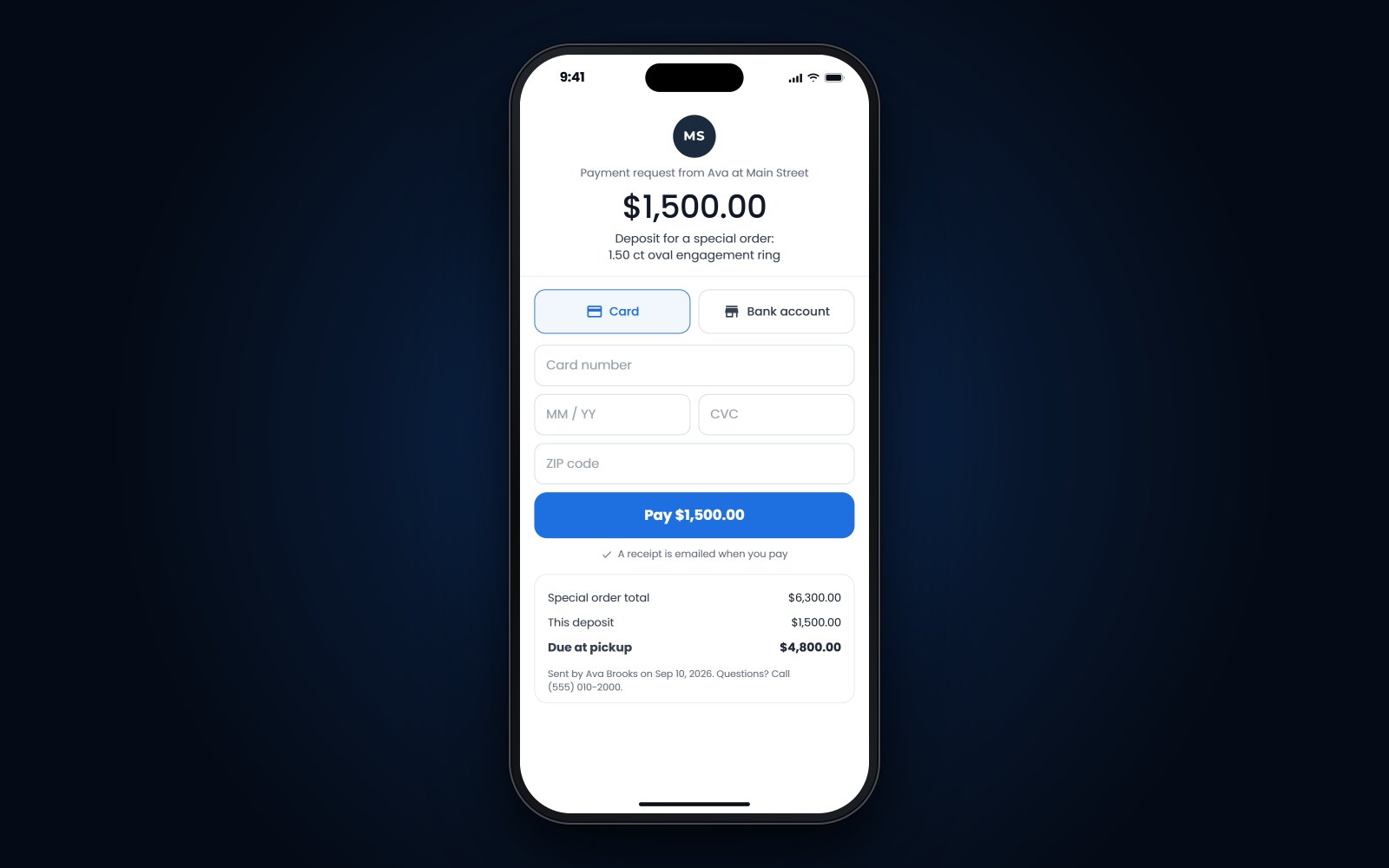
Short answer: Text to pay for jewelry stores means sending a secure payment link by text or email, so the customer enters their own card or bank details instead of reading a card number to your staff. It suits special-order deposits, layaway and balance payments, repair approvals, phone sales and wholesale invoices. A good request says the amount, what it is for and who sent it, and the payment lands on the right sale.
In this article
- Why staff should not take card numbers over the phone
- When text to pay for jewelry stores works best
- What a good payment request includes
- Taking bank transfers (ACH) by link
- Phone sales and shipping after a link payment
- Following up on unpaid payment links
- How Flawless POS handles payment links
- Frequently asked questions
Why staff should not take card numbers over the phone
For example, a customer calls to pay the $3,450 balance on a custom ring and starts reading out a card number. Someone at your store hears it, sometimes writes it on a sticky note or a repair envelope, and then keys it in. Every step is a chance for the number to be overheard, lost or misused.
The PCI Security Standards Council, which sets the card industry's data security standards, is direct about this. Its guidance on phone payments says that if the person answering the call writes down the account data, that counts as storage, and your processes come into scope for PCI DSS (PCI SSC (opens in a new tab)). The card security code may not be stored after authorization, and the Council's FAQ says storing it in any form of digital audio recording after authorization violates PCI DSS Requirement 3.3.1 (PCI SSC FAQ 1210 (opens in a new tab)).
If your phone system records calls, a card number read aloud ends up in the recording too. That is one more reason to keep card payments off the phone entirely, including for regular clients who are happy to read you their card.
The same guidance points to a better way: technology where staff never hear or enter the card data, such as the cardholder entering it on a secure web page through a link sent by text or email. That is what a payment link does.
It also lists 2 habits worth making store rules. Never send card data over unencrypted messaging such as text, email or chat, which means never asking a customer to text you their card number. And if card data is ever written on paper, store it securely and shred it when it is no longer needed.
When text to pay for jewelry stores works best
A link fits almost any payment where the customer is not standing at your counter:
| Situation | Why a link helps | Tip |
|---|---|---|
| Special-order and custom deposits | The customer pays from home after approving the design, and the deposit lands on the order. | Put the deposit terms in the message or on the receipt, including what is refundable. |
| Layaway payments | Regular payments without a trip to the store. | Send the remaining balance and the final pickup date with each link. |
| Balances on finished work | The customer pays before pickup, so the visit is quick. | Send it with the pickup reminder. |
| Repair approvals | The customer approves the estimate and pays a deposit in one step. | Include photos of the damage with the estimate. |
| Phone sales | A client buys a piece from a photo or your website without reading you a card number. | Hold the piece until the payment clears, then ship it or set it aside. |
| Wholesale invoices | Retail accounts pay online by card or bank transfer. | Include the invoice number and due date, and accept partial payments only if your terms allow them. |
For custom work, send the deposit link only after the client has approved the design and the price in writing, and say in the message what the deposit covers. If the client later disputes the charge with their card issuer, that approval and the message are your record of what they agreed to.
For layaway and special orders, a link only works if the terms behind it are clear. Our guide to layaway and special orders covers deposits, schedules and cancellations. Wholesalers should pair online payment with clean memos and statements; see what wholesale jewelry software should handle.
What a good payment request includes
A payment request should be easy to recognize and easy to trust at a glance. Include:
- Your store name and the salesperson's first name
- The amount and exactly what it is for, such as the deposit on order 10482
- Whether it is the full balance or a partial payment, and what will remain
- A link to a secure payment page
- How long the link stays open, if it expires
- A receipt sent automatically after payment
- The payment applied to the right sale, order, repair or invoice, so nobody posts it by hand
For example: "Hi Dana, it's Marcus at [store name]. Here is the link for the $1,200 deposit on your custom oval halo, order 10482. The $3,450 balance is due at pickup. Call us at the store with any questions."
Tip: Tell the customer the link is coming before you send it, on the call or at the counter, so a text with a link does not catch them by surprise.
A payment link the customer asked for is a transactional message. Consent and opt-out rules for texting still apply, so read our guide to texting customers from your jewelry store before you set up automatic requests.
Taking bank transfers (ACH) by link
Many payment links can take a bank transfer (ACH) as well as a card. That can make sense for a large wholesale invoice or a big retail balance, but bank payments behave differently from cards:
- They take time to settle. A bank payment can show as pending for a few business days.
- They can come back. Under Nacha's rules, the normal return timeframe is 2 banking days (Nacha risk topics (opens in a new tab)), but returns for unauthorized consumer debits have a 60-day timeframe (Nacha return reasons (opens in a new tab)).
- Release the goods after it clears. For a large balance paid by bank transfer, wait for the payment to settle before the piece leaves the store or ships.
Put your rules for partial payments and returned bank payments in your written terms, for retail balances and for wholesale accounts alike. Card payments can be disputed as well, so for any large payment taken at a distance, keep the customer's approval, the messages and the receipt together with the sale.
Phone sales and shipping after a link payment
A sale by phone or text to someone you have never met carries more risk than a sale at the counter. These habits help with the high-value ones:
- Ship to the billing address on the card for a first-time buyer, or ask them to pick up in the store.
- Slow down on rush orders for expensive pieces going to an address that does not match, especially from new customers who ask nothing about the piece.
- Call a first-time customer back at the number they gave you before you ship a high-value piece.
- Insure the shipment for its full value and require a signature on delivery.
- Keep the payment receipt, the messages and the tracking number with the sale in case of a dispute.
For a regular client, a quick confirmation call is usually all it takes. Save the extra checks for new buyers and big tickets.
Following up on unpaid payment links
Follow up on a schedule, and keep each reminder short and friendly:
- Next business day"Hi Dana, just checking that the deposit link came through. Happy to resend it, or you can take care of it when you stop in."
- 3 or 4 days laterResend the link with the amount and what it is for, and offer another way to pay, such as stopping by the store.
- About a week laterCall. Ask whether anything about the order has changed. A delay sometimes means a question or second thoughts, and it is better to hear that now.
- Before a deadlineFor a layaway or a special-order cutoff, say the date plainly and what happens after it, as your written terms say.
Note each reminder on the customer's record so 2 salespeople do not send the same nudge on the same day. If a link has expired, send a fresh one instead of asking the customer to call in a card number. Stop the reminders as soon as the payment comes in, and send a short thank-you with the receipt.
How Flawless POS handles payment links
Flawless POS sends payment links, so customers pay from their own phone instead of reading a card number to your staff. Recent changes:
- Wholesale invoices. Since July 1, 2026, emailed wholesale invoices carry a button to view and pay the invoice, with card, bank transfer (ACH), PayPal or Venmo, or Zelle as payment options.
- Bank payments. Since July 7, customers paying through a link can pay by bank transfer (ACH) as well as by card.
- Every supported processor. Since July 31, payment links work with every card processor Flawless supports.
- Repair approvals. Since August 14, customers can approve a repair estimate and pay all or part of it from one link.
- Requests from the terminal. Since September 1, the standalone payment terminal can send a payment request by text or email.
For card processing itself, see payment processing from Flawless, or book a demo and send yourself a test link.
Frequently asked questions
Is it safe to take a credit card number over the phone?
It puts the number in front of your staff, and if anyone writes it down, PCI guidance treats that as storage. The card security code may not be stored after authorization, including in call recordings. A payment link avoids both because the customer types the card on a secure page.
Can a customer pay part of a balance by link?
Usually, yes. Send a link for the partial amount if your terms allow it, and say in the message what the payment covers and what remains, so the customer and your records agree.
Should we accept bank transfers for big purchases?
They can work well for large invoices and balances, but they take days to settle and can be returned after they look paid. For a high-value piece, release it only after the payment has cleared.
How long should a payment link stay open?
There is no fixed rule. For a deposit or a balance, about a week is a reasonable window. For a quote on a gold piece, keep it shorter because the metal price moves, and send a new link with the current amount if it expires.
What if a customer says they never got the link?
Check the phone number or email on file, then resend it. Ask them to look for it while you are on the phone, and offer email if the text does not arrive.
Sources
- PCI Security Standards Council - Information Supplement: Protecting Telephone-Based Payment Card Data (November 2018) (opens in a new tab)
- PCI Security Standards Council - FAQ 1210: Are audio or voice recordings permitted to contain sensitive authentication data? (opens in a new tab)
- Nacha - ACH Network Risk and Enforcement Topics (opens in a new tab)
- Nacha - Differentiating Unauthorized Return Reasons (opens in a new tab)