
Short answer: Jewelry consignment means your store sells a customer's piece on their behalf and pays them an agreed share when it sells, while they keep ownership until then. It works best with a written agreement that sets the price, the payout, the term, the markdown schedule, who insures the piece and what happens if it does not sell. Keep consigned pieces separate from your own stock, and pay consignors only after the sale is final.
In this article
- Why jewelry stores take customer pieces on consignment
- What a jewelry consignment agreement should cover
- A sample consignment term sheet
- Taking in a consigned piece
- Keeping consigned pieces separate from your own stock
- Paying consignors and keeping records
- How Flawless POS handles customer consignment
- Frequently asked questions
Why jewelry stores take customer pieces on consignment
For example, one client inherits a diamond tennis bracelet she will never wear, and another has a signed vintage brooch worth far more as jewelry than as metal. A buy offer based on melt value would disappoint both of them, and buying the pieces outright ties up your cash in stock you did not choose.
Consignment lets your store sell the piece for the owner. You add fresh, often one-of-a-kind stock to your cases without paying for it up front, and the owner can end up with more than a buy offer would pay.
Good candidates:
- Estate jewelry with stones and workmanship worth more than the metal. Selling estate jewelry on consignment lets the price reflect that.
- Upgrades, where a client consigns an old piece and puts the payout toward a new one.
- Signed and designer pieces that have a resale market.
- Pieces you would not buy outright because the value is uncertain or the price is high.
Poor candidates are low-value pieces, costume jewelry and anything you cannot verify. If you would not put it in your case, do not take it in. If the client would rather have cash today, a buy may suit them better; our guide to trade-ins and scrap gold covers pricing those.
For the difference between vendor memo goods and consignment, see our guide to memo vs consignment, which covers who owns the goods, who insures them and when money changes hands.
What a jewelry consignment agreement should cover
Put everything in writing and have the consignor sign at intake. The agreement should settle each of these:
| Term | What to decide |
|---|---|
| Payout | A percentage of the selling price, a share of the profit, or a flat amount the consignor nets. Say whether it is figured before or after sales tax and any card fees. |
| Asking and minimum price | The starting price, the lowest price you may accept without calling the consignor, and who can approve an offer below it. |
| Term | How long you keep the piece, such as 90 or 180 days, and whether it renews. |
| Markdowns | When and by how much the price drops, and the floor it never goes below. |
| Insurance and loss | Whose insurance covers the piece in your store, and at what value. |
| Returns | What happens to the payout if a buyer returns the piece within your return window. |
| Payment timing | When the consignor gets paid, for example 30 days after the sale, once the return window has closed. |
| Unsold pieces | How much notice the consignor gets to collect the piece, and what happens if they never do. |
| Cleaning and repairs | Whether you may clean, polish or repair the piece before sale, and who pays. |
| Ending early | Whether the consignor can take the piece back before the term ends, and any fee. |
Set the asking price the way you would price your own estate stock: condition, current demand and what similar pieces have sold for. An insurance appraisal states replacement value, which is a different number from what a piece will bring on resale, so explain that difference at intake before the consignor anchors on the appraisal.
Call your insurance agent before you take in the first piece. Ask whether your policy covers property of others in your care, up to what limit, and whether that includes pieces at an off-site event.
For unsold pieces, check your state's rules before you sell or dispose of anything a consignor never collects. A clear pickup deadline in the agreement, and notices you can prove you sent, protect you and the consignor.
A sample consignment term sheet
Here is an example of the terms a store might offer for a diamond bracelet. It is an illustration, not a standard. Set your own numbers and have your attorney review the agreement.
| Term | Example |
|---|---|
| Consignor payout | 60% of the selling price, before sales tax |
| Asking price | $4,800, agreed at intake |
| Minimum price | $3,600; any offer below it needs the consignor's approval |
| Term | 180 days from intake |
| Markdowns | 10% off the current price at day 90 and again at day 135, never below the minimum |
| Payment | By check or bank transfer 30 days after the sale, once the return window has closed |
| Returns | If a buyer returns the piece, it goes back on consignment and any unpaid payout is canceled |
| Insurance | Covered by the store's policy at the minimum price while in the store's care |
| Unsold piece | Consignor is notified at day 170 and has 30 days to collect |
| Early withdrawal | Allowed at any time, with a $50 fee to cover cleaning and photography |
Under those example terms, the price drops to $4,320 at day 90 and to $3,888 at day 135. If the bracelet sells at $3,888, the consignor's payout is $2,332.80 and the store keeps $1,555.20 before its own costs.
This is not legal advice. Consignment touches contract, consumer and secondhand dealer laws that vary by state.
Taking in a consigned piece
Treat intake like a repair take-in with higher stakes. What you record on day one settles every later question about condition, stones and value. Our repair intake checklist is a good starting point. For consignment, add these:
- Consignor's name, contact details, ID and how they want to be paid
- Photos from several angles, including stamps, marks and any damage
- Metal and karat as tested, total weight, measurements and ring size
- Stone count, shapes, approximate weights and any chips or abrasions
- Certificates, appraisals, boxes and papers the consignor hands over
- An appraisal note: your estimate of value and how you set the asking price
- The signed agreement and a receipt listing each piece
Describe consigned pieces accurately when you list them, whoever owns them. The FTC's Jewelry Guides cover how diamonds, lab-grown stones and treated gemstones must be described (16 CFR Part 23 (opens in a new tab)). Gemstone treatments, for example, must be disclosed when they are not permanent, need special care or significantly affect value (16 CFR 23.24 (opens in a new tab)). A consignor may honestly believe a stone is natural and untreated, so test it before you list it.
Tip: Give the consignor copies of the photos and condition notes with their receipt. It heads off the "that scratch was not there" conversation months later.
Keeping consigned pieces separate from your own stock
A consigned piece sits in your case, but it belongs to the consignor until it sells. The IRS lists goods consigned to you among the merchandise you do not include in inventory (IRS Publication 538 (opens in a new tab)). Mixing them in throws off your inventory value, your margins and your year-end count.
- Tag consigned pieces so staff can tell at a glance, with their own SKU range or a tag color
- Link each piece to its consignor and its agreement
- Count consigned pieces separately at inventory time
- Run a monthly list of consigned pieces by age, so markdowns and pickup notices go out on time
- Keep payouts owed on your books as money owed to the consignor, apart from store funds
Check your state's secondhand dealer rules too, because some states treat taking used goods on consignment like buying them. Florida's definition of a secondhand dealer covers a business engaged in purchasing, consigning or trading secondhand goods (Fla. Stat. 538.03 (opens in a new tab)), and Texas requires dealers to report crafted precious metal they accept for sale on consignment (Tex. Occ. Code 1956.062 (opens in a new tab)). This is not legal advice.
Sales tax is another state question. In Washington, for example, the Department of Revenue says the consignee is generally responsible for remitting the sales tax on consignment sales (Washington Department of Revenue (opens in a new tab)). Ask your accountant how your state handles it.
Paying consignors and keeping records
Pay on a schedule and show your math. A consignor who gets a clear statement is more likely to bring you the next piece.
- Wait until the sale is final: the payment has cleared and your return window has closed.
- Figure the payout exactly as the agreement says, on the actual selling price after any discount.
- Send a statement with the piece, sale date, selling price, payout terms and amount.
- Pay by check or bank transfer, and record the payment against the consignor's account.
- If a sold piece comes back, handle the payout as your agreement says, and reverse it if you have not paid it yet.
Put the check number or transfer confirmation on each statement, so a question months later takes one look to answer.
Keep the agreement, intake photos, statements and payment records together for each piece. How payouts to consignors are reported for tax purposes depends on your setup and on the consignor, so ask your accountant before the first payout.
Consignors are clients too. Note on their record what they consigned and when it sold, and let them know when new pieces arrive. Our daily clienteling routine has a simple way to fit that in.
How Flawless POS handles customer consignment
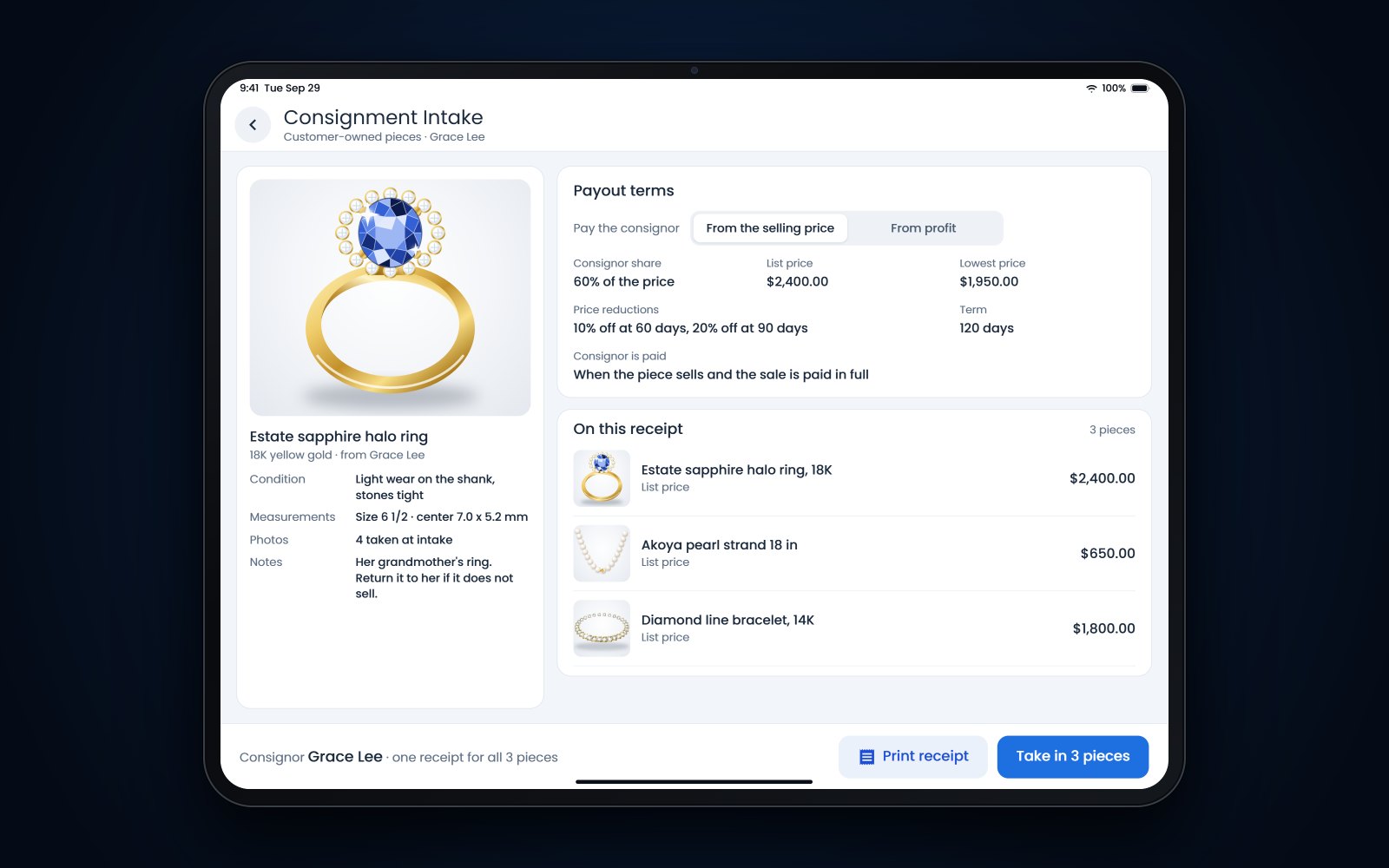
Flawless POS has long handled memos and consignment tracking. Since August 2026, stores can also take in customer-owned pieces directly:
- Intake from the customer's record. Start a consignment from the customer's record and take in one or more pieces on one receipt.
- Payout terms per piece. Set the payout while adding the piece, either from the profit or as a percentage of the selling price.
- Price reductions. Set the markdowns for the piece at the same time.
- Consignor payments. Pay consignors from Flawless when their pieces sell.
It has truly changed our business and has allowed us to process a lot of one of a kind, unique sku's with less work than other platforms.
To walk through a consignment intake from start to payout, book a demo.
See also: Jewelry memo and consignment software.
Frequently asked questions
What is a typical consignment split for jewelry?
There is no standard split. It depends on the piece, the price and how much work the store puts into selling it. Whatever you choose, write it into the agreement, say whether it is figured before or after sales tax and fees, and apply it the same way every time.
Who owns a consigned piece while it is in my store?
The consignor does until it sells. That is why consigned pieces stay out of your inventory and why insurance has to be settled in the agreement. Ask your accountant and attorney how your state treats consigned goods.
When should I pay the consignor?
After the sale is final, meaning the payment has cleared and your return window has closed. Paying on a set schedule, such as once a month with a statement for each piece, keeps it predictable for both sides.
What happens if a consigned piece does not sell?
Follow the agreement: markdowns first, then a pickup notice when the term ends. Keep proof that you sent the notice, and check your state's rules before you sell or dispose of a piece the consignor never collects.
Is customer consignment the same as memo?
They overlap. Memo usually refers to goods a vendor sends a store to sell or show, while customer consignment means selling a private owner's piece. In both cases the goods are not yours, so keep them out of your inventory.
Sources
- IRS - Publication 538, Accounting Periods and Methods (inventories) (opens in a new tab)
- 16 CFR Part 23 - FTC Guides for the Jewelry, Precious Metals, and Pewter Industries (Cornell LII) (opens in a new tab)
- 16 CFR 23.24 - Disclosure of treatments to gemstones (Cornell LII) (opens in a new tab)
- Florida Statutes 538.03 (2025) - Definitions for secondhand dealers (opens in a new tab)
- Texas Occupations Code 1956.062 - Report of purchase, trade-in or consignment (opens in a new tab)
- Washington Department of Revenue - How consignment sales are taxed (opens in a new tab)